Be Modern, Be 'Civil' to domestic servants
By M J Akbar
A hundred years ago, according to a recent book, domestic servants constituted Britain’s largest source of employment. That simple statistic reveals, better than anything else, the inequality of a class-driven society, and the partnership between wealth and power in Victorian and post-Victorian Britain. The Industrial Age was well under way, but had not achieved the critical mass that would broaden the working class and spawn the Labour Party. The British upper classes were not cruel to servants, although there were strict distinctions: in a grand house, servants were permitted to eat and drink as much as they wished, but could only live downstairs.
The meltdown of the ancient regime was evolutionary in Britain, rather than revolutionary, as in Russia, even though British democracy was a stained and evolving process, full of rotten boroughs and inbuilt inequity. Democracy needed a lot of latitude if as famous a prime minister as William Pitt – the Elder could be considered elected, when the total electorate in his constituency consisted of five voters. Women got the vote even later than the “lower classes”. It took two world wars, and the death of millions of poor in the service of an empire designed to fatten the rich, before the privileged system withered.
Nineteenth century America did not have servants, it had slaves; and slavery reinvented itself in many forms after its official abolition before it withered. The British attitude towards colour was far more sophisticated, and many nuances of racism could survive under a veneer of wit. Samuel Johnson, famously, had a devoted Jamaican servant, Francis Barber, as well as a pet cat. Barber was not allowed to carry the cat as it would be demeaning to both.
More to the point, today the word “servant” has disappeared from the popular lexicon of both America and Europe. If it survives it is only within the construct of a “civil servant” — who is definitely not a servant, and very often not particularly civil either. Of course, there is still a population that earns from service at homes in the West: the huge demand for “illegal” immigrants confirms this. But the terms of reference have changed in favour of the servants. Only a thin elite can afford full-time house servants, since their cost is high, and beyond the reach of the professional middle class.
There are, at least to my knowledge, no statistics available, but it would be a safe bet to claim that the largest source of employment in contemporary India is domestic servants. In that sense, we are where Britain was a century ago. There is a world of difference between the service economy and a servants’ economy; India claims the first and lives in the second. The domestic servant is the first rung of aspiration for more than half of India.
The tensions are palpable, particularly in urban India, which has neither the sense of neighbourhood nor a culture of sympathy. The servant is both the provider as well as the potential assailant, particularly if male, for he belongs to a world that is distant both geographically and psychologically. The young man cleans utensils only because he is a prisoner of necessity. The rewards are pitiful; the treatment pitiable. The threat of servant violence is the regular diet of the media; but cruelty towards servants is largely ignored, perhaps because journalists are part of the middle class and complicit.
Developed societies in the West created robotic machines, like the dishwasher, to fill the gap, even as they lifted the poor into an expanding middle class, loosely defined as a group with enough for food, clothing, shelter and basic education. The Indian attitude to washing machines is unique: we hire servants to use them. Those who cannot afford washing machines can still afford servants to wash clothes the older way. Some overlap is understandable in the transition phase, but the incremental rise in upward mobility is a flickering fact, not a sustained reality.
The tension of denial is evident on the visage of those servants who haven’t reconciled to their dull fate. It’s true that the majority of servants have no dispute with their economic destiny, since this maximum-effort, minimal-reward employment prevents starvation. But that, surely, is not a pleasant reality.
The good news about India is that plumbers and electricians are becoming more expensive. The rising cost of skills is proof of some transfer of wealth. A tongue-in-cheek view suggests that India will not become a modern economy as long as there are civil servants. Let me assert, tongue firmly in right place, that India will become a modern economy only when domestic service is treated as civil, and a service that deserves the salary available to the starting circle of government jobs.
Appeared in Times of India - March 07, 2010
Sunday, March 07, 2010


The gap between promise and delivery
Byline by M J Akbar: The gap between promise and delivery
It was such a relief to learn, from no less an authority than home secretary G.K. Pillai, that Maoists aim to overthrow the Indian state by 2050. That gives us four decades during which the plus-40 bourgeois can die in their beds; those blessed with first jobs in 2010 can retire in comfort, and hope for a ringside view of the revolution; and those below 20 can worry — unless, of course, they have joined the revolution.
Frankly, if by 2050 we have not managed to eliminate poverty, there won’t be much of an Indian state left to overthrow.
The Government has a shorter timeframe: it believes it can eliminate Naxalites from the 34 districts where they are still impregnable, within seven to eight years. Pillai is a fine officer and an excellent home secretary, but the solution to the Maoist threat does not lie in his domain. Whether the Naxalites fortresses increase from 34 to 100, or dwindle to zero, will depend on whether the Government can make impoverished India part of the narrative of rising India. This will not happen if Government functions on the static principle of “business as usual”.
Prime Minister Manmohan Singh has called Maoists an existentialist threat. So far, his Government is treating it as a law and order matter. It is a hunger and oppression problem: life subsists at near-starvation levels in the catchment areas of Maoism; and public protest is suppressed brutally by the police, who treat the tribal poor as a contemptible species. This brutality is hidden behind a thin veneer of lies, which we — the whole establishment, whether politicians, civil servants, businesspersons or media — condone through our silence.
There seems to be a curious, and incomprehensible, edge of helplessness in the Prime Minister’s statements, as if he is unable to escape the trap of ‘business as usual’. He told Parliament, for instance, that the government had been a failure on sugar prices. To begin with, it is his government that he is talking about. Second, he is publicly and directly accusing a senior colleague, agriculture minister Sharad Pawar, of mismanagement. So what happens? Nothing. Mea culpa is meaningless if those who are culpable are not held accountable. But of course, to apply this dictum to only Pawar would be subjective. Dr Singh admitted in Parliament that minorities [code word for Muslims] were under-represented in government jobs. Admission is fine, but this government has been in power for six years: what has it done to resolve the problem? The Prime Minister did try, which is why the Ranganath Mishra commission was constituted; but he has not found the will to implement its recommendations. The Marxists in Bengal have done so, incidentally. Our democracy’s parameters have shifted from promise to delivery.
The gap between promise and delivery could also affect the principal thrust of the Prime Minister’s second term, progress in relations with Pakistan. Certainly, Dr Singh means well, but good intentions are, alas, not good enough. BBC News — not an Indian propaganda vehicle — has just sent out a story from Islamabad which says: “Since 2009 militant activity has been on the increase in the Kashmir region…Initially militant groups in Kashmir appeared to be operating on their own — but there is evidence to suggest that they are once again under the protection of Pakistan’s intelligence establishment. Training camps are once again being set up on the Pakistani-controlled side of Kashmir. Recruitment is also up in Pakistan’s Punjab province, which has provided most of the shaheeds or ‘martyrs’ for the militants. In fact, so emboldened have the militants become, that one militant alliance, the United Jihad Council (UJC), held a public meeting for militants in Muzaffarabad in mid-January 2010. The meeting was chaired by, among others, former ISI chief Lt Gen Hamid Gul. It called for a reinvigorated jihad [holy war] until Kashmir was free of ‘Indian occupation’.”
The resurgence of militancy coincides with Dr Singh’s efforts to revive the peace process, which began through second-track channels and led to the joint statement at Sharm-el-Sheikh in Cairo. Islamabad, in other words, read Delhi’s goodwill as weakness. It also believes that India will buckle under pressure from two prongs: escalation of terrorism, and American pressure on India to settle on Kashmir. Pakistan’s foreign secretary Salman Bashir nodded discreetly towards the international community during his press conference in Delhi, even as he thanked Dr Singh personally and profusely for reopening talks.
Delhi has to get real if it hopes to fend off impending crises. India will survive the Maoist insurgency by ending poverty, and in no other way. This is only possible through good governance, which is impossible without accountability. And peace with Pakistan is a welcome hope, which we applaud; but it is risky to shake hands with anyone holding a gun.
Sunday, February 28, 2010
How India lost the plot in talks
How India lost the plot in talks
By M J Akbar
Delhi lost its own plot one day before foreign secretaries Nirupama Rao and Salman Bashir sat down at Hyderabad House to reopen the dialogue between India and Pakistan.
Salman Bashir came to Delhi for two sets of talks, not one. The Government of India was the second half of his agenda. The first, and from his perspective the more important, part was the resumption of dialogue between Islamabad and secessionist elements in Jammu and Kashmir, Hurriyat leaders and the more extreme Syed Ali Shah Geelani.
Bashir did not want to talk to Omar or Farooq Abdullah, Mufti Mohammad Sayeed, Mehbooba Mufti or Ghulam Nabi Azad, who represent parties that have won a substantial number of seats in the assembly. He wanted to hear what Geelani said, that there was a storm brewing in the Valley. Bashir reassured Geelani that Pakistan had not abandoned its dream of altering the map of India.
These pre-arranged meetings were held with the consent of the Government of India. If the Indian government had wanted to prevent them, Hurriyat leaders and Geelani would not have been able to catch the flight from Srinagar to Delhi. Precedence — the fact that we have enabled such meetings before — is not the point.
India stopped the ongoing dialogue in unusual circumstances, after the terrorist invasion of Mumbai. Delhi offered a resumption of talks, but with one condition, that they would focus on terrorism; and issues like Kashmir (part of the composite dialogue) would be taken up only after Pakistan had provided satisfaction that it had acted against known terrorists and instigators of Mumbai, like Hafiz Saeed.
If that was going to be our focus, if that was the agenda we had set, why did we permit the meetings between Pakistan and Hurriyat-Geelani? We could have explained that Pakistan could talk to the Kashmiri leaders on the Indian soil the next time around, if there was a next time; on February 25, it would only be about terrorism.
When we did not, Pakistan inferred that it was business as usual, and that our position on terrorism was rhetoric meant for domestic consumption. Pakistan voiced such an inference when Salman Bashir briefed the media, saying that Kashmir had been discussed “extensively” and suggesting that India had returned to the negotiating table because of international pressure.
It was, he implied with that little smile on either corner of his mouth, a diplomatic triumph for Pakistan.
Perhaps, the time has come for India to demand reciprocal rights. It would be interesting if Nirupama Rao insists that during her next visit to Islamabad (she has received an invitation) on meeting insurgents from Balochistan — assuming that they are either alive or outside jail.
Let us be clear about one reality: Salman Bashir could have returned without undue damage to his professional health if talks with Rao had been sabotaged before they started, but he might have had to take a flight to some other country if he had returned without meeting Hurriyat and Geelani. Kashmir is the heart and head of Pakistan’s policy towards India.
There is insufficient recognition, certainly among Indians and possibly within the Indian government, of the fact that Pakistan’s policy has hardened after the Mumbai terrorist onslaught, rather than softened. Pervez Musharraf’s “close-to-a-solution” is now denied as mere waffle, since nothing was put in writing.
Mumbai is not cause for mea culpa, but reason for accusation: India deserves what it got because it holds Kashmir “illegally”. In such a narrative, Hafiz Saeed becomes the daring maverick who brought Kashmir back to the centrestage as the “core” issue (a term Salman Bashir used repeatedly, as was his brief).
India and Pakistan might agree, therefore, that terrorism is an evil, but they have totally divergent definitions of who constitutes a terrorist. Salman Bashir can agree on terrorism without blinking an eyelid, and moan about thousands dead in his own country — but they died from Taliban bullets and bombs, not from a Hafiz Saeed gun. India’s terrorist is Pakistan’s freedom fighter.
As Bashir coolly explained in Delhi, Hafiz Saeed was within his democratic rights when, at his Lahore rally, he told followers armed with Kalasnikovs that one Mumbai was not enough. The Pakistan army would have opened artillery fire if the Taliban had dared to hold a similar public meeting in Peshawar.
Rao, who was firm enough during the talks, made one serious mistake. She forgot a basic law of Indo-Pak diplomacy. She left the last word to Salman Bashir. Her hurry to brief the media was inexplicable; it was Bashir who had to go take a flight out of Delhi. She could have waited. We lost the plot both before and after the talks.
Appeared in Times of India - February 28, 2010
Saturday, February 27, 2010
Count the numbers when the numbers begin to count
Byline by M J Akbar: Count the numbers when the numbers begin to count
Those who began counting the number of MPs left inside the Lok Sabha when Finance Minister Pranab Mukherjee finished his Budget speech before empty Opposition benches have a weak memory. They forgot where Pranab Mukherjee and Dr Manmohan Singh, the two men who run this Government, learnt their ABC. Pranab Mukherjee had a headmistress called Indira Gandhi. Manmohan Singh went to the more complicated seminary presided over by P.V. Narasimha Rao.
To clear any residual confusion, the Prime Minister is a politician of the more subtle kind. He was less of a politician when he was Rao’s Finance Minister, which is why he would get exasperated and at least once sent in his resignation (which Rao ignored). He has now learnt to make the pace of power an ally rather than an adversary.
For the record, during the last phase of the Budget speech, the Government had only 274 MPs on its side, which is as bare a majority as is possible to have. Mukherjee finished his speech without a tremor, and Singh sat unperturbed on his front bench seat. They had learnt at primary school that Governments do not fall because of numbers, they fall when they become uncertain or indecisive or provocative. Mukherjee was a Cabinet minister when Indira Gandhi ran her Government for over two years without a majority in the House. Singh was Finance Minister of a minority Government for at least three Budgets; in fact, Rao began to wobble only after he purchased a majority in the House. Perhaps this was the moment when Dr Singh transited from bureaucrat to politician; survival in office became more important than the means by which he and his Prime Minister survived.
The Prime Minister and Finance Minister know that their Government is safe because while the Opposition may threaten it with a sequence of actions, it is not yet ready for the consequence, a general election. Not a single Opposition party, apart perhaps from Mayawati’s BSP or possibly Jayalalithaa’s AIADMK, would gain from an election, and some will certainly be whittled further. It is not just the Government that knows this; Opposition parties do as well. And yet the walkout by all Opposition parties on Friday was neither insignificant nor meaningless.
For starters, it was not spontaneous. It could not have been premeditated since no one knew that the Finance Minister would send out a cordial invitation to a few bulls while sitting in a china shop packed with price-rise cutlery. But the joint action was indicative of an unspoken understanding that has been building among Opposition parties. This has developed out of a pragmatic assessment of predicament. The last election results were a clear signal that if the Congress is not checked, it will swallow up most of their space, and do so without even an ungainly burp. Ideology, therefore, has to make way for strategy. The Marxists cannot block the Congress in Madhya Pradesh; and the BJP cannot challenge the Congress in Bengal or Kerala. But it is in their common interest to keep the Congress down to what might be called manageable numbers in Parliament. This thought cannot have escaped some of the allies of the Congress in the Government. Much as Mamata Banerjee may want to destroy the Marxists, she will not play second fiddle to Congress in the process. Some Congressmen are whispering about a privately commissioned opinion poll that suggests Congress would win if it fought alone in Bengal. If such whispers reach Ms Banerjee, expect a circuitous response.
In politics, the surest way to break your leg is to try and win the Olympic gold in either the long jump or high jump. The only way to move forward is step by gingerly step. Paradoxically, the absence of a clear horizon might actually help such a gradualist approach; you take the journey one milestone at a time and then wait to see if anything cogent is visible on the horizon. The first bit is always floor management in Parliament. If the Opposition parties can find some issue that enables them to rise above their differences, then the very act of unity raises that concern into a national issue. Moreover, if there is no unity on prices then Opposition as a concept has collapsed beyond repair.
The second stage will be much harder, of course, because there are more contradictions in Opposition than there are in UPA. But the next round of Assembly elections will be helpful in clearing Opposition space. We will know, for instance, whether Lalu Yadav can dent Nitish Kumar, or whether the latter’s eminence will move up to pre-eminence. Similarly, in Uttar Pradesh either Mayawati or Mulayam Singh Yadav will prevail. Beyond that, events and circumstances will determine who does what.
Long before the end-game, there comes a midpoint. The numbers that matter are those that count at the end, not at the start or the middle.
Sunday, February 21, 2010
Talk without hope so there's hope for civility
Talk without hope so there's hope for civility
By M J Akbar
Sensible nations either go to war or negotiate peace; they don’t sulk. So it is sensible for India and Pakistan to resume talks at a formal level. The tricky part is to discover what kind of talk makes sense.
War is always much easier to start than peace. You need only a trumpet to launch hostilities. Peace requires a rather more complicated orchestra; there will be discordant notes from some insistent trombone; the bass could be playing a military march; all musicians might not read from the same sheet; and there is always the likelihood of liberal violins airing strains more relevant to heaven than to realists who live on earth. If the maestro-conductor tears his hair occasionally, you can understand why.
The heavy breathing about the February 25 talks between foreign secretaries Nirupama Rao and Salman Bashir suggests that neither Indian nor Pakistani media, which sit in the front row and shape the response of the audience, have quite understood what a bilateral dialogue between hostile neighbours is all about. Each journalist is cranking up the decibel level around one question, and one question only: what will the diplomats say when they meet?
You don’t need a sting operation to find out what Ms Rao will say. Defence minister A K Antony has already informed us that infiltration has not gone down, and cordite from Pune is still in the air. She has no option except to hammer away at terrorism and the “war by other means” that Pakistan launched after its failure to seize the Kashmir valley by irregular and then regular forces in 1947-48. The strategy for subversion was initiated by the same person who planned the first war, a Colonel Akbar Khan. He adopted the rather ambitious nom de plume “Tariq”, after Tariq bin Ziad, Arab conqueror of Spain in 712. He wrote two papers after ceasefire on January 1, 1949, “What Next in Kashmir?” and “Keep the Pot Boiling in Abdullah’s Kashmir”. Prime Minister Liaquat Ali Khan sanctioned Rs 1 million to arm a “people’s militia” in Indian Kashmir. The Abdullahs have moved into their third generation, but the blood in that pot has not stopped boiling. The outcome of the dialogue on February 25 will be determined not by what Ms Rao says but by what she hears.
No prizes for guessing what her counterpart will say: precisely the same thing that his ministry has been saying for six decades: Kashmir, Kashmir, Kashmir. In the old days, they were more focused and claimed that Kashmir belonged to Pakistan. These days they are a little more circumspect in letting “Azad Kashmiris” some leeway; but they are still certain that Kashmir does not belong to India. In the time left, Salman Bashir will talk about Indus waters, but that is a comparatively minor issue since India has, in principle, accepted the responsibility of an upper riparian state to share water with territory lower down. Disputes over quantum are really small potatoes.
In the absence of real answers, the practice has been to resort to platitudes. Platitudes survive because they have latitude. The problem is that the flexibility of excuses has been fully exhausted. There is a tired ring to the deadpan explanation for terrorism: “we must address core issues”, meaning Kashmir. There will be a me-too variation this time; an injured expression and the hapless suggestion that Pakistan too is a victim of terrorism. This risible argument does not bear examination. The fact that terrorists with another cause blow up Peshawar can hardly be justification for Pakistani establishment help to those who want to blow up Srinagar, or Mumbai, or Pune. As for Kashmir, Pakistan has signed two agreements, at Tashkent in 1966 and at Shimla in 1972, endorsing the ceasefire line of January 1, 1949 as the effective border: if anything, Tashkent was more specific than Shimla. A third treaty confirming this would end the dispute, but no one has suggested that this is on the agenda.
Is there anything new to say or hear? Are we going to talk for the sake of talks? That may be better than not talking at all, but it would be useful to place a marker along the way to the conference hall. This is about civilians pretending to be civil, not about finding solutions. There is no solution apart from the status quo, and if the status quo were acceptable to Pakistan we would have had warmth and cooperation after 1972 — and, by now, dozens of authors trying to make money out of books on Pindia. Pindia, after all, has a nicer ring to it than Chindia, and it makes a more dramatic story than analysis of frosty neighbours secretly delighted that the Himalayas separate them.
Let us talk without hope so that there may be hope for civility.
Appeared in Times of India - February 21, 2010
Saturday, February 20, 2010
The PM’s high-wire politics
Byline by M J Akbar: The PM’s high-wire politics
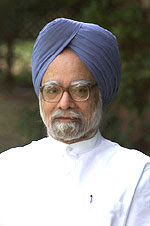 It is perfectly understandable. Denied any flexibility in manoeuvring members of his Cabinet, Prime Minister Manmohan Singh is doing the best he can by reinventing his personal Cabinet, a collection of personally chosen eminent personae given assignments from the PM’s priority list.
 It is perfectly understandable. Denied any flexibility in manoeuvring members of his Cabinet, Prime Minister Manmohan Singh is doing the best he can by reinventing his personal Cabinet, a collection of personally chosen eminent personae given assignments from the PM’s priority list.
Dr Singh can do nothing to Cabinet colleagues because the current law of coalition politics says that once you are seated in a particular chair, only an election defeat can drag you out of it. Competence, performance or even interest in your job has nothing to do with your continuance. DMK supremo’s son Alagiri has around zero interest in his Cabinet job, and does not care who knows this. His real ambition is to succeed his father as Chief Minister of Tamil Nadu, a legacy currently assigned to his brother Stalin. A Cabinet member is meant to be part of a team, and implement a collective decision even if he is personally opposed to it. His politicisation of an important pre-Budget decision, to lift a key fertiliser subsidy, would have been sufficient for dismissal in any normal Cabinet system of governance. The Prime Minister could do nothing about it since the DMK functions as an autonomous ally.
Gradually, through a creep-and-collect process, the Prime Minister has used his rights of appointment to his personal office to create a parallel mini-administration that can address those aspects of the national agenda that he is most interested in. This is not quite the Kitchen Cabinet of the Indira Gandhi days, when a core group of personal favourites functioned as a super Cabinet, arguing the merits and demerits of a particular policy before it was presented to an obedient full Cabinet. The Prime Minister’s Men do not intervene, or interfere, in ministries outside their domain, as the Kitchen Cabinet would. But if the Prime Minister has made any project his own, then the relevant ministry has to understand that there is a higher authority and it is called the PMO.
The two most high-profile members of Dr Singh’s office in his first five years, National Security Adviser M.K. Narayanan and former Foreign Secretary Shyam Saran, have both lost their positions because of the Prime Minister’s increasingly evident desire for some solution to the Kashmir problem. Shyam Saran was an indirect casualty, but a casualty nevertheless. No one resigns from the PMO unless it has been made apparent that the terms of relationship have changed. Media has been fed the perception that Saran was upset because he was denied the status of a Minister of State. Ministers have become so devalued in the last decade, that this is the least of a Prime Minister’s problems. He can get any status for whoever he likes. The substantive disagreement lay in the fact that Shyam Saran was not made NSA, because the Prime Minister decided that Shivshankar Menon was, intellectually and temperamentally, closer to his line of thinking on Pakistan.
Dr Singh knows he is taking huge risks. He has deliberately underplayed hard evidence from Indian intelligence that Pak-based, anti-Indian terrorist organisations continue to get active support from the Pak military, and that they are not non-state actors. Pakistan’s Army chief, Ashfaq Parvez Kayani has reiterated, in his latest doctrine, that India remains the pre-eminent threat to Pakistan, implicitly justifying the military’s support for the second arm of his country’s response to India, the terrorist network. Elements of Pakistan’s political class have not helped Delhi by immature grandstanding, describing India’s return to the talking table as a victory for Islamabad. This obviously grates on Indians. The biggest risk is here: Dr Singh has moved far ahead of Indian public opinion in his peace gambit. This is in direct contrast to the Indo-US nuclear deal, when middle class opinion was cheering on the deal at each stage of negotiations. The middle class that wanted a closer relationship with America is not equally eager to buy the American prescription for peace on the subcontinent, of which these talks are the opening move.
It is not certain that Pakistan will buy it either, because the tail at the end of the dog is that Pakistan might have to dilute its deep friendship with China, which does not fit into the US-Pak strategic paradigm. America would be much happier with a US-Pak-India relationship built on a shared perception of regional threats. Senator John Kerry has described the resumption of the Indo-Pak dialogue as “critical to the United States”, and suggested that the Indian initiative is an extension of the new India-US relationship. More specifically, the US believes that India-Pak cooperation is essential to victory against the Taliban in Pakistan and Afghanistan. However, Senator Kerry might have to convince General Kayani first.
Perhaps Dr Singh is depending on the United States to tweak an ear or twist an arm in Islamabad at the appropriate moment as he tries to woo Pakistan by diluting the status of Kashmir’s relationship with India. This is high-wire politics. We shall watch with some hope and greater apprehension.
Sunday, February 14, 2010
Sharp descent for Padma awards – and the Republic
Sharp descent for Padma awards – and the Republic
By M J Akbar
Maulana Azad has been much on my mind for a variety of melancholy reasons. The neglect of his memory is reflected in the loneliness of his shrine at Urdu Park, near Delhi’s Jama Masjid. It is utterly appalling that we romanticize a pathetic weasel, Bahadur Shah Zafar, who lost an Indian Empire, and diminish the man who, along with a dozen others, sat at the apex of a party that destroyed the British Empire.
Singular conviction was the hallmark of his politics. While his great compatriots had the support of their communities, Azad stood bereft, but resolute and heroic, against a rising tide of venom. His political courage was complemented by intellectual depth: Sarojini Naidu once said Azad was 50 on the day he was born. Find him in two lines of verse he wrote at the age of 14: Azad bekhudi ke nashebofaraz dekh Puchi zamin ki to kahi aasman ki.(Azad, see how this restless spirit soars /The question is of the earth, the answer of the skies.)
He was our first education minister, a chair he filled till his death in 1958. Nehru wanted to honour this giant with a major Padma award. Azad laughed it off. How could a government give itself an award, he asked. Azad did not measure his worth with a political tape. There are still those who turn down awards because they do not want their independence besmirched by a gift from government.
You have to be naïve to believe that the awards process is free of government interference. The obedient will always be allotted their corner a little askance of the deserving.
You have to be either extremely insecure, or be possessed by a hypocrite’s need for camouflage, to lobby and beg and wheedle for a Padma award.
It is perfectly all right if the award comes your way without your knowledge, which still happens half the time. The other half becomes an opportunity for racketeers who treat a Padma award as a certificate of exoneration after a lifetime of deceit and manipulation. This subverts the very purpose of the award.
The people have recognized the cynicism at the heart of the process, and therefore do not much care one way or the other. In any case, awards are a mutual-backscratching operation between the elite. No one is going to rush off to buy a ticket to a Saif Ali Khan movie because he has suddenly become a Padma Shri.
To be fair, Saif himself was a trifle puzzled at the sudden arrival of honour at his doorstep. He has been known to give the odd brilliant performance, and he dances almost as well as his girlfriend, but one doubts if he, or anyone else, thinks of him as a legend.
The most amusing story about awards was told to me by one of the finest human beings I have had the privilege to know, or know of, H Y Sharada Prasad. He was the most trusted member of Indira Gandhi’s inner circle, a bureaucrat of the old school. Honesty was his outstanding virtue, but his principal asset was wisdom born of a marriage between learning and experience.
Sharada Prasad treated fortune and misfortune as equally deceptive imposters, passing the days of exile from power (after Mrs Gandhi’s defeat in 1977) with as gentle a smile as he possessed when he sat in the holy of holies, the Prime Minister’s Office.
He was a friend of D G Tendulkar, whose nine-volume biography of Gandhi may be untidily written, but is one of the great classics of modern Indian history. It is lost today in some forgotten shelf of Publications Divisions, bought by libraries as part of a respectable list that no one reads. Tendulkar used to live very simply in a tenement in Mumbai, with a beloved stray dog as his best companion.
Early every morning, the dog would wake up the author and the two would go for a walk along Marine Drive. On his return home, Tendulkar would catch up on the last of his sleep. One day, the dog came rushing back after Tendulkar had dozed off, and virtually dragged the author out of his bed and on to the street. Just as they reached open air, an earthquake destroyed the flimsy tenement. But this is not the relevant story, of course.
Tendulkar was given a Padma Bhushan when Dr Rajendra Prasad was Rashtrapati. His first reaction was to send a telegram to Rajendra Prasad saying that could he please be given a watch instead — what he really needed was a watch, not a piece of paper from the Government of India. Let it be on record that Tendulkar got both the watch and the Padma.
From Tendulkar to oily businessmen is a sharp descent for the Republic.
Appeared in Times of India - February 14, 2010
Saturday, February 13, 2010
The Boys of Chidambaram
Byline by M J Akbar: The Boys of Chidambaram
The best way to manage a controversy is to initiate it. Omar Abdullah was not giving voice to some sudden inner revelation when he suggested that the “boys” who had gone across the Line of Control could be welcomed back, surely as part of some ongoing Indo-Pak deal. Ghulam Nabi Azad’s riposte stole Opposition space, another clever ploy, if it was prearranged. It might not have been. Azad could have been motivated by legitimate concerns. Home Minister Chidambaram’s support to Omar Abdullah, however, confirmed that there had been consultations between the two before Omar broached such a slippery subject.
Chidambaram, as we all, know, is a fine lawyer. A lawyer’s skill rests on the dictum that facts are malleable, and argument is infallible. This is a heady tribute to human intellect, since it makes the mind a decisive arbiter. Alas, for every forensic ploy there is another waiting on the counter. Chidambaram has introduced the rather disingenuous logic that since these “boys” (can’t call them “terrorists” anymore, can we?) merely went across to territory that India still claims as its own, they never left Indian soil. They are only being resettled at another Indian address.
Counsel for Opposition could open his arguments with a potent challenge: Why is the Home Minister so anxious to bring back those who left India to wage war against it, when it has not been able to rehabilitate those, like Kashmiri Pandits, who were driven out by militants? Is the welfare of those who wanted to destroy India more important to Delhi than the welfare of those who wanted to preserve the multi-religious, secular character of Kashmir and India?
Chidambaram’s “boys” went to Pakistan-Occupied Kashmir not because they thought they were moving on to another part of Indian soil, but to launch a war through which they would snatch Kashmir from India, and were prepared to offer their lives for such a cause. They dreamt of either independence or integration into Pakistan. Perhaps our Home Minister believes that boys will be boys. Or he may have found time to delve into the Bible and ruminate over the parable of the prodigal, which explains the metaphysics of slaying the fatted calf for a prodigal.
The more intriguing question is, why would the prodigal want to come back? Are they ideologically disillusioned and have now become torchbearers of Indian secularism? Or do they want to be reunited with their families, a much more reasonable and realistic aspiration? The one question that cannot be satisfactorily answered, except over time, is this: Have Pakistan-based groups and agencies which still believe in the “Kashmir Jihad” abandoned these “boys” or will there be, among them, some who will resume an insurrection from Indian Kashmir? Is the risk worth taking for India?
Basic question: Who has identified the proposed prodigals as authentic? They did not leave their names and addresses with the Intelligence Bureau in Srinagar when they went off to prepare for their holy war. There are no special genetic traits that differentiate Kashmiris on either side of the LOC. The Pakistan Government did not control this lot directly. They were outsourced to outfits like the Jamaat-e-Islami and Lashkar-e-Taiba, so the only people who would know a genuine cross-border warrior from a homegrown one would be Jamaat or LET. Would Delhi honour certificates handed out by LET?
Who — Delhi or Islamabad? — has placed the return of warriors into the dialogue framework? If it was not on the agenda, or going to be put there, why would Delhi inject the thought into public discourse?
An India-Pakistan dialogue is a tiptoe through minefields at the best of times, so one is curious as to why more mines should be planted on the eve of yet another resumption. There is a special excitement about the 2010 talks because they have been rescued from a trough as deep as crater resulting from the 13 December attack on Parliament; and because Dr Manmohan Singh has made it amply clear that peace with Pakistan is the principal objective of his second term. The adage that the road to hell is paved with good intentions has its uses in a debating society; the road to heaven, after all, cannot be paved with bad intentions. Good intentions take you to a crossroads. After that, your destination, heaven or hell, is entirely dependent on your judgment.
Dr Singh’s good intentions are not in doubt. But he does tend to get tempted towards bylanes in his anxiety to reach heaven. Sharm-el-Sheikh was one such foray that helped no one except India-baiters in Islamabad. The “boys of Chidambaram” is another that can help no one except Pakistan-baiters in Delhi.
Sunday, February 07, 2010
Danger from the New Brahmins
Danger from the New Brahmins
By M J Akbar
Indian democracy is in danger of subversion by a self-confident,aggressive, articulate, patriotic and well-meaning force, the oligarchy of the successful. It might be a mild exaggeration to suggest that its principal characteristics are aftershave and English.
Many of them possibly disdain aftershave or perfume, and would not be crass enough to be preceded by five yards of Axe effect, to name the most advertised aftershave of the moment. But they are loyal to the English language, the proven mantra to worldly success. This new class of thirty-somethings (terribly reluctant to turn 40) is a product of consistent high growth since economic liberalization began in 1991. They bring with them a fresh mindset, a happy sense of purpose, a professional approach to governance and a welcome lack of social baggage.
So why should they be considered a potential hidden danger? Their assets dominate contemporary business, media and politics; their liabilities are buried in a general reluctance to see beyond their celebrity status. Politicians have always been celebrated, and rightly so; if you are in public life, you will be under public scrutiny. But they have not been celebrities. The difference is being squeezed by a squeal culture that is another dominant trait of a substantial and growing elite.
Danger lies in the fact that this creamy layer of 20% at the top has no interest in involving the froth of 80% in decision-making. It recognizes the problem of poverty, of course, and is even concerned enough to address it at policy level. It would much prefer an India in which beggars do not stare through the window panes of its cars; unfortunately, beggars can’t be screened out by black film for reasons to do with public security. But it treats the poor as both the cause and the consequence of poverty, and therefore unworthy of more than a token presence on the table. In a sense this is the old caste system in a modern manifestation; it is a karmic view of government, propagated by the New Brahmins, wearing a tie in front instead of a tiki at the back.
Commonwealth Delhi is their true capital, designed for their comforts and convenience. Not a single bicycle lane has been constructed in the newly reconstructed city, because it is still downmarket in Delhi (unlike London, where mayors and future Prime Ministers use it). You eliminate poverty by denying it space in your environment. If you don’t see a slum it doesn’t exist. The Commonwealth Games, which will last less than a week, are an excuse to switch spending towards an infrastructure for luxury, essential for a class that has found the wherewithal to afford luxury. One is not being a killjoy, or taking the puritan view that India should not host an international event till Ram Rajya has arrived. There will always be imperfection and inequality; but it is what you do with opportunity that determines whether the social purpose is egalitarian or elitist. Capitalist London has used the 2012 Olympics to upgrade its poorer areas. Delhi has done the opposite, improving what was already good, ignoring the squalor that floats under the thin surface of glitter.
Is Delhi the development model for the coming decade? There is a huge and growing aspirational class that supports the oligarchy of success, because it is straining at the door to be let in. This emerging constituency, perhaps a maximum of about 300 million, is keen to outsource its future to an oligarchy because it has sniffed the latter’s success. It wants membership of the oligarchy. It is strong enough to shift a general election towards one political party or the other, but it is not strong enough to sustain governance.
That leaves 800 million dependent on goodwill. Democracy is not about generosity. It is about entitlement. Democracy is not about patronage. It is about equality. Democracy is about being inclusive, not exclusive. Democracy is about an equal vote in the political boardroom, not just in the ballot box.
The slick highways dotted with malls and upwardly mobile dhabas, transporting a world beyond the reach to villages they traverse, are both a tease and a frustration. Why shouldn’t the young of rural India who cannot afford the highway toll dream of magic lights in the big city? They do not want to plod while New Brahmins travel at 100 mph. They do not want to end up as labour in a busybody small town; they want a job in the new New Delhi. The poor are not fools. They know they cannot be managers. But if the nation cannot find a profitable avenue for their skills then the social structure will be vulnerable to their anger.
If the high table cannot find a seat for them, then there are other tables, some with guns.
Appeared in Times of India - February 7, 2010
Saturday, February 06, 2010
Licence to drive, everywhere
Byline by M J Akbar: Licence to drive, everywhere
An Opposition talks [when it is not dumb]. Government acts [when it is not indolent]. A Government is measured by what it does. The Government of Maharashtra says that Mumbai belongs to every Indian, but decides that its 24,000 taxi licences belong only to a language-specific group. There is the usual fudge around the decision, typical of a Government which wants to hunt with the Shiv Sena and run with the Bihari vote.
One wonders if each licensee will actually be driving the cab himself. Here is a much more likely scenario: mid-level businessmen ready to deal with the rough and ready side of Mumbai, in cahoots with politicians on both sides of the fence, will pick up the licences and then hire cab drivers at competitive wages. Since eager Biharis — that term includes people from Uttar Pradesh, signalling the cultural power of Bihar — will be ready to work for lower wages than Mumbaikars, they will be eventually hired. It is a cheaper route to the status quo for both the politician and the businessmen; the first gets cheap votes and the second gets cheap labour.
There is something odd about the controversy. Common sense suggests that it is in any taxi driver’s interest to pick up the local language: why would he want to lose business by ignorance of the passenger’s language? A taxi driver does not need to be literature doctorate; just know enough language to be cordial and communicative. The whip-up is more about politics than jobs, which is why it is riddled with inconsistency. Nationalism always falters against chauvinism, unless nationalism becomes chauvinist. Thus, the Shiv Sena or its antagonist offshoot headed by Raj Thackeray, will demand the return of an Akhand Bharat from the Khyber Pass to the Chittagong Hill Tracts, but deny an impoverished fellow-Indian marginal space in Mumbai.
The sharpest tweak to the Sena froth came not from its foes but from its friend, the BJP, which raised an interesting contradiction. How could the Sena, which opposed Article 370 for Jammu and Kashmir, demand protective restrictions for Mumbai? There was no answer, of course, because there isn’t one. My regret is that the question has not been asked more often. But it was a relief to witness all national parties taking on the Senas not only on Mumbai but also on their menacing and communal threats to Shah Rukh Khan. The BJP’s support to Shah Rukh was important not only for the actor but also for the party. It was an opportunity for the BJP to move a step or two away from its image, and it did so. Is it compulsory to hate Pakistan and Pakistanis in order to live in Mumbai? Is that the new oath you have to take before Bal Thackeray? Will the Senas send squads to drive the Prime Minister out of Delhi because he has agreed to restart talks with Pakistan?
There was a time when investment in conflict offered regular returns. The Senas have not understood a basic message from a series of humiliating electoral defeats: significant sections of the Indian electorate, and increasing numbers of the urban young, have decided that this is arid yield from a low-return idea. They understand something that seems to have escaped politicians at the apex: economic growth cannot co-exist with a culture of intimidation and violence. Indians have not fallen in love with their neighbour. Emotion, in any case, is unnecessary baggage. But war has never raised the living standards of men, unless you have notions of becoming an imperial ruling class, and that doesn’t work anymore, thank heaven.
A taxi driver has an iconic status, a signature presence, in any great city — and Mumbai is one of the great urban centres of the modern world. It must sustain both aspects: it must belong to the world, and remain modern as well. A city either grows or decays; it cannot stay stagnant. Mumbai cannot grow by becoming isolationist, nor can Delhi, Kolkata, Bangalore or Chennai. Kolkata gave shelter and nourishment to the Sikh taxi driver without demanding he learn Bengali; but he did learn Bengali, and today his children have passed out from schools and got jobs. That is what a great city does; it welcomes the forlorn and lifts them. Mumbai’s extraordinary film industry is the most exciting meeting place of India; its skyscrapers were built with steel from Jamshedpur; its markets are full of food and goods from India and the globe. Mumbai does belong to Maharashtra, but it is also the present and future of India.
Sunday, January 31, 2010
We need private firms in defence
We need private firms in defence
By M J Akbar
In theory the Republic Day parade is an exposition of our military strength. In practice it might have become an exposure of military fragility. If it were merely a question of poor display, it would not have mattered. The crisis lies in the degradation of our armed capability, arising from years of political indifference, bureaucratic ego and military frustration.
Defence, appropriately, is a word with a double-edge. Its obverse, offense, is a complementary necessity. An army does not have to be offensive in order to maintain the capacity to offend. A purely defensive force will always be in psychological retreat during peacetime, and physical retreat in war. You don’t have to be Clausewitz to understand that; common sense should be sufficient. A few years ago a Chinese general famously told the world that his country had the capability to put a nuclear missile into California. This did not lead to a collapse of Sino-American relations; China’s ambassador to Washington was not summoned for a dressing down. Nor was the general cashiered by Beijing. It is useful to remind even friends of the strength of the arm at the other end of a handshake. And it is essential to tell an actual or potential enemy the weight of the iron beneath the glove.
The dilemma is compounded by the fact that the concept of peacetime has been blurred beyond recognition by terrorism. The formality of conflict – official declaration, set-piece battles on fields, truce, peace treaty – has been overtaken by continual, sudden havoc. The unpredictability of violence has become a crucial nerve-test for defence services, which include, obviously, the police. If terrorists realize that the paramount armed institution of a nation is a guard dog that has lost its teeth, then it will increase levels of infiltration and assault.
The state of night-vision devices, essential to border-watch, is, to stretch a pun into irony, illuminating. We have 3,000 tanks, enough to overwhelm the western front. The trouble is that 75% of the tanks are daytime warriors; they go blind at night, while Pakistan has just received the latest, third generation devices from the US as an ally in the “war on terror”. Night sights on infantry light machine guns have batteries that drain in two hours. Everyone knows what to do, but not how to get it done. Government wants the Army to buy India-made devices from a particular public sector undertaking. This undertaking cannot find a foreign supplier that will transfer technology. Foreign companies are reluctant to part with knowledge that could affect their business; and if they had to collaborate, they would prefer to do so with private companies. Indian private sector companies are not allowed to manufacture weapons.
This is inexplicable and unforgivable, but, paradoxically, comprehensible. The official reason is that defence is “sensitive”. In other words, India’s government does not trust Indian businessmen. The same government trusts Russians, Europeans, Israelis and is eager to trust Americans to supply the most critical weapons, but finds Indians untrustworthy. This is the inexplicable part. Why is this comprehensible? An interlocked system of demand-supply-lubrication has been set up in defence. The international arms industry supplies quality goods, but at hugely inflated prices. It is loathe to permit any domestic competitor in one of the world’s largest markets, and the Indian political-bureaucrat class listens to this lobby because a safe system of percentages and lifestyle protection keeps it satisfied.
In 1947 India had a defence production capability, inherited from the British, that was infinitely superior to China’s. It would take many pages, rather than a mere column, to report the pinnacles that China has scaled in six decades while we cannot even produce enough Ichapur rifles. Where necessary, China adapted foreign technology to create superior products, including warplanes. The difference is not in human ability, but in commitment to a term that was a hallmark of the Nehru era but has been abandoned in the last two decades: self-sufficiency. Nehru, alas, is a poor example for self-sufficiency in defence, because his minister, V Krishna Menon, thought politics could protect the nation. But this Nehruvian principle would have served us best in the sector he and his successors ignored.
Our model was a mixed economy, but we refused to mix the economics of defence production. If Indian entrepreneurs had been permitted space in weaponry they would have been supplying the world by now, enriching themselves and the nation in the process. China believed in, and delivered, self-sufficiency. We chose the easy, and buttered, road to a dead-end.
If it is any consolation, Pakistan is an even worse situation. Maybe that is why doves are cooing in Delhi and Islamabad, while terrorists check their options and opportunities in both countries.
We need Private firms in Defence
Saturday, January 30, 2010
Peace means the summer of 1965
Byline by M J Akbar: Peace means the summer of 1965
There is a duality but not a contradiction running through the complexities of the India-Pakistan relationship. Friday’s newspapers, for instance, reported a confrontation between Home Minister P. Chidambaram and Prime Minister Yousaf Gilani: the former is convinced that Islamabad is protecting the widely-acknowledged principal architect of the 26/11 Mumbai terror attacks, Hafiz Saeed, chief of the Lashkar-e-Tayyaba. Gilani thinks India has not supplied sufficient evidence against Saeed. Chidambaram counters this with, “What can I do if a Government closes its eyes to the evidence?”
Outside the squat offices of power, a virtual festival of Indo-Pak peace is being celebrated in major Indian cities, with full participation by Pakistani writers, musicians and its cultural elite. Why isn’t this a contradiction?
There has always been a peace constituency in both India and Pakistan, but it consisted of idealists, regional-romantics and do-gooders. It used to be drowned out by a coalition of viewpoints and ideologies ranging from indifference to hostility to blood-thirst. Change has come in most categories of opinion, on both sides of the border, though not on a mirror-track. The bloodthirsty lobby in India began to lose its appetite after Bangladesh, an outcome beyond its imagination. For a while it compensated by continuing to target Indian Muslims as a surrogate enemy, but that too has waned since there is no longer any electoral reward in domestic conflict, an important consideration in a democracy.
Pakistan’s fanatics flourish because they have lifted elements of their multi-level agenda above the compulsions of domestic power. We should not waste newsprint on their fantasies, except to note that their terrorism remains the single greatest provocation for a fourth, and potentially devastating, war between India and Pakistan.
Perhaps it is just such a prospect that has driven the most useful lobby on the subcontinent, that of realists, towards peace. Realists have clearly strengthened Pakistan’s variable and possibly fragile peace constituency immeasurably. You don’t have to fall in love to be a good neighbour; in fact romance can have harmful side-effects. But good neighbours do not pelt each other with stones [through media] or test nerves with sniper fire during their waking hours.
Peace has to be defined, or it will remain elusive. It has to be a specific, objective, negotiated condition, neither too ambitious nor too insignificant. If it is mere absence of formal war, then we have found it already. The search continues because we know that the present uncertainty is inherently volatile, prone to exploitation by anarchists and terrorists. If we want a mutually fruitful peace, we need to diagnose the causes of war.
There are two defining dates in the Indo-Pak relationship, only one of which is recognised for its spawn of consequences. There have been, in effect, two partitions of India: the one in 1947 is in every child’s history book; the one in 1965 has not been adequately understood. 1947 divided the land; 1965 divided the people. Till Pakistan launched, in 1965, its second effort to seize our part of Jammu and Kashmir through a formal military offensive, people travelled freely on easily-available documents, the rail border at Wagah bustled with business even if the occasional customs officer bristled with pompousness in an effort to disguise harassment and petty corruption, the border on both wings was so porous that humans and goods were easily smuggled in both directions, businessmen retained cross-border investments, media was freely available and conflict was the prerogative of politicians and military brass. In 1965, we built a wall between neighbours that the Cold War architects of the Berlin rampart could have envied.
Those who want to reverse the reality of 1947 are either fanatics or fools. [Terrible as they are, the former could be less troublesome than the latter.] India and Pakistan are separate nations, and may they retain their present borders for eternity. Those Pakistanis dreaming of breaking India should be sent to a mental asylum, where they can befriend those Indians who want to capture Islamabad.
Sanity demands a return to the summer of 1965 [war began in September] and not a return to the summer of 1947 [partition came in August]. This objective has the merit of being possible. If we link Indo-Pak harmony to a solution of the Kashmir problem, we will remain frozen in a subcontinent-wide Siachen. Harmony will induce steps towards a solution; not the other way around, because there are impenetrable barriers on the way around.
A road with dual carriageways is logical; a road with contradictions is an invitation to deathly accidents.
Sunday, January 24, 2010
Save earth from human nature
Save earth from human nature
By M J Akbar
The ever evolving definition of hell needs a Delhi update. Hell is being trapped in a steel tube ensnared in the evil fog of an airport tarmac. Hell is helplessness as deceptive nature winks through the seeming window in a darkness flecked by swirling waves of heavy, oppressive air and then shuts it with an impenetrable, dense, grey screen as your aeroplane begins to taxi optimistically towards opportunity. Where the hell has global warming gone?
Should it be considered entirely appropriate, or wickedly fortuitous, that the world has witnessed its coldest winter in a long while just after the much-vaunted gathering of the high, low, mighty and weak at the Copenhagen conference on global warming? The conference itself produced a molehill of unimplementable phrases out of a mountain of hype; the charter could not tie China to Togo or America to Tonga despite the presence of an extraordinary collection of worthies who tried their level best to disguise their failure behind the fanfare of promotion. The dramatics started much before the meet: the Maldives held a Cabinet meeting on its ocean-bed and Nepal on Mount Everest.
Not to be outdone, our own acrobatic and hirsute minister for environment, Jairam Ramesh, flipped a breathtaking triple somersault. But no resolution was actually adopted by the 192 nations present and five countries would not even deign to pretend they agreed. No one gave any commitment on reduction of carbon emissions that could be held to account because it was not required. Big boys sniffed at the kids, who hollered for more pocket money. China would not even permit nations like Germany, who had come with commitments, to record their percentages lest it become a precedent that it would be compelled to follow. In the classic manner of those who have little to offer, it sought, and got, agreement to talk another time, as if a conference in Delhi was going to ever be the success that Copenhagen had been unable to deliver. The reason was never stated, but is now becoming apparent: there is a growing suspicion that climate theology has been constructed out of shaky testament.
Hypocrisy might be the least of our travails by the time details fully unravel. We might be staring at a PR process over the last few years during which bombast and academic fraud with multiple epicentres, one of them Delhi, has been richly rewarded with grants, respectability and what used to be the highest of accolades, the Nobel Prize for Peace.
What is the difference between a band and a bandwagon? The first turns into the second when the trumpets begin to play false notes, and the world applauds it as revolutionary music.
The 2007 Nobel Peace Prize was won jointly by Al Gore, father of climate change, and a United Nations body, the Intergovernmental Panel on Climate Change. The latter created a worldwide brouhaha by announcing that it was ‘most likely’ that Himalayan glaciers were in retreat and would disappear by 2035. It was the perfect horizon: too far for anyone making the prediction to be alive in that year, and close enough to frighten the wits out of alarmists. ‘Most likely’ means, in such parlance, a 95% probability. The evidence for such a dramatic conclusion came, it now transpires, from a single interview given by an Indian glacier specialist (a former vice chancellor of universities now working for the government of Sikkim) 10 years ago to the New Scientist. TERI gave him a reasonably comfortable retirement benefit at its comfortable Delhi premises and its director, now in his avatar as Cardinal Green of Pope Gore, went on to share the limelight in Oslo. The scientist was comforted by a Padma Shri — not bad, but not quite a Nobel Prize. The New York Times has now reported that this scientist (let us leave him nameless) claims he was ‘misquoted’ in that original interview. As misquotes go, this must surely be the most glistening jewel in the baggage train of a bandwagon.
No one stops a roll on its way to reward, so we should not be too surprised that this particular scientist did not notice he had been misquoted while the Nobel was being doled out. What is astonishing is the absence of any due diligence by the Nobel committee. Sceptics have suggested that the Peace award to US President Barack Obama was egg on Oslo’s face; well, this was a whole hatchery. Maybe Nobel has simply run out of candidates for the Peace Prize. Peace is not the favourite pastime of our times, and is too relative. Nobel should rename the award: Sanctimonious Prize? Brand Value Prize? Holy Cow Prize?
The dark fog of nature can never compete with the oily smog of human nature.
- Save Earth from human nature
Saturday, January 23, 2010
Price of Power
Byline by M J Akbar: Price of Power
As they say, it’s a no-brainer. Trust and loyalty rank much higher on Delhi’s power graph than integrity. The working definition of loyalty is discretion. The system works on silence. This holds true for both politician and bureaucrat, although the public image of the former is synonymous with a gabfest and the bureaucrat is increasingly becoming prey to the siren call of the camera. In any case, it is extremely rare when a veteran with a career stretching across five decades achieves an indisputable reputation for discretion and integrity.
M.K. Narayanan did not set out to win any popularity contest when he joined the Intelligence Bureau in 1961, although his understated sense of humour won him more friends than you might imagine. From virtually the start he occupied a room in the sanctum sanctorum of India’s power pyramid, the South Block on Delhi’s Raisina Hill.
MK’s career coincides, almost exactly, with the maturing of the Indian state through a series of existential crises. Till 1961, the worst problem was communal riots, interspersed with troubles over state formation: difficult, certainly, but hardly formidable. Within a year of joining IB, MK was working with his legendary boss B.N. Mullick to find out how the Chinese had blown massive holes in our security across the Himalayas. Communists were part of his brief and he sent the topmost leaders to jail because their ideology took precedence over their nationalism. It is ironic that he should now be sent as governor to a state run by Marxists.
He might equally easily have been sent as governor of Jammu and Kashmir. In fact, it would have been more relevant to do so, for this state began to blip loudly on his professional radar in 1963, with the disappearance of the Mo-e-Muqaddas, the holy hair from the Prophet’s beard preserved in Srinagar. Mullick was the first IB chief to write a memoir, so we know that the recovery of the holy relic was an IB triumph. But we have not been told how precisely this happened. MK knows. And he has kept quiet.
Move from 1963 to 1965: The war launched by Pakistan to seize the Kashmir valley was a major challenge to IB. Kashmir, Punjab, Bluestar, Mrs Indira Gandhi’s assassination, the conflagration in the Northeast, the Lanka catastrophe, Rajiv Gandhi’s tragic death: MK’s experiences constitute what might be called a covert history of India. He was extremely close to Rajiv Gandhi and maintained the relationship with the family. Every Prime Minister after Rajiv sought and got his advice. His appointment to PMO on the return of Congress was inevitable.
What was certainly not inevitable was his sudden departure from PMO to the senior citizens’ rest home, a Raj Bhavan. No one has offered an explanation. A year ago there was a reason. There was a demand for his resignation after the terrorist onslaught on Mumbai. But neither Mrs Sonia Gandhi nor Dr Manmohan Singh would even consider this. MK had, more than anyone else, shepherded the nuclear deal through domestic and international minefields. There was visible harmony between the PM and him. How and why has this harmony been suddenly ruptured?
Home Minister Chidambaram’s discomfort with him is not an explanation. Power equations are not a love affair. A high table always needs different voices, and MK would always add high value to any discourse. In any case, this was a Prime Minister’s decision, not a Home Minister’s. Nor do seasoned Prime Ministers suffer from mercurial likes and dislikes.
The last five years have shown a pattern. While Dr Singh keeps an eye on the wide spectrum of governance, to the extent that is humanly possible, he reserves his core energy for a single policy focus. In his first term this was the nuclear deal. MK was an eminently suitable partner in that enterprise. The second term is clearly going to survive on a separate heartbeat. The PM seems to have put peace with Pakistan at the heart of his new agenda. The nuclear deal will seem a picnic compared to a Pakistan and it requires courage to even attempt it. MK has spent five decades protecting his nation from the intricacies and duplicity of an often-hostile neighbour. Perhaps the PM wants someone with less memory. That is a mistake. Vision without a reality check is an incomplete construct.
Sunday, January 17, 2010
What if Pakistanis land at our border?
What if Pakistanis land at our border?
By M J Akbar
A good friend from Lahore, an activist deeply committed to people's rights and the integrity of Pakistan's legal structures, asked me a question so startling that it took a while to sink in. What would India do if a million Pakistanis reached the Wagah border, demanding safety in India from the Taliban and its ancilliary ideological warriors?
The prospect is only as unthinkable as an analyst suggesting, over coffee on College Street in Calcutta in 1969, that three million refugees from East Pakistan would descend on the city's maidan within two years, forcing a war that would lead to an independent Bangladesh. Pakistan lost the trust of half its population within a quarter century of its birth. Within another four decades, half of what was left is in mortal fear of the other half.
Just as 1971 could not be contained within the geography of Pakistan, a second existential upheaval will also spill over into India. It cannot seep westwards into Afghanistan, because this is, in a sense, another east-west confrontation: the east is under siege from the frontier west, and the east can only move further east for asylum.
How would India, and, more important, Indians, react? In various ways, surely: shock, smugness, gloating, concern — both for those trying to stream in and for the volatile consequences of their arrival. But at some point, sooner rather than later, this range would have to coalesce into one broad sentiment that could then be translated into official policy. Would that be sympathy or cynicism? Would the human heart prevail as children, women and the young sought the comfort of India, or would antipathy make us dismiss them with a sneer: "You made your bed in 1947, now sleep on its thorns."
Punjab would have the decisive voice. I believe that most of Punjab, though not all, would speak from its heart, perhaps with tears in its eyes, even if a colder Delhi thought it a good idea to consign the refugees to thorns. Is this being sentimental? Perhaps, but it would be a cold life without sentiment. In 1971, West Bengal did not check the religion of refugees. Most of them were Muslims, but that was less important than the fact they were three million frightened and hungry Bengalis.
But there are also significant differences, both in time and space. India had never felt threatened by East Pakistan. Bengali Muslims did not forsake their language or script although there was pressure from Karachi "nationalists", in the early years, to write Bengali in the Urdu alphabet (just as, for instance, Kemal Ataturk made Turks abandon the Arabic script and switch to Roman). The reaction was so severe that such ideas were quickly forgotten. There were riots in Bengal, as bitter if not as widespread as those in Punjab, but links were more firmly maintained. There were riots, and there was discrimination against Bengali Hindus; but East Pakistan was not emptied of Hindus, as happened to Hindus in Pakistani Punjab and Sind. Any anger against Indian "repression" was soon overtaken by the reality of West Pakistani oppression against Bengalis for reasons that can only be described as racist.
Time offers its own angularities. In 1971 Indians were angry at the aggression of 1965. War is a tragedy, but one which is acceptable as part of human experience; there is no lifetime in history that can claim it has not undergone the tension and cleavage of war. The dominant experience of the last four decades has been of terrorism. Terrorism is a sly, surreptitious, contemptible evil that makes no distinction between innocent and enemy. How much will the horror of remembered terrorism faze eyes and ice up veins if, God forbid, there is clamour at the gates of Wagah? War will inevitably follow refugees into India; it is possible that a fifth column might camouflage itself in the misery of a human exodus. When citizens have made borders irrelevant why should armies, state or non-state, uniformed or shadowy, respect lines drawn on water? Who will be where in that war? Will the Pakistani armed forces be as divided as the country, split by ideology? Will half the Pakistanis fight alongside Indian forces? The imponderables chase the unthinkable.
One of the defining images of Pakistan's sense of itself is etched on the walls of its side of Wagah: a depiction of wrecked refugees streaming into the new country after Partition. The calamity was not one-sided; there were traumatized millions entering India as well. But India has not frozen that moment in stone, to remind everyone that this was once the brutal battlefield of a civil war. Perhaps Lahoris will erase that image, wherever it is, before they reach the gates of Wagah.
Appeared in Times of India - December 17, 2010
Smoke and Smokescreens
Byline by M J Akbar: Smoke and Smokescreens
One of the more curious episodes in recent weeks is the indignation with which Indian Army chief General Deepak Kapoor’s statement that India’s forces were ready to face war on two fronts simultaneously, against China and Pakistan, was received. The Islamabad establishment has treated this as a virtual declaration of war. It is possible that the politicians of Pakistan have begun to confuse Islamabad with Delhi.
Generals in Delhi do not declare war. The Prime Minister and his Cabinet do that. Generals have only one duty. They have to reassure the government and the nation that they will be able to protect the country even in the worst possible circumstances, and deliver on the assurance. The nightmare scenario for India is a concerted, coordinated offensive by China across the main Himalayas, and by Pakistan on its Kashmir wedge. This is, conversely, the dream scenario of General Headquarters in Pakistan. General Kapoor was doing his job when he made that statement.
There was a time when, to put it in the language of the Fifties, war-war was the business of generals and jaw-jaw was the responsibility of politicians. The taciturn warrior began to disappear with the British Empire and Soviet Union; and as American military power began to fill the strategic vacuum the greater individual freedoms of America began to permeate the Pentagon and its equivalents. American officers took their final orders from the White House, but they had plenty to say in-between. The most recent case was last year’s debate on a troop surge in Afghanistan. The Pentagon not only told the White House, which was dithering, what it wanted, but made sure the American voter and the citizens of Pakistan and Afghanistan got the message as well. The infection has reached the stiff upper lips of Britain: generals there make demands for equipment through the media. Discipline cannot completely sanitize the military brass from the influences of the democratic spirit, and its institutions.
China did not react sharply to General Kapoor’s comment, although it can hold its own in any sparring match. It may be argued that it did not need to do anything but laugh. A little after General Kapoor’s claim, the Government of India admitted, formally, that China had eaten away vast amounts of [presumably unpatrolled, or sparsely visited] border territory. Even more interesting than the government’s admission was the fact that Indians seemed beyond caring. The Opposition parties shrugged and concentrated on screaming at one another; television, which gets hysterical when a leaf flutters, had other things to do. Clearly, media reserves its visceral reactions only for its western rather than its northern border. This is maybe because the occupation of distant, barren land cannot compare, in televisual terms, with the throbbing drama of the heights and valleys of Kashmir.
Islamabad’s reaction has nothing to do with any threat from India, because there is no threat from India. India does not desire an inch of land beyond the Ceasefire Line or the international border. Equally, it will not surrender an inch of what is under its control. Pakistan, however, has built a layered case before America which boils down to this: it cannot fight all of America’s enemies on the Frontier, or those who treat the Frontier as sanctuary for the conflict in Afghanistan, as long as Indian guns are pointed at its back. It needs relief in the east to fight in the west. Washington has bought this argument, and Delhi has obliged as unobtrusively as possible. Our two-front General Kapoor has quietly presided over the withdrawal of over 40,000 troops from the Kashmir valley, and their transfer to the eastern Himalayas under the cover of rising worry about China. It’s very neat actually: we use China, possibly with Beijing’s knowledge, to help out America in its Pakistan war.
As long as there is no change in ground realities, this game can be played to triangular, or even quadrangular, satisfaction. Alas, everyone is not playing the same game. The spurt in terrorist violence in Srinagar during the last fortnight could be aimed at disturbing this dainty strategic daisy chain. Specialists are warning of an impending attack on the Indian mainland.
The delicate diplomatic balance could crumble if Pakistan and America push too hard, and believe that they can manoeuvre Delhi into a final settlement on Kashmir. There is very little space for negotiations on Kashmir itself, given that Pakistan is searching a major dilution of the status quo and India, at least at the moment, will agree on only the Ceasefire Line as the solution. Is the sudden talk of National Security Advisor M.K. Narayanan being shifted to a powerless Governor’s bungalow indicative of a major change in Delhi’s Kashmir policy? He was a status quoist. Dr Manmohan Singh thinks, perhaps, that he can remobilize the constituency that cheered the nuclear deal with the United States. That may be easier in theory than practice. Pakistan, after all, is far more explosive than any number of nuclear plants.
Was General Deepak Kapoor’s two-front statement part of the smoke or the smokescreen?
Sunday, January 10, 2010
Why Jyoti Basu could not be PM
Why Jyoti Basu could not be PM
By M J Akbar
Why did Jyoti Basu describe the decision to deny him the prime minister’s office in 1997 as Indian Marxism’s “historic blunder”? He was not in love with status. He had more power in Bengal than most prime ministers have in India. He was content in Kolkata and capable of mounting an offensive from the Red Fortress that could shake the parameters of the Red Fort. V P Singh could never have become prime minister without his muscle. The decisive word in “historic blunder” is “historic”, not “blunder”. Basu realized that his party, CPI(M), had taken a wrong turn at a swivel moment in history.
A surface view might suggest that the most significant political change since 1997 has been the decline and fall of the Left, a process disguised by accidents of electoral mathematics until the slide became an avalanche three years ago. We are so hypnotized by party politics that we are unable to recognize the politics of people. The more startling fact is that the last decade has seen unprecedented growth of the Left, now a substantive presence in about 200 districts rather than in the 50-odd that used to deliver its MPs.
The difference is that Naxalites are not in the organized sector of Indian democracy. A look at their spread is to define what the CPI(M) could have been if it had not been blinded in Bengal and cockeyed in Kerala. Basu saw what his comrades did not. The Left needed a quantum leap from regional satrapies by offering leadership to the underprivileged and marginalized through the colossal power of a prime minister. A prime minister’s language, perhaps even more than his policies, sets the agenda of the nation. Basu had been weaned in the Nehru era and matured during the Indira Gandhi years. He was flexible enough to mix the high idealism of Nehru with the pragmatic diction of Indira Gandhi and the edge of Communist activism to establish a national constituency that the Left forsook in the 50s. Nor could Congress have withdrawn support to him on a flimsy excuse, as it did with Inder Gujral, without paying a heavy price in the ensuing general election. Basu had street-and-state credibility.
The CPI(M) was impelled into the “historic blunder” because of its hypocritical approach towards Delhi. It has always sought influence without responsibility. Its very junior brother, CPI, had no qualms about joining Deve Gowda’s coalition government. The CPI(M) forgets that heavy flirting does not beget babies; nor, logically, can atheists pray for immaculate conception. An analogy from the history of Marxism is irresistible: the Basu blunder was akin to Lenin telling Kerensky he had no time for the Kremlin, but pointing out that he be consulted each time Kerensky wanted to name a provisional governor. It is, perhaps, all too appropriate that the CPI(M) is Marxist and the CPI(M-L) is Marxist-Leninist.
The CPI(M) has never fully understood its own potential. When, after the split from the CPI in 1964 it rejected the Maoist-extremists of Naxalbari, and decided to work within the framework of nationalism, democracy and a bourgeoisie-capitalist economy, it became the first instance of what should be called the New Left.
The Old Left was already mired in stifling party dictatorships, and unable to recognize the temper of a world shifting towards the accountability of elections and the freedom of individual choice. As an increasingly stable democracy, but with enormous social and economic disparities, India provided the perfect environment for the creation of a New Left template. The CPI(M) was meant to use the system to whittle away its imbalances and shape a society that would never have been perfect but would certainly have been more egalitarian. After the collapse of the Soviet Union, the CPI(M) could have provided an example, if not leadership, to the Left in Africa, Latin America and Asia, filling a huge vacuum that is still empty.
The fall of the Left does not mean that the world does not need a leftist voice or agenda; perhaps it has rarely needed one more urgently. As a Communist prime minister of democratic India just half a decade after the implosion of the Soviet Union, Basu would have influenced not just his own country but the world. He would have conducted a foreign policy that understood independence without being a silly, ranting, anti-American caricature.
There are substantive reasons why the epic struggle between Right and Left seems to have tipped in favour of the former. The Right has displayed the ability to compromise, in theory and practice, on the rim in order to protect the core. The Left has surrendered to demands of its core constituencies, like trade unions, even when they had become unsustainable and counter-productive.
Basu was the Cromwell that the modern Left abandoned in a fog of uncertainty.
Appeared in Times of India - December 10, 2010
Saturday, January 09, 2010
Peace is where the media is
Byline by M J Akbar : Peace is where the media is
The advertising is smart enough to be effective, although how long its effect will last could well depend on what appears on the front page of the Times of India rather than the page carrying this ad. The campaign is unique: a joint public service venture by the Times, India’s most powerful media group by a distance, and Jang, Pakistan’s most influential newspaper. The theme is unquestionably laudable: Aman ki Asha [Hope for Peace]. No region could possibly want peace more urgently than a subcontinent addled with angst and saddled with two nuclear powers.
This could not have happened without a quiet nod from governments in Delhi and Islamabad; and possibly three, if you want to add Washington. The purpose is surely to soften up the street for a deal brewing somewhere within the innards of government. Citizens, so far addicted to conflict at any cost, must slowly be retuned to the wavelength of peace at any cost. It is axiomatic that both countries will have to compromise on some elements of deeply-held positions to create the “give” that will get the solution. The process of selling the “give” to their own publics has begun, albeit through indirect methods. The choice of Jang is relevant. The true equivalent of the Times would be the Dawn group, but readers of Dawn are probably already amenable to the idea of a rational rapport with India. It is the Jang reader who needs to be turned.
The first advertisement had the kind of headline that makes copywriters give each other awards: Occasionally, peace deserves a war. The amplification in body copy was neo-Buddhist: peace is passive, serene, good; war is active, violent, destructive. It is obvious that we would not appreciate the value of peace if we did not know the price of war — just, I suppose, as Adam and Eve did not understand the worth of Paradise before they were banished to earth. One wonders, however, if anyone caught the double entendre. Jang means war, unlike, say, the Times of India, which created a newspaper to report on the times of India.
The official explanation is that Jang was launched in 1944, when the world was at war. I doubt if anyone wanted to start an Urdu paper on the subcontinent in order to support the liberation of France from Nazi Germany. 1944 was also the year of a Muslim League slogan: “Ladh ke lenge Pakistan! [We will win Pakistan with war!]” But this is good news. If Jang can reinvent itself as a warrior for peace, then something important and beneficial is happening, or has already happened, among opinion-builders in Pakistan.
The problem is with the front page. On 8 January, while its inner pages were pushing peace, the Times carried a front page story saying “700 Jihadis” had been let loose to spread mayhem in Jammu and Kashmir. On the morning of 9 January all papers published taped extracts of conversations between two terrorists who had entered a hotel in Srinagar and their handlers in Pakistan-occupied Kashmir. When one of the terrorists said they were surrounded and trapped by Indian police, the reply was “Shahadat se pehle zyada se zyada policewalon ko maro, zyada se zyada nuksaan pahunchao [Before martyrdom kill as many policemen as possible, destroy as much as possible]”. After one terrorist was killed, the other sent a desperate message, “Khel khatm hone wala hai [The game is about to be over]”. The reply he got was “Daro mat, tumhe jaldi Rab mil jaayega [Do not be afraid, you will soon find God]”.
I do not know how Jang reported the incident; in the old days the terrorists would have been extolled as “freedom-fighters” and “martyrs”. The incident underlines the enormous difficulties in building a peace constituency. But this much is certain, if peace has to come then it will emerge from page one and not from pages carrying advertisements. One is not suggesting the false equation used all too often by those who have no interest in peace, that a solution can only be crafted after violence ends. A terrorist organisation, or even a maverick individual, can always sabotage such a counter-productive condition. But we need news that the government is not a silent agent provocateur, that it has been able to identify and imprison the masterminds of terrorism operating from Pakistan. This is not a specific Indian demand; it is the basic minimum that the international community expects in the global fight against terrorism. Islamabad’s compliance is a must.
We should not succumb to hopelessness when terrorists get through our defenses and inflict violence, as they did in Srinagar this week. There may not be unanimity in the Pak establishment on peace, but, as noted, the participation of Jang represents an important reappraisal and it would be extremely foolish to ignore any glimmer. The initiative taken by media groups also means that they must create a new culture of reporting in which honesty is not undermined by hysteria. The street listens to media in the hope that it is more credible than governments, a hope that is often belied.
Peace, like charity, begins at home, and peace is where media is.
Sunday, January 03, 2010
Path to peace runs through Kashmir
Path to peace runs through Kashmir
By M J Akbar
When was the last time you read the front of a Christmas card? This seasonal benevolence begs an intriguing question: Which comes first? Peace on earth or goodwill towards men?
Any Indian visitor to Pakistan will vouch for the genuine goodwill he finds. We are an emotional people; cricket is the perfect pitch for hostility since all its crises can be sorted out over a sumptuous dinner afterwards. But all the warmth between Indians and Pakistanis has not translated into peace between India and Pakistan. The relationship began with war over Kashmir within six weeks of birth because the two nations are founded on antagonistic concepts of nationalism.
Pakistan is a child of the two-nation theory. This is not a matter of geography. Its premise is that Hindus and Muslims belong to separate nations. Jinnah reiterated a million times that living with Hindus was submission to Hindu tyranny and sneered at Maulana Azad when the latter insisted that a secular multi-faith state was not only possible, but desirable. This is the basis for every Pakistani’s conviction that the Kashmir valley is rightfully a part of Pakistan, and Indian rule in Srinagar is ruthless colonization.
India has accepted the fact of Pakistan. It supported Pakistan’s membership of the United Nations even when Afghanistan opposed it. But India’s ideology cannot accept that there should be two nations because there are two faiths. Its Constitution and six decades of democratic experience say so. India’s ideology makes Kashmir as inviolable a part of India as Pakistan’s ideology makes it a part of Pakistan. Pakistan would not want Hindu-majority Jammu even if anyone offered it, since Pakistan is a Muslims-only state. Its Constitution forbids non-Muslims from becoming president or prime minister.
Kashmiris have added a singular twist to this existential dilemma, with a three-nation theory. The progenitor of the concept of Kashmiri independence was not a Muslim: in 1947 Maharaja Hari Singh delayed accession to either state in the hope of acquiring a unique and separate status. Over time, and particularly after the marginalization of Kashmiri Pandits from the valley, independence has become a Kashmiri Muslim, rather than a Kashmiri, demand.
Where is the median point at which such conflicting aspirations meet or merge? The difficulty should be apparent to even the most optimistic goodwill-salesman. One of the three has to abandon a fiercely-held ideology, with attendant consequences.
Delhi seems to believe that the easiest negotiating space lies in the three-nation theory. It has set in motion, through the familiar ruse of committees, a virtual-nation option for Kashmir in the guise of autonomy. Islamabad would match Delhi’s rearrangement after a pre-arranged signal, and Kashmiris would be offered the substance of independence without the reality. Such a solution would be illusory without legal and Constitutional permanence. It would be vulnerable on disparate counts. Many Pakistanis would not see it as a solution, only as partial victory in the long haul to the full acquisition of Kashmir.
This is certainly the declared objective of terrorist networks and their allies in government, who would be tempted towards greater violence. The Lashkar-e-Taiba and its friends are unlikely to sign any peace-on-earth deal with India. There could also be a change of mood, or change of government, in Delhi. Nehru withdrew many of the commitments made in the Delhi Agreement with Sheikh Abdullah because they were incompatible with the federal structure and a potential threat to Indian unity. Fudge is inedible.
The idea of Pakistan is being battered each day on the streets by guns and suicide bombers. A common faith could not prevent a revolution in Bangladesh, a revolt in Baluchistan, or, last week, the massacre of Shias. It would be interesting to find out through a poll whether Shias today feel more secure in Lucknow or Karachi. Pakistan’s Muslims created a separate country because they could not live with Hindus and Sikhs; today they are discovering that they cannot live with one another. The evidence is in front of us; the inference is too inflammatory to be uttered.
The solution to Kashmir cannot lie in a failed theory. And Kashmiris surely appreciate that independence is not possible. Perhaps this subcontinent needs one last touch of surgery. The price of Partition in Punjab and Bengal was horrific, but it brought peace. Six decades later, West Bengal has the highest density of Muslims among all states in India, and the strength of secularism has persuaded Bihari Muslims to migrate to Punjab. Kashmir was divided along the ceasefire line because Pakistan, in 1947, chose war over talks. If Pakistan insists on an ideological claim over the valley, there will be no peace. If it can find space for pragmatism, Islamabad and Delhi can shake hands on a Happy New Year without needing to count their fingers afterwards.
Times of India Column
Saturday, January 02, 2010
Sense and absence
Byline by M J Akbar: Sense and absence
Does it matter that there was no tribal or Muslim on the dais when the Congress celebrated its 125th anniversary? Or that the history of the party has now been co-opted into the history of the Nehru-Gandhi family, with token homage to Mahatma Gandhi and throwaway references to titans of the first two decades of our nation-building process?
The second has become, in truth, an irritation to commentators rather than voters. Those who support the Congress have already conflated the party with the family, a process that began during Mrs Indira Gandhi’s time and has matured during Mrs Sonia Gandhi’s leadership. So has the party structure. The Congress voter believes that the two Mrs Gandhis do the best that they can for the poor, which is at least better than the rest. And the party identifies the family with something other leaders have not been able to provide: electoral success. Lal Bahadur Shastri did not live long enough to translate his sturdy promise into Lok Sabha seats. And while Narasimha Rao may have, in his own estimation, saved the nation from economic ruin he could not save the Congress from political ruin. The family is safe anchor for those Congressmen who want to be in power for twenty years or the end of their lives, whichever comes quicker.
But the first has to be a problem. There is of course always an element of tokenism in any high-table seating arrangement, but those tokens have value, which is why they are preserved. Sonia Gandhi, Dr Manmohan Singh, Pranab Mukherjee, Mrs Sheila Dikshit and Motilal Vora were natural claimants, although it did not go without notice that there are three Brahmins in the group. The presence of A.K. Antony had nothing to do with either Kerala or his Christian faith; it was proof that Mrs Gandhi holds him in high esteem. J.P. Aggarwal sat there as host, but Mukul Wasnik was given space because of his community, marking this pleasant and decent person as the Dalit face of the future. Rahul Gandhi did not sit on the dais, presumably because he was away on holiday. It was a politically sensible holiday, for he still has a slightly nebulous status, party-wise: he is certainly not a member of the audience, but not quite the equal of Manmohan-Pranab-Dikshit-Antony group. Absence can have its uses.
But not every time. The absence of a tribal or a Muslim was not out of choice. The ranking Muslim Cabinet minister is Ghulam Nabi Azad, a Kashmiri. Muslims of the Gangetic belt, from Hardwar and Saharanpur to Kolkata via Patna do not identify with him; and this is where the bulk of the faithful live. The absence of tribals is an even bigger problem, for one of the main reasons for the growth of Naxalites in the tribal belt is their conviction that they have been marginalized by the larger political formations. Unable to offer a face of its own, the Congress was forced to co-opt Babulal Marandi in the Jharkhand elections. It did well, but would have done better if it had built its indigenous tribal leadership.
While the home ministry might launch its armed offensive against Naxalites, sensible politics demands a parallel dialogue with the communities that constitute the strength of this opposition. There are no Congress leaders who can play this role. Muslims are quiet now, but if passions do rise over job quotas Congress will face the same difficulty with its strongest vote base.
Complacency is never a good idea, and the BJP has sent a signal that it just might be getting its act together. Its new leader Nitin Gadkari has sent two interesting signals. He invoked Deen Dayal Upadhyay’s concern for the last man in the queue, a reversal of the impression that the party could not look beyond the first man in the queue. The second is a collage: he served chicken at a reception at party headquarters; he used a line from a Hindi film song at a press conference; and, in his individual capacity, he is a bit overweight. While weight and temperament are not necessarily correlated, it is generally true that men who eat more than they should are also tolerant of human indulgence. Think the laughing Buddha. Think Shakespeare’s Julius Caesar, who wanted men about him who were fat and was wary of yon Cassius with his lean and hungry look. A chap who can chow down with the best, and listens to film music is unlikely to be rigid, although the jury must remain out on this question till the end of this year.
There will be many battles in the decade ahead, some fierce, others lukewarm. But while we are engrossed in the high drama of the Naxalite revolt, economic upturn-downturn, minority-poverty definitions, watch out for the subliminal conflict between Rahul Gandhi’s fashionable stubble and Gadkari’s film song quotations. Chorhon kal ki baatein [forget yesterday], said Gadkari at the press conference, which was fine: but does he have a nai kahani [new story] for the naya daur [new age]?
Subscribe to:
Posts (Atom)