Sunday, January 22, 2006

The Bangalore Virus

Edited & Brought to you by ilaxi

Byline by MJ Akbar: The Bangalore Virus

Five questions sum up the breadth of news: What, When, Where, Why and How. The breadth of politics is spanned by a single question: Why? What, When and Where become largely irrelevant because you can hardly undo the past; and How helps with the gossip but does not interfere with facts. "Why" is crucial because its answer is the only means by which you can try to pre-empt a similarly unpleasant surprise in the future.


If you manage to get surprised by H.D. Deve Gowda, then you have not been in touch with his astrologer. On the scale of political mistakes, that is the full twelve inches of the ruler. The Congress, which was shocked rather than surprised when Gowda brought down the coalition government in Karnataka, has itself to blame. Anyone with an ear open in Delhi or Bangalore knew at least a fortnight back that Deve Gowda had placed his hands firmly on the carpet and was going to pull it from under Dharam Singh’s chair. Our newspaper had suggested as much in the political diaries we publish, and we were hardly alone. But ever since it came to power, the Congress has been floating in a delirium. It is hard to see clearly with eyes wide shut.

Five questions sum up the breadth of news: What, When, Where, Why and How. The breadth of politics is spanned by a single question: Why? What, When and Where become largely irrelevant because you can hardly undo the past; and How helps with the gossip but does not interfere with facts. "Why" is crucial because its answer is the only means by which you can try to pre-empt a similarly unpleasant surprise in the future.

So why did the former Prime Minister of India sabotage his own coalition with Congress in Bangalore?

The easy answer is: to satisfy the ambitions of his son, H.D. Kumaraswamy. That is correct as far as it goes. But that proposition makes two assumptions. The first is that the Congress would not have been amenable to making Kumaraswamy chief minister if pressed. As post-mortem flutters indicate, any deal would have been a better alternative to Congress than life in arid wilderness. The Congress is ready to accept Mr Kumaraswamy as the new leader even as I write.

But a deal is unlikely, even in the name of secularism, which brought the two together after the elections of 2004. Instead Gowda and BJP MLAs are off on the familiar countrywide package tour (a resort outside Bangalore for a day, then to the comparative safety of Jayalalithaa’s Chennai, before onward to the protection of Fortress Jaipur, under the pleasant but beady watch of Mrs Vasundhara Scindia) to keep them together, and out of reach of any possible enticement from the Congress.

The second assumption is that we are only dealing with the hopes of a son. You also have to factor in the ambitions of the father.

It is perfectly logical that those who became Prime Minister through the good graces of fortune should be confident that the astrologer who was, quite against the odds, right the first time should be correct again when he predicts a second successful tilt at the windmill. I don’t know who Deve Gowda’s personal astrologer is, but he would not be worth the sandal paste on his forehead if he had not studied the stars and predicted that Deve Gowda would become Prime Minister again.

It is now established that the way to Delhi is through the states. Deve Gowda has set in motion a process that, he hopes, will not only make his son chief minister of Karnataka but also make him either Prime Minister or at the very least deputy prime minister in Delhi. Hope is not quite the same thing as fulfilment but it is the first step towards achievement.

Any coalition in power has two principal strategic objectives. The first obviously is to keep the existing coalition together. The second, no less important, is to prevent the emergence of an alternative coalition. Very often the survival of the first lies in the success of the second.

Untouchability plays an important part in the psychology of coalitions. For a long while the Congress was treated by most smaller parties as untouchable. The riots in Gujarat gave Congress its opportunity to turn the BJP into the untouchable. Mrs Sonia Gandhi used the chance, with remarkable finesse, to put together a rainbow partnership that was very effective, electorally. Such was the pressure of success that Deve Gowda, who had not aligned with the Congress before the 2004 elections, was forced to join a Congress-led government after equilateral results made it possible for any two sides to keep the third in Opposition. In neighbouring Andhra Pradesh, Chandrababu Naidu broke his partnership with the BJP. In less than two years, Deve Gowda has quietly undermined that untouchability. That process may have started when Nitish Kumar stuck with the BJP in Bihar, and proved that he could still get at least a part of the Muslim vote. But Deve Gowda has taken it a decisive step forward.

To return to the basic question: Why? The Congress has not made any serious political miscalculation or appropriated too much more than it deserved. One could argue that it is hitting above its weight in Delhi, keeping all the key centres of power, but that is a reality which junior partners know they have to live with. The problem is not the present, but the future. The smaller parties in the coalition know one indisputable fact, that the Congress can grow in their states only at their expense. This is glaringly true in a state like Maharashtra, and only marginally less valid in Karnataka. There is only one point on which Mulayam Singh Yadav and Mayawati are agreed in Uttar Pradesh, that they would rather be defeated by each other than be defeated by the Congress. Chandrababu Naidu has only the Congress to worry about, which is why he cannot be in a Congress-led coalition. Nor can Om Prakash Chautala in Haryana. The Left is less worried because it is confident that it will defeat the Congress in both Bengal and Kerala. Others cannot be as sanguine; and the Left might try a quick look over the shoulder just in case there is a de facto understanding between Congress and Mamata Banerjee in Bengal during this summer’s Assembly election.

This is the fundamental problem before the Congress, whether its leaders formally address it during the Hyderabad AICC or not. They might content themselves with pretty slogans rather than real issues, because an AICC has now become the Christmas party of a political party, a happy jamboree of sentimental reunions fuelled by pretty good food. The logic of a coalition permits no encroachment. The logic of power demands encroachment. The history of the Congress demands it as well. That is the dilemma.

Successful politics is the combination of personal ambition with unsentimental reality. Deve Gowda and Kumaraswamy’s decisions will be influenced by what they want now as well as what they want ten years later. If the price of power now is elimination in the next elections, they will seek other options while they can.

One reason why the Left Front works in Bengal is because the various partners have, over two decades, established their territories: the Forward Bloc, for instance, knows that it will get this many seats in any election. The Congress-led coalitions are new, and no one knows what they will get in any future seat-sharing arrangement. Nor is it possible to know, for all political parties are personality-oriented. The presence or absence of the leader becomes a huge variable.

The political map of India is a stack of coalition governments: a straight line of coalitions from Delhi to Bengal via Patna and Ranchi, followed by a straight line from Kolkata to Trivandrum via Bhubaneswar and Chennai and back again to Mumbai via Bangalore. Andhra may not look like a coalition government, but it is one. The Congress is in power on its own strength only in small states like Punjab, Haryana and Assam. There is always the danger of a virus moving from one stack to another.

We are in a transition phase of Indian politics, and 2006 could be so transitory it might even bypass Deve Gowda’s astrologer.

Monday, January 16, 2006

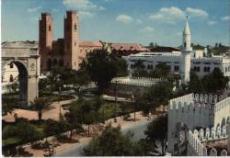
A Somalia Notebook

Edited & Brought to you by ilaxi

Byline by MJ Akbar :A Somalia Notebook

War is a great boon to technology. A cruise liner defended itself against heavily armed Somali pirate boats last year with the LRAD, Long Range Acoustic Device. It emits a sound from a long range that the human ear cannot tolerate and has proved a brilliant answer to pirate guns. So as long as pirates are human they can be driven. I am told that the device is being used in Iraq to disperse unwanted crowds. For more details on LRAD check Google. The Almighty, Omnipotent Google knows all.


How many guns make a warlord? 25 technicals, so about 250 armed men with Russian AK-47s and Belgian pistols make you a lord, and you can go up the hierarchy to viscount or marquis or earl or proper baron if you include a couple of anti-aircraft guns and artillery pieces.


But there are no kings in Somalia. A top of the line AK-47 costs between 400 and 500 dollars; many of the weapons are below the line. I picked up one, while we were lunching off chunks of dry roast camel in a dhaba, lent to me by a young man in a shy smile and a lungi. It was heavy, a little less than ten kilograms. I gave it back after making appropriate noises, carefully avoiding even passing contact with the trigger. At a rough glance, my benefactor had about a million and a half Somali shillings worth of ammunition in his belts: a dollar fetches three bullets.

Three great symbols of modern civilisation are available in Somalia: the AK-47, Coca Cola and the mobile phone. Three mobile phone companies, Nationlink, TelecomSomalia and Hormut, ensure proper competition. An international call costs only 30 American cents. They also double up as money-transfer operations and one of them (defunct after landing up in the suspect category) sent Washington into paroxysms after 9/11 with a word that previously did not exist in a western dictionary but was perfectly understood in much of Asia, hawala. Americans were in Somalia a decade before 9/11 but never picked up this word. Maybe that is why they never stayed. You have to understand Somalia to stay in Somalia.

War is a great boon to technology. A cruise liner defended itself against heavily armed Somali pirate boats last year with the LRAD, Long Range Acoustic Device. It emits a sound from a long range that the human ear cannot tolerate and has proved a brilliant answer to pirate guns. So as long as pirates are human they can be driven. I am told that the device is being used in Iraq to disperse unwanted crowds. For more details on LRAD check Google. The Almighty, Omnipotent Google knows all.

Their present having been stolen, Somalis take comfort in the past. Ancient Egyptians imported cinnamon, frankincense, tortoise shells and "slaves of a superior sort" from Somalia and conceded that Somali civilisation matched their own. If the Magi were kings from Africa, then it is at least plausible that the one carrying frankincense for the infant Jesus came from Somalia. Ibn Batuta, the 13th century Tunisian traveller who did not waste time on inconsequential places, found Maqdashaw a "town of enormous size" where "a single person … eats as much as the whole company of us would eat … and they are corpulent in the extreme". The only parallel I can think of is a Kashmiri enjoying his wazwan in front of us mere mortals, but of course the Kashmiri is not corpulent. The waters of Chashm e Shahi keep him slim.

How many clans make a nation? The Arabs found 39 when Mogadishu became one of their principal trading colonies in the tenth century. This was the breakdown: Mukri (12), Djidati (12), Akati (6), Ismaili (6) and Afifi (3). The Mukri, who also had a dynastic ulema, were in the ascendant when Ibn Batuta visited the port. The nation state is a recent idea. Nomadic Somalis lived across a far wider region than their present borders, including Ethiopia and Kenya. European colonisation came only towards the end of the 19th century. The British came to the north because, as they put it, they wanted guaranteed meat supplies for their garrison in Aden. The Italians wanted the fruit groves of the south. The French were tempted, typically, by temptation and occupied Djibouti. The clans did not wait to be conquered. They took the easy way out and sold their rights, most often for less than a hundred dollars. The treaties were remarkable for their three-point simplicity. Point 1: All rights are yours. Point 2: I get 70 or 100 dollars. Point 3: You have the last word in all disputes. Neighbours could hardly resist exploiting such weakness. In 1891 Emperor Menelik II, founder of modern Ethiopia, wrote to European powers: "Ethiopia has been for 14 centuries a Christian island in a sea of pagans. If Powers at a distance come forward to partition Africa between them, I do not intend to remain an indifferent spectator." He did not. He sent word to Amir Abdullahi, ruler of the historic city of Harar and pivotal to Muslim east Africa, to accept his suzerainty. The Amir, heir to a dynasty of 72 generations, sent presents and a helpful suggestion, that Menelik should accept Islam. Menelik promised to conquer Harar and turn the principal mosque into a church. The Medihane Alam Church, in front of the Galma Amir Abdullahi, or the old palace, is evidence that Menelik kept his word.

The mosque was converted but not the people. While Ethiopia proudly and correctly claimed to have become Christian at the time of Constantinople, lands like Kenya changed only during the wave of missionary activity that accompanied colonisation in the 19th century. As Jomo Kenyatta, first President of independent Kenya, famously said, "When the missionaries came to Africa, they had the Bible in their hands and we had the lands… We closed our eyes to pray and when we opened them, we had the Bible in our hands and they had the lands…"

Harar has the feel of a city that has travelled a long way through history but now has nowhere left to go.

Unesco has recognised Harar, about 450 kilometres east of Addis Ababa through land rich in the local addiction, chat (or khat), a mildly intoxicating but stimulating leaf that is chewed slowly, as a heritage city. There is some excitement among the educated elite that Unesco may do more for Harar than all the rulers since the defeat of Amir Abdullahi at the battle of Chelenko in 1887. There is hope but not too much trust. As a sociologist who did his post-graduate studies at the Tata Institute of Social Sciences in Mumbai some twenty years ago, told me over mercato in the lovely café in the courtyard of the city, "We have been living too long on a diet of pledges."

Little was done for the people, who are of Somali origin, but bitter wars were fought over them. In the Seventies, Siad Barre of Somalia invaded Ethiopia to take back the Ogaden region, where Harar is. Talk that Ogaden possessed huge reserves of oil and gas might have encouraged the invasion. Siad Barre’s tanks penetrated deep into the desert before they were defeated by Cuban soldiers who acted as mercenaries of the Soviet Union (Ethiopia had a Marxist-Leninist regime then, a fact that merely Socialist Siad Barre forgot). Hararis remember the Cubans as a wild lot, shooting donkeys playfully even after being told how valuable these pack animals were. A few Cuban faces in a traditional and conservative society are more evidence that "liberators" make their own rules.

The elders, gradually losing their eminence as a new anger slowly seeps through the young, are resigned to stagnation, and the eyes flicker with old zeal only when they dream that Menelik’s church will once again become a mosque in their lifetime. The people, as elsewhere in Ethiopia, can be strikingly good-looking. The girls wear embroidered head scarves or, rarely, the hijab with jeans. The boys are in the ubiquitous football T-shirt. One bearded young man had EBAMA, San Jose, California, Badr 2004 written on his T-shirt. It stood for Ethiopian Bay Area Muslim Association. Had he lived in America, I asked. No, he said. Few leave Harar. Those who go send T-shirts along with cheques, but do not return.

The mansion in which the Lion of Judah, Haile Selassie, was born is in the old city, called Jubal, and was built by an Indian. You walk down a narrow stone alley full of shops and tailors with Singer sewing machines. Indians, particularly Bohras from Mumbai, dominated commerce during Muslim rule in Harar. Haile Selassie was born here because his father, Menelik’s brother, was made governor after the defeat of Amir Abdullahi. Unesco has allocated funds for the restoration of the mansion, but ten families have made it their home and will not move. The most interesting occupant is a healer.

He sits, erect, on a mattress at the centre of one end of a spacious drawing room on the ground floor. His fame is recorded for posterity in a notebook where his literate patients describe their miraculous recovery, and attach passport-size photographs to add a face to their identity. He is 52 and learnt his skills from his father, whose picture is framed on the high wall behind him, above a carpet with a drawing of the holy mosque at Kaaba, and a much-extended string of prayer beads which he uses for dhikr, a Sufi form of devotion, at night. A woman enters, kisses his extended hand twice while he continues talking to us, and joins another with a child in a corner. There is a telephone on a table, and two small tape-players, one broken. The telephone rings once during our visit, and is picked by an aide lounging on the side who, we realise later, also speaks English. A notice board indicates that the healer cures all the tough diseases, including gynaecological problems, but, alas, back pain is not on the list. He assures me that he can repair nerves that wrack your back as well, and there has been a cancer patient or two who has gone home happy. He explains that he uses herbs and plants, and not shaman-style magic. Perhaps he tells villagers, who crowd around him in the mornings since they have to return by nightfall, something different; perhaps he is equally candid with them. He asks about herbal medicines in India and I include Tibet’s fame in my response.

The notice outside affirms that the healer does not accept fees, but donations for the cause are not unwelcome. I do not use his expertise, but my donation is not unwelcome either.

- Back to Main Blog

Sunday, January 08, 2006

Who Said This?

Edited & Brought to you by ilaxi

Byline By MJ AkbarL Who Said This?

‘Children nowadays love luxury, have bad manners, contempt for authority, disrespect for elders."

Who said this?

One of the more educative joys is to read intelligent book reviews. The success of a review is generally measured by the speed with which you order the book afterwards, or cancel any such intentions. Very occasionally there appears a review that is so intelligent that it makes purchase of the book redundant. This is hard luck upon the author and the publisher, and my heart goes out to both for predictable reasons. I saw one such review in the Christmas issue of the Spectator. The unfortunate publisher is Hodder and Stoughton, and the unlucky compiler of Keeping My Words: An Anthology from Cradle to Grave is Magnus Magnusson. The review did nothing more, or indeed less, than string together a selection of the best quotes; in the flavour was the dish.

The quotation recorded above is from this collection. Proof of its relevance appears wherever you look, although its defining words need to be understood more clearly. Luxury does not mean buying Louis Vuitton shoes or Cartier watches. It simply means buying what your parents cannot afford. A pair of Diesel jeans for an insistent child therefore is a serious luxury for any middle-class Indian parent. (When the child stops being a child, earns a salary and buys himself something he cannot afford, he is being self-indulgent, which is no one else’s business.)

Bad manners is a similar disease: it is doing what your parents do not want you to do, like misbehaving with boring relatives or being nasty to their spoilt children.

On the other hand I rather like the idea of children having contempt for authority. This is surely one of the redeeming features of youth. Respect for authority is designed to make you a carbon copy of the establishment, ending all hope of change and progress.

So who said this?

Socrates.

Socrates was born in 469 BC and committed suicide in 399 BC at the venerable age of 70. It confirms my theory that but for electricity life hasn’t changed all that much in two and a half thousand years.

I was familiar with only three of the quotations offered in the review. Of them, Mark Twain’s take on sons and dads finds a place in just about any anthology: "When I was a boy of 14, my father was so ignorant I could hardly stand to have the old man around. But when I got to be 21, I was astonished at how much the old man had learned in seven years." As Einstein pointed out, everything is relative, but nothing is more relative than relations between father and son.

Those who have read Gore Vidal and Truman Capote, the terrible twins of the old Esquire magazine, a brilliant monthly offering of wit and fiction that has been modernised to suit the tastes of kids of 14, will surely recall Vidal’s remark upon learning that his friend and rival Capote had died: "That was a good career move." Cats cannot begin to compete against New York’s literary elitists.

And if you have not for some odd reason read a non-elitist American called Ogden Nash, then I urge you to rush to the nearest bookstore, for the long-dead author is still alive in reprint. Here are his considered feelings on the complex tiers of age:

Senescence begins

And middle age ends

The day your descendants

Outnumber your friends.


I suppose the point of such an anthology is to provide a working philosophy for the reader, but trust the Russians to take it too far. Since Anton Chekhov is 19th century Russian I expect gloom, but this is life with a permanent overcast: "If you are afraid of loneliness, don’t get married." How do you recognise a married couple in a restaurant? They are the two who aren’t talking.

Americans, unlike Russians, are not gloomy, but when their hearts break you can hear the sound all the way in India. F. Scott Fitzgerald, who is as American as his name, gets Chekhovian on another slant: "It is in the thirties that we want friends. In the forties we know they won’t save us any more than love did." But, honestly, who falls in love to be saved?

The French, naturally, have a very different take on friendship; the Frenchwoman being in a class by herself. The author Colette sniffs: "My true friends have always given me supreme proof of devotion, a spontaneous aversion for the man I loved."

The Frenchman has a justified foreboding of the Frenchwoman. Alexandre Dumas (of Musketeers fame) is certain that "It is only rarely that one can see in a little boy the promise of a man, but one can almost always see in a little girl the threat of a woman".

Bertrand Russell, who could not have been less French, was not talking of Dumas, but he could have been: "Men who are unhappy, like men who sleep badly, are always proud of the fact." Check out the content of any male conversation. If it isn’t about what has gone wrong, then there is no conversation. If there were no bad news, men would go home, presumably to sleep badly. This is one of the few aphorisms that seems to me to be of universal application.

It is remarkable how poignant the stiff-lipped English can get when they are helpless. When they can help themselves, they help themselves to an empire on which the sun never sets. When they become helpless, they can’t see beyond the White House. Two British politicians experience adolescence and infirmity. John Prescott, the large, bluff, gruff deputy prime minister of Tony Blair’s Britain, recalls, "The 11-plus split me from the girl I carried a torch for. She passed, I failed. She went to grammar school, I sent her a love letter telling her I missed her — she sent it back with the spelling mistakes corrected."

If you are on the edge of tears already, let them flow freely in the company of Alec Douglas Home (pronounced, naturally, Hume), who became Prime Minister of Britain after Harold Macmillan only to hand over power to Harold Wilson and the Labour Party.

To my deafness I’m accustomed,

To my dentures I’m resigned,

I can manage my bifocals,

But O, how I miss my mind.


As Alan Bennett, the acerbic British playwright notes, "In England, you see, age wipes the slate clean… If you live to be 90 in England and can still eat a boiled egg, they think you deserve the Nobel Prize."

Being a nationalist, I began to wonder why an Indian was not being quoted. Even the Chinese got a look-in, albeit in the form of a proverb. ("I hear and I forget. I see and I remember. I do and I understand." Very inscrutable.) The book is clearly littered with wisdom from all manner of nationalities. The Chinese have built up a terrifying reputation for wisdom: is our international reputation limited to the Kamasutra, which requires expertise in gymnastics rather than intellect?

Or was the Indian quota filled by Socrates?

Hear anyone over fifty in India and all you hear is moans about the younger generation: they don’t listen, they want everything, they don’t care.

Thank God for such children. India’s future is bright.

-Back to Main

Sunday, January 01, 2006

Conflict,Corruption,Cricket

Edited & Brought to you by ilaxi

Byline By MJ Akbar: Conflict, Corruption, Cricket

What do we really celebrate when we usher out the old year and cheer in the new — birth or death? I get the politically incorrect feeling that we are far happier about the death of the past than the promise of the new. The last twelve months have generally had little to recommend them. The wish that the next twelve months might be better is the usual triumph of optimism over reality.

Politics has its own calendar. Its seasons, controlled by human nature rather than nature, are whimsical and arbitrary. But December is too often dominated by that demon hovering over the Indian nation state, terrorism, as if those who hate what we have achieved cannot bear to let a moment of goodwill pass without tainting it with innocent blood. The attack on the Indian Institute of Science in Bangalore was particularly heinous because a house of learning has been protected from ancient times by respect and honour. Only a savage violates values that are synonymous with civilisation.

Scientists are one of the great success stories of modern India, pioneers who have led momentous revolutions that might be the envy of a Marx or a Mao, for the struggle against hunger is more important than the struggle against class. The fact that killers were able to hit our premier campus in Bangalore indicates not only the depth of their reach, but also underlines how vulnerable we have become.

Terrorism is a dirty war fought at many levels in the bleak and arid ambience of a fog. Its perpetrators measure success by the level of fear they have created, for they know that fear feeds both rational and irrational responses. Since, so often, the enemy is a phantom, you can define him according to your prejudices. A proposition is proved by assumed objective. Assumptions are not necessarily wrong, but anger so often over-rides right and wrong. The terrorist wins when he can sow fear and confusion. The politician and the policeman know that fear can become a key to more votes and more funding. There are layers of evil, deception and exploitation that sustain one another.

The three staples of news in 2005 were conflict, corruption and cricket. Worthy things also happened in 2005. The government introduced a rural employment scheme which the Opposition helped pass with solemn assent: who in his right mind in Parliament is going to oppose a populist idea when it is the government’s job to find the money for it, and take the risks of almost inevitable mismanagement and deflated hopes? Does anyone remember that bill, which will demand a substantial chunk of the budget when it is implemented? No. However, a fair number of news addicts would probably be able to sketch out Monica Bedi’s features, and recall the year in which she met Abu Salem.

They would also know how many MPs were expelled from Parliament for taking cash to ask questions, and the correct spelling of Paul Volcker’s name. At this point, I cannot but pause for an irony. There is an MP from Bengal called Adhir Chowdhury who is accused of murdering 12 people, and has seen the inside of a jail more than once in his rich and varied life. He continues to be an Honourable Member of Parliament because while there is clearly great anger at getting caught with your hand in the till, there is no clarity about what to do in the case of a man with a knife at someone’s throat.

Volcker and Monica Bedi would pale in comparison to cricket. Cricket is the true religion of our times, with various sects protecting the omnipotence of their leaders with a fervour that was once reserved for the Almighty’s affairs. The worshippers at the Temple of Sourav Consciousness rather overdid it, actually. If I were the chief executive of the Saint Greg School of Thought, I would insist that Sourav Ganguly open the innings in Pakistan, and let him face the onslaught of the Shoaib Akhtar Brotherhood, rather than hide him at number six.

One of the finest combinations of artistry, theatre and Mongol-style mayhem was the sight of Sachin Tendulkar and Sehwag taking apart Shoaib during the World Cup semi-finals in South Africa. The runs were not really the issue. It was the brilliance of craft and absolute fearlessness of the batsmen that made those five-odd overs so memorable. That is the standard, in character, we expect from cricketers now and if Sourav is in the team then he must deliver at that level in Pakistan.

Cricket, conflict and corruption will provide the bridge stories between 2005 and 2006, and the paying public will probably get better performance levels in all three areas. The Pakistan tour by the Indian team will look after the mass-frenzy needs of January and February. Any sensible planner would make sure that George Bush’s India visit takes place after the cricket is over: Bush and Manmohan Singh don’t stand a chance against live coverage of Sachin vs Shoaib.

There were two ways in which MPs could have reacted to the expulsion of their errant brethren. They could all have decided to stop taking bribes. They chose the second option: one gathers that anti-surveillance electronic equipment has sold out in Delhi’s black market. If there is a market for intelligence, there is a bigger market for counter-intelligence. Jamming devices are fetching a high premium. This will doubtless encourage the sting-masters of journalism to take their search-and-destroy missions to more complex and lucrative levels. Justice Pathak’s enquiry report will resurrect Volcker in Delhi. The government is in a bit of a bind on this one actually. If it exonerates former foreign minister Natwar Singh it will be accused of bias; if it suggests guilt, there will be consequences for the Congress.

Conflict, and its handmaiden, terrorism, will, alas, remain the burden on the shoulders of an India ready to spring to the high table of the world’s economy. It is important to recall that before China launched its economic miracle, it took a deliberate decision to resolve border conflicts by placing them in the storehouse and getting on with the rest of life. The key dilemma for Delhi will not be terrorism itself, but the degree to which the Pakistan establishment is involved in encouraging it.

Over the last 12 months the view of the Manmohan Singh government has changed; it now believes that Islamabad has not lived up to its promise to curtail terrorism within India. But there will come a political chance to reverse regress, since Dr Manmohan Singh is likely to visit Pakistan before the middle of 2006. If that visit proves a failure, then conflict levels could touch flash-point again. Hawks in both Delhi and Islamabad, who have been condemned to a miserable diet ever since they drove South Asia to war fever but could not take it to war, are back in business with their hands on the menu.

New Year greetings and thoughts are flying at a furious pace through SMS: there is nothing like commerce to generate goodwill. One friend with a particularly devious mind suggested that life had got it all wrong: we should be born old and die young. He provided graphic reasons for his theory, many of them unprintable. But the point is worth considering. A new year is always born old, muddied by the hangover of so many yesterdays, and gets older. Youth means the birth of a new idea, or a new reality; and those are few and far between. We may have been young only once, in 1947, and that birth was a painful Caesarean, which resulted in twins separated at creation and condemned to compete, contest, combat, conspire but rarely to cooperate. Would it have been better if India and Pakistan were born old, and had become young by 2006?

It’s a thought.

- Main Blog

Sunday, December 25, 2005

The Bush Fade

Edited & Brought to you by ilaxi

Byline By MJ Akbar: The Bush Fade


The best thing about 2005 is surely the fact that it has reduced one year from the term of President George Bush. The wisdom of limits has sometimes been questioned, particularly when a sensible President like Bill Clinton comes along. But a George Bush always turns up to reinforce the merits of the law.

George Bush is not malevolent. I have this sneaking suspicion sometimes that he might even mean well. He certainly wants a theoretical democracy to prevail all over the world, for the commendable reason that with all its faults it is the most honest system of governance yet devised. He is simply a man of little understanding, which makes him a victim of the last thing he has understood. Sometimes this is in harmony with previous logic, sometimes in direct contravention, but once he is convinced about something it becomes a conviction, until the next thing he chooses to understand comes along.

His views are a slide presentation of shifting certainties. Because he is well-meaning he is totally sincere about each slide. He was as certain about the need to use torture in America’s war against terror before 10 December, as he was sure on the 11th that torture should, pace the John McCain amendment, never be a part of American policy. He does not abandon a past position; he simply forgets about it and seizes ownership of each defeat by reformulating it as victory.

He is not simple. That would be an underestimation. You cannot win two elections in America by being simple. But he is simplistic. He defers easily to those who prey upon his weaknesses with a simple ruse: they win his trust by applauding his horizon, and then map out highways that have little to do with objectives. Having led him to the centre of that inflammatory maze called Iraq, they are now charting non-existent escape routes booby-trapped with death. When a proper history of his years as the most powerful man in the world is written, it will be a long story of some success, substantial failure — but most of all a narrative of unintended consequences.

Bush was elected in 2000 to take America away from the problems of the world. Those were the innocent days during which he mispronounced "Musharraf". He was re-elected in 2004 to make America safe from the problems of the world. He will leave, in 2008, America more vulnerable to the problems of the world than it has been in a long while. On paper, he wants to change the Middle East by changing Iraq into a democracy. In practice, Iraq is heading towards what might be called a radical-democracy, where popular support has shifted decisively towards those who oppose American policy as well as American values. The one thing that Shias and Sunnis are now agreed upon in Iraq is that Americans must leave their land. Kurds support the Bush White House in the hope of achieving independence, or near independence, and that is not an option that anyone in the neighbourhood wants to hear about. Unless matters are managed with tact and intelligence, they could suffer the fate of the South Vietnamese. The radical-democracy syndrome is visible in Egypt as well, where President Hosni Mubarak opened a vent, possibly so that the West could see who would crawl out from the democratic woodwork. The only surprise when the Muslim Brotherhood got 88 seats in the legislature was why they did not get more.

George Bush and his fawn Tony Blair have now come to the end of their list of reasons for staying in Iraq. They now say that they must stay to train the Iraq Army so that it is able to fight the insurgency. In other words, they cannot pull out because of a problem that did not exist before they came. There was no insurgency before the Occupation. (The average death rate, by the way, is 30 per day; Iraqis also die, although there is reluctance to recognise this.) So we have the classic conundrum. American and British troops will not leave until the insurgency is controlled; and the insurgency will not end unless the Anglo-American armies go. Welcome to the near future.

Sometimes I wonder if policy-makers in Washington and London know what they are talking about. Every day you hear and read, from sources both civilian and military, that the Occupation forces must arm and train an Iraqi Army that can fight the insurgency after the Occupiers depart. This is the civil-war theory: after us, the deluge. This is a familiar of history: empire is always justified in terms of the good that it is doing (civilisation, trade, economic growth et al), and there is always going to be chaos after they leave, if the slaves have the temerity to ask them to leave. Winston Churchill kept harping on the chaos that would descend on India once the Haileybury and Oxbridge Sahibs left.

Let me suggest an alternative scenario. Once Bush and Blair get out of Iraq, if they do it on their watch, the insurgency will end. There will be some residual violence, because this messy war will have left deep sectarian wounds. But, sooner rather than later, the insurgency will be absorbed into Iraqi life, mostly into its politics and partly into its armed forces. We have already seen how Shia militias have become an element in Iraq’s politics and emerging power structure. Space will be created for the Sunnis as well, since common sense suggests that sectarian domination does not work. What, however, about unintended consequences? Will George Bush, over the coming two years, help create an Iraqi Army which could become the strongest Arab force in the region? Could such an Army become a formidable counterweight to Israel, particularly if it works in alliance with Iran? The days incidentally of the Iraq-Iran conflict, which brought such legitimate joy to Washington and London, are over.

Bush is doing Iraq’s Shias a favour they will never forget; has given Iran’s government a lifeline it will never acknowledge; and might have weakened Israel to an extent it will never admit.

It is remarkable that the Bush fade began so soon after the Bush pinnacle. Normally, a re-elected President has two years for a cruise towards history, free from the sinews of political compulsions. By the third year of a second term a President begins to look like the past rather than the present or the future, and starts his farewell visits around the world. In the case of George Bush, the American voter began to ask the very questions that he had ignored when sending him to the White House to continue his war. At the heart of this questionnaire was the most basic of all questions: Every war has a point, what is the point of the Iraq war?

Having admitted that all past answers were wrong, Bush is struggling to find a new answer. If all he can offer is a genie called an imagined Caliphate, then there is very little hope for sanity.

There was a poignant moment in the Bush year of 2005, widely publicised when some embedded but obviously disobedient camera captured a scrawl on a notepad. I can imagine the scene: a worthy but never-ending conference at the United Nations where protocol is in command. At some point, Bush sent a note to Condoleezza Rice wondering if there was any chance of a "bathroom break". I daresay nature doesn’t change its rules for the high and mighty. Presidents and Prime Ministers need a break as often as you and I. Bush surely wasn’t the first eminence to need one. Would Bill Clinton have sent such a note to Madeleine Albright? Somehow, I don’t think so. I rather see him as getting up, making a small but meaningful joke, and promising to return as soon as he could. Television news channels would not have interrupted their broadcasts to telecast this.

George Bush has confidence; you can see it in the arms that loop over on either side, rather than fall down straight, and there is just a hint of swagger in the stride and the eyes. But I am not too sure that he has self-confidence.

-Back to Main Blog

Sunday, December 18, 2005

Tripartite Solution

Edited & Brought to you by ilaxi

Byline By M.J.Akbar: Tripartite Solution

Here follows a solution to the most compelling and complex challenge facing contemporary India.

SUGGESTION NO. 1: If Govinda can become a Member of Parliament, why can’t Sourav Ganguly? The Congress leaders of Bengal, defence minister Pranab Mukherjee and information and broadcasting minister Priya Ranjan Das Munshi have expressed the deepest concern over his fate and future. The Congress has such a shortage of candidates that they put up the hapless Nafisa Ali from Kolkata, although the chances of any voter below 60 recalling that she was born in the city were as remote as the possibility of George Bush winning an election from Fallujah. While Govinda needed a Congress wave in Mumbai to defeat Ram Naik, Sourav Ganguly could generate a pretty strong tide between Narkeldanga and Garia on his own.

After all, it is fear of alienating the young voter in Kolkata on the eve of the Bengal Assembly elections that made Pranab Babu (whose knowledge of cricket, shall we say, is not quite up to selector-level) and Priya Da (whose knowledge of football has made India a tenth-rank world power in the game) identify themselves with the former captain of the Indian cricket team. The logic is simple: if Ganguly has become a vote-getter, let him get the votes for the party that needs them desperately in Bengal. Ganguly certainly isn’t much of a run-getter anymore, and, on the field, more of a run-giver than a run-saver.

It is obvious that Sourav Ganguly has reached his first midlife crisis, and requires both our total sympathy and what help we can provide. Since a sportsman’s working life is short, midlife also comes earlier. Ganguly is too famous to belong to the shadows. He needs limelight like a temperamental plant needs sunlight, or he will wither. There is no better limelight for him than membership of Parliament. In fact, after getting him elected (a Congress MP could always resign in the national interest to make way for Sourav), the Congress could turn the limelight into a spotlight by making him minister for sports. He could then use all the power and influence of office to get his friend and mentor Jagmohan Dalmiya re-elected as chief of the Board of Control for Cricket in India. The other advantage is that neither Shane Bond nor Shoaib Akhtar will ever get elected to the Lok Sabha, so Sourav should shine in the House.

SUGGESTION NO. 2: The selection of the Indian cricket team, the only team that matters to India, should be done by the same process that is used to select Indian pop idols like the new Kashmiri role-model Qazi Tauqeer and the svelte Bengali girl Ruprekha Banerjee. We are a proud democracy, and once vox populi has spoken there can be no further argument. The Voice of the People is the Voice of God.

This would take reality TV into a new dimension and assuage the ravenous hunger of TV channels for ratings. In one stroke all TV channels could become profitable. It would also appease the insatiable appetite of mobile phone companies, since the poll would, naturally, be conducted on SMS. Any other form of polling would take time and have to be managed by the Election Commission. If the EC were involved, it would stagger voting into six phases over two months, and you don’t get that much time between matches. So, my apologies to the Election Commission, but there it is: what is good for Bihar may not necessarily be good for Indian cricket.

A television-SMS driven cricket selection process would have enormous beneficial side-effects. I have already mentioned that the channels would become profitable, but look at what it would do for politicians. TV channels would no longer need to hit under the belt of Nehru suits or under the folds of dhotis with hidden cameras to get the stings that drive up ratings. They would have neither time nor interest in exposing politicians, for cricket polls would bring in far, far more revenue. Consider the ad rates for a ten-second spot just after the DJ (yes, sexily-dressed disc jockeys would run the show, not news anchors) announced, "And the winner is…! But before we tell you the name, ek chota sa break..." Since selection is already all about frenzy, imagine the frenzy generated by election.

It would also be a well-funded election. All candidates would be backed by those industrial houses whose goods they sponsor. We are talking multinational money here, my friends; not something siphoned off for asking questions in Parliament. If Indian politicians think that their elections have become expensive, they should watch what happens when Hutch takes on Airtel in the cricket stakes. I can see advertising agencies, direct marketing firms, opinion pollsters and public relations agencies sprouting up just to get their hands on the additional business. There will inevitably come a point when the BCCI charges a royalty of one rupee for every vote cast. If there is money to be made, you are not going to be able to keep the BCCI out of the loot, no matter whether it is headed by Jagmohan Dalmiya or Sharad Pawar. Business is business.

If things go well, and there is no reason why they should not, cricket-elections could add one per cent to India’s economic growth, thereby enabling the government to fund the rural guaranteed employment scheme and keep the interest rates for pension funds at 9.5%. This would immediately stabilise the coalition government of Dr Manmohan Singh, and ensure that a Prime Minister as clean as him remained in office till 2009. I can see nothing but the pervasive glow of good news in my scheme.

SUGGESTION NO.3: Ramanathan Krishnan should be brought back as captain of the Indian Davis Cup team, possibly along with Naresh Kumar and Akhtar Ali in the squad. The most persistent reason I have heard for retaining the "Mahan Kalakar", as an MP described him, in the team, is that Ganguly was so brilliant.

Indeed he was. There are very few joys in my life as great as watching Ganguly and Sachin Tendulkar in partnership at their best. It was magic. I think it was Dravid who described him as a god on the off-side. Trust me, those of us who have seen Ganguly at his best find it double embarrassing when Shane Bond turns him into a Jumping Jack, and every bowler who can pitch the ball short gets an extra nip when he sees Ganguly at the crease. Any player should hate the thought of television highlighting his follies on the news. It is not a pretty sight. It is also absolutely true that Ganguly was a great team leader once, and deserves every acknowledgement. I am very serious when I suggest that he must be honoured in some way for his talent and his contribution to modern Indian cricket. What he could not handle was decay, which is always slow, invisible to you but obvious to everyone else. The rewards of sport are commensurate with its demands and dangers. The worst wound to a sportsman’s mind is the stab of fear. Once that lodges in your subconscious, it destroys you. Instead of dealing with the problem, Ganguly sought to prolong his sporting life with politics in the dressing room and the boardroom.

Indian cricket has been jinxed with its captains. Kapil Dev hung around not for the good of the team but to beat a world record in a tussle between age and utility. Azharuddin needed a disgraceful scam to be thrown out, and brought shame to a game he had done much to glorify. The Sachin Tendulkars who can leave the captaincy because it is hurting their contribution to the team are very rare. When Sachin’s time comes to go, he will not wait to be pushed. He will not surrender the aura around his name for that one series more in which you tip over into an abyss. Even the most emotional of Ganguly’s supporters argues that he should have been treated better because he was so good. The "was" is subconscious but accurate.

No player is bigger than a national team. We have a team today that can over the next two seasons be knitted into a winner of the World Cup in the West Indies. Or we can shred it into pieces, as the West Indies did to their once-phenomenal side.

Sunday, December 11, 2005

Unbroken Story

Edited & Brought to you by ilaxi

Byline By MJ Akbar: Unbroken Story

It doesn’t surprise me that George Bush had a plan to bomb the Doha headquarters of the pesky Arabic news channel Al Jazeera back into the desert age. What shocks me is that he hasn’t sent Al Jazeera a thank you note after his re-election last year in November.

A victory that became comfortable after the results were in, obscures how close the contest was. For a couple of hours on polling day, the opinion pundits and television channels were preparing for a John Kerry presidency, and liberal gloating over the demise of Bush ended only around noon.

Democrats are now convinced that the critical factor that swung the election away from Kerry was the sudden and very mysterious appearance of an Osama bin Laden tape promising the usual death and destruction of America. It focused American minds wonderfully on all the potential horrors vital to the Bush cause; it was the kind of nightmare image that his most loyal ad gurus could not have paid enough money for. Where did the tape materialise? The usual route. Address of origin: Officially unknown. Address of destination: Al Jazeera. Impact: On all those little suburban homes in Ohio and Iowa that swung the vote away from war hero Kerry to war President Bush.

For many months before the election there was talk of a last-minute "October Surprise", possibly a quiet gift from President Pervez Musharraf to his friend and mentor Bush. Many thought that this would be either the arrest or the death of Osama. It turned out to be far more sophisticated: a tape that kept both of them in business. As the British tabloid, Sun, might have screamed if reporting such a story: "It was de Jaz wot did it!"

The White House did not quite deny the Daily Mirror story that the bombing of Al Jazeera was discussed between Bush and Tony Blair in Washington. It merely dismissed the thought as "outlandish". How far out of land do you have to go to be outlandish in a Bush conversation? Was the invasion of Iraq once outlandish? What is safe and credible and inlandish? That America doesn’t do torture? All those Abu Ghraib pictures must have been from Al Qaeda torture cells.

Actually it doesn’t much matter what was discussed. During times of war stress, all manner of things are discussed. It is much more important to note what has been done rather than what has been discussed. The Bush White House has ensured more than one "accident" in Afghanistan and Iraq to bully and threaten Al Jazeera. To its credit, the channel has refused to let its brow be beaten.

Blair’s response was a verbal grimace that said "Can we change the subject?" Fair enough. I daresay that while Blair did nothing to stop Bush from invading Iraq he may have laid a restraining hand when Bush prepared to invade Al Jazeera.

The British response to the Al Jazeera problem might be far more subtle, and therefore successful. Al Jazeera is launching an English channel next year and is, at the moment, busy hiring a clutch of ex-BBC types, including a few who have lost their credibility along with their teeth. This strategy of implosion seems infinitely superior to the tactics of explosion. Mumble and waffle, the staple menu of this crowd, inside the studio could damage the channel far more than crash and bang from the sky.

All the experience and evidence to the contrary fails to shake the conviction of governments that they can censor all the news all the time. News has this fascinating ability to slip around a corner and reach its target. There will always be one channel or newspaper or Internet avenue that refuses to close its eyes. The motives of media may not even be idealistic. It may do this for nothing more, or indeed less, important than commercial success. Better reporting means more viewers/readers; which means more revenue. Al Jazeera is in demand because it repeatedly brings you the stories that the Occupation forces in Iraq want to hide. The day this stops, Al Jazeera will wither. Audiences are far more loyal to content than to brand. Brand helps, but is no substitute for content. If the English Jazeera takes a different editorial line, it will become as forgettable as any establishment channel.

The subtext of this story is the remarkable ability of Osama bin Laden to pop up where he wants and return to hibernation in some remote, or not, corner of the world that shall forever be Al Qaeda.

As we noted, his tape turned up just in time to influence the fate of George Bush last year. How did that tape travel from wherever Osama is holed up to the offices of Al Jazeera in Doha? On a flying carpet? Was it carried by invisible genii from the Arabian Nights? Did it travel hand to hand from the mountains of the western Himalayas to the waters of the Arabian Sea? Whose were those hands? Was it posted by ordinary mail? Did it come by DHL? Who was the cameraman who shot the interview and edited it in a studio? Or does Osama live in a palace with multi-media facilities? Does no one in the Pakistan government, or on the FBI staff in Pakistan and Afghanistan, know anything, or want to know anything? How come these questions never get asked, let alone getting answered?

America went to war against Afghanistan four years ago to find Osama bin Laden because it was convinced that Osama had masterminded 9/11. If the Taliban had handed over Osama, who was in their protection, and which they admitted, the case for war against Taliban-Afghanistan would have weakened considerably if not disappeared altogether.

Three years before 9/11, in 1998, Nawaz Sharif, the then Prime Minister of Pakistan, told Bill Clinton that Osama bin Laden was on dialysis, and it was only a matter of time before he went the way of all flesh. It’s been a long time, particularly for one with such weakened flesh. Dialysis can keep you going for decades, but what it does do is make you very vulnerable as well. I am not talking only about physical vulnerability. It is very difficult to be on dialysis and hide, when the world’s eyes are trained on you. Dialysis reduces mobility. It demands constant attention to medical apparatus, and presumably competent doctors. Does Osama run such a brilliant, foolproof operation that there are no leaks despite such huge vulnerabilities? Can he survive, with such basic needs, on a lonely mountaintop? Or is he ensconced in some urban jungle? Since there are no urban jungles in Afghanistan (Kabul is at best an urban corpse), he must be in an urban jungle in Pakistan. Is Karachi a good place to look for him? We heard a few days ago one of his deputies saying that he was alive and leading the holy war. If he is alive, why hasn’t he been arrested?

There is something going on that does not quite add up.

Al Jazeera has broken any number of stories. Why doesn’t it break the biggest story of all: where is Osama bin Laden?

- Back to Main Blog

Sunday, December 04, 2005

Sounds of Silence

Edited & Brought to you by ilaxi

Byline By MJ Akbar: Sounds of Silence

If you want to understand the Big Story, look for the small detail. When the action is being broadcast in the merciless way that television adopts, get out of the din and check the silence.

The sound of the breaking story can be very loud; in the case of the Iraqi oil scam that has splattered the life and career of former foreign minister Natwar Singh and could spill over into Congress fortunes, the noise has been powerful enough to shatter the glasshouse in which Delhi VIPs live. But the sound of silence can be louder.

There was no home more silent than that of Mr Natwar Singh on Friday 2 December, the day Aaj Tak, building on the interview that India�s ambassador to Croatia, Aniel Matherani, gave to Saurabh Shukla of India Today, exposed how precisely the lucrative deal had been made by the minister�s son Jagat and his "cousin" Andaleeb Sehgal with the Saddam Hussein regime. Media, planted outside the walls of the ruling class bungalow, reported that all phones, including mobiles inside the Natwar establishment had been switched off, but of course they were referring only to those numbers that they knew of. Cabinet ministers have the use of secure telephone systems limited to select levels of power, and surely there was a mobile number or two that was unknown to media.

There were no calls made on Natwar Singh by friends or ministerial colleagues in his moment of anguish, possibly to save embarrassment to both host and guest, or maybe because there was nothing much to say after Matherani�s revelations. Matherani was a member of the delegation led by Natwar Singh to Baghdad during which the deal was apparently made, and his recollection of detail was devastating. Late in the evening, Mr Natwar Singh came out to read a simple, and very short, statement in which he denied all allegations, and reiterated that his conscience was clear but did not explain the reasons for such clarity. He added that his lawyers were looking into the matter. He did not specify whether he was planning to sue India Today, Aaj Tak, and about a thousand other channels and newspapers carrying the full story. He could also have been planning to sue Aniel Matherani, but I rather doubt that. I mention this because someone in the Congress once threatened to sue the United Nations, and that did not quite happen.

The silence was particularly deafening because it was in sharp contrast to the megawatt protests of outrage that followed the revelations of the Volcker report some weeks ago. Mr Singh then sought out anyone and everyone in order to pour scorn, vitriol, anger, vehemence on Paul Volcker and anyone who thought the latter had a point. Such was the media high that son Jagat was trundled out to supplement father Natwar. Young Jagat was so stiff that he did not even sit down, and he made the memorable statement that young Andy was not a particularly good friend, just one of many acquaintances. I don�t think he wants to be reminded of that now: live by the media, die by the media. On Friday both father and son seemed to have taken a vow of silence, leading to gossip that someone had given a few orders. Silence is not the preferred weapon of the Singhs.

In the evening the agencies issued a statement from our ambassador in Croatia, denying he had made any accusations against his former boss in the government and still his senior in the Congress Party, the leader of his famous delegation to Baghdad in 2001, Natwar Singh.

Aniel Matherani is a nice sort of chap, with lots of hair on his head and plenty of smiles on his face, but you wouldn�t want to put him at the head of any research project. His great asset has been loyalty to the Congress. He has been a functionary in the Congress office through thick and thin � and the years of thin have outnumbered the years of thick. I don�t know if he always spelt his first name the way he does now; most Anils prefer to stick to four letters. I suspect that some astrologer advised the alteration to change his luck. If that is true, find out the astrologer�s name, because the Congress victory 18 months ago certainly changed his fortunes. Foreign secretary Shyam Saran said, on the infamous Friday, that Mr Matherani had already been recalled from his post in Zagreb. One could ask why, and why he has not returned as yet, and the answers would be most interesting; but that would not be the most important question. A far better question would be to ask why he was sent as ambassador in the first place. Was he the leading expert on the intricacies of Balkan politics? It was a grace-and-favour job: Natwar Singh had gracefully rewarded favours done.

Prime Minister Manmohan Singh has told Parliament that the Enforcement Directorate will not hesitate to look wherever necessary in its search for guilt. Here is a suggestion. Technology enables telephone companies to keep a record of all phone calls made. They should get a list of all calls made to Aniel Matherani on Friday, both at his office numbers and to his personal mobile phones.

Praise be to technology. If India Today had not taped its interview, and then broadcast it on television, it would not have had the impact it did. Print is cold beside the warmth of a live voice, and that is what viewers heard all through the day: a member of the original Baghdad Four narrating precisely how the oil-vouchers deal was done.

Here is the Big Denial: "I gave no interview to India Today."

Hullo? We could always check out whether the voice of Matherani we heard on television was his real voice or not. A simple check should establish that.

The second sentence provides clarification: it was off-the-record. There was a bit of huffing about "complete breach of privacy." Well, it was a long breach, because the interview was pretty comprehensive, and while our ambassador to Croatia might not win the next Nobel Prize for Physics, he was surely aware that he was passing on information of volatile importance at a very crucial moment. More to the point is whether what he said, and he definitely did say it, is true or not.

The denial adds that the interview was "distorted" and "misrepresented" and "out-of-context". Where? The Matherani denial never explained what had been distorted or misrepresented. As heard on television and published in print, the interview is comprehensive; the questions and answers flow into each other. The last sentence of the denial is meant to be conclusive: "I also completely and unequivocally deny that I said oil vouchers were allotted to Shri Natwar Singh during the delegation�s visit to Iraq as reported in the story".

This is as brazen as it can get. Matherani provided exquisite and unchallenged detail of how Natwar Singh virtually smuggled his son into the Congress delegation; how Andy Sehgal "accidentally" met them in Amman; how Natwar Singh arranged for them to stay at the Baath Party hotel, and took both of them to meetings to give the impression that the delegation consisted of six members rather than four, and implied that the delegation had a political component and an "economic" component (read oil vouchers for latter); that the arrangements had been made earlier and all that was required was to give implicit legitimacy to the Singh-Sehgal partnership, which was done; how they stayed back in Amman on the return journey in order to complete the deal in Jordan. I could repeat all this verbatim, but a column has space limitations. I might however quote the last sentence of the interview: "That Natwar and the Congress never knew is hogwash."

This is the indictment of an insider who wants to remain an insider, as the "denial" indicates. The individual and the party knew, and deliberately attempted a cover-up, according to India�s ambassador to Croatia, a position that he still formally holds. All his statements so far are statements of a high, and highly-paid, official of the government of India, appointed by this government.

There is one sound that Natwar Singh, his son Jagat, and their acquaintance-cum-friend-cum-cousin-cum-partner (these are only the avatars one is aware of, there could be more) Andy Sehgal must be praying for: the sound of silence. Their presumption must be that public memory is short and media memory a total dwarf; that time will somehow make this story go away. The establishment also must have a vested interest in a slow fadeout, for who knows what will emerge in the next interview: the stress on middlemen fearing that they will be made scapegoats must be enormous.

Prime Minister Manmohan Singh has a simple responsibility, and one addresses this to him because of the belief that he is an honourable man. He must prove, and quickly, that India is ruled by the law, and Delhi is different from Saddam Hussein�s Baghdad.

Sunday, November 27, 2005

Bihar's Gift

Edited & Brought to you by ilaxi

Byline By M.J.Akbar : Bihar's Gift

Nitish Kumar has not yet won the Bihar election. He has only won an opportunity. We will know whether he has converted that opportunity into a hard political victory by this time next year.


Chief minister Nitish Kumar will be tested on a five-point report card.
** Law and order at the top
** Naxalites
** Economy
** Urban Renewal
** Hindu-Muslim relations


No matter which way the numbers are stacked, there is only one clear winner in the long-drawn Bihar Sudoku: a Sikh gentleman generally resident in Delhi who barely intervened in the turmoil of India’s most turbulent state except to give Lalu Prasad Yadav the chance to convert what was a self-inflicted wound in March into suicide in November. When the Almighty was writing Dr Manmohan Singh’s destiny, He took a lot of care to ensure that every loophole was properly sealed.

Nitish Kumar has not yet won the Bihar election. He has only won an opportunity. We will know whether he has converted that opportunity into a hard political victory by this time next year.

If Nitish Kumar believes that he can do everything, he will achieve nothing. Bihar is not suffering just from the sins of Lalu; Lalu was only the most cynical of a long line of chief ministers who compounded a disease that began in the Sixties. It might shock readers to know that Bihar was consistently ranked among the best-administered states in the Fifties; but there is no point discussing how prosperous Bihar was when Chandragupta Maurya was in power.

Chief minister Nitish Kumar will be tested on a five-point report card. I was going to put "law and order" at the top but felt, on consideration, that it might be too ambitious. If the new chief minister can ensure order, even if he cannot implement the full majesty of the law, he can claim distinction. There has to be a curb on the dacoits and gunmen who form a parallel, and more effective, administration. He should import high-profile consultants who can draw up, and perhaps oversee, a comprehensive plan that addresses the menace district-wise. On a practical, and politically incorrect level, a few trigger-happy policemen might be needed.

Priority number two will be Naxalites. Bihar shares a long border with Nepal that is porous for criminals, smugglers and those who dress up violence in ideological clothes. The sharp escalation of Naxalite violence across the country is also an indictment of the Union home ministry. As far as this terrible problem is concerned, Delhi’s response is to jerk a knee before the cameras whenever a story bursts on the front pages, and retire hurt when the news disappears from public view. Clearly, unlike straight crime, there is a social dimension to this problem, which has to be addressed politically. Nitish Kumar must involve the Leftist parties in a bipartisan effort that must be transparent and sincere. The chief minister will probably run dry of his resources of sincerity after a year’s pressures and strains, so it is best that he start doing something right away.

Third: the economy. Nitish Kumar should stop trying to think of the answers, because there is no answer that will take less than fifteen years to implement. He will have long passed his sell-by date by then. But there is something that can be done, which is a deft combination of the cosmetic and practical. Bihar is littered with tombstones of projects aborted. For decades, its leaders have laid the foundation of grand schemes that never saw as much as a wall being built, let alone a chimney constructed. The chief minister could go back to what had been sanctioned (this will save a lot of time), get a fast-track reassessment done, offer the best terms to industrialists of repute, and bring at least a few tombstones to life.

Fourth: urban renewal. If someone were to control the mosquitoes of Patna, he would be renamed Chandragupta. Disease is another name for neglect and filth. So far, the city’s services ensure little more than comfort for the residential area of the political class, up to a point. There should be a ministry for infrastructure in the Bihar Cabinet, with a politician of some ability heading it, and a strong bureaucrat in charge. To treat a road as a joke, as Lalu did, is to sign the death warrant of the economy.

Finally, the government will be severely tested on Hindu-Muslim relations. So many of Lalu Yadav’s crimes were forgiven because he was absolutely flawless in ensuring peace between communities so easily provoked into violence. His government imploded because even Yadavs and Muslims deserted him in large numbers. Nitish Kumar found a brilliant political answer by creating his core vote around backward castes other than Yadavs, but there had to be a spillover from the Lalu vote to ensure such a comprehensive victory. Lalu was complacent because he was convinced that no one would get a majority, and no one was better than him in cobbling a coalition. Complacency is the blood brother of power.

Nitish Kumar’s problem is accentuated by the fact that the BJP is his ally, and too many of its leaders find Muslim-baiting irresistible. But the challenge is greater than being the good cop of the alliance. Nitish Kumar has to use power to create a vote base as solid as Lalu’s. Only then can he hope to change political equations. If he grows, he will be a potential leader of a Third Front. The "if" should be written in capital letters. A key to his future will be the level of trust he can create among Muslims. I suspect that he will at some point announce a job reservation for backward caste Muslims (akin, in some ways, to the 4% Karnataka model rather than the hurried, ill-thought Andhra scheme that was punctured by the courts). This will create friction with the BJP, which will do him no harm either.

If victors are hard to identify, losers are not. Victors demand applause; losers invite sympathy.

The biggest loser in Bihar was Shatrughan Sinha, because he decided to lose when his side was winning. All wars have collateral damage, the serious-sounding term for being shot dead by your own side. Shatrughan Sinha, erstwhile filmstar and BJP-minister pulled off something spectacular: he shot himself dead. No wonder his nickname was Shotgun Sinha. I hope this gives pause to the myth that filmstars enable you to win elections. This proposition was always demeaning to the Indian voter. To collect a crowd is not synonymous with collecting votes. Former filmstars make a difference when they become politicians, in the extraordinary manner that N.T. Rama Rao did, or Jayalalithaa has done.

Lalu Yadav may have suffered a setback, but he is still in play. His fate will be determined by the quality of Nitish Kumar’s performance as chief minister.

And thus to the question that I hope has been nagging you: how has Dr Manmohan Singh become the winner of the Bihar election? In just about every which way.

Defeat in Patna has made Lalu Yadav impotent in Delhi. After the first Bihar elections, Lalu was powerful enough to demand and obtain a disgraceful recommendation to the President dissolving the Bihar Assembly without due consideration. If he had won, he would probably be discussing a better portfolio for himself at the Centre — for starters. Now, the Prime Minister can take Lalu’s support for granted. An occasional smile will be sufficient to keep him happy.

A simple fact will explain more. Dr Manmohan Singh has never been in danger of being destabilised by the BJP-led Opposition. Why would any party of the ruling alliance exchange the comfort of power for the uncertainty of an election? The only party that might conceivably have an interest in another election is one that hopes to do much better. For the past year, voices have been gathering strength in the Congress that, with the BJP in disarray, a midterm election could win the party up to 200 seats. The additional seats would come from Madhya Pradesh, Rajasthan and Maharashtra (where the Shiv Sena is fading into inconsequence). It is axiomatic that another election would mean the end of Dr Singh’s tenure in office, irrespective of how the Congress fared.

The defeat in Bihar has ended all talk of a midterm poll. Unless some seismic event takes place that no one can foresee, the government of Dr Manmohan Singh is safe for the rest of its tenure. The accidental Prime Minister has become a politician of substance.

- Back to Main Blog

Saturday, November 19, 2005

Vice President of Torture

Edited & Brought to you by ilaxi

Byline by : By M.J.Akbar

Media disseminates information, triggers reaction, further shapes response, and creates new facts. Media thereby becomes the vehicle of change and the procreator of history. Truth was never a simple fact, but it could be hidden in an establishment cupboard till the time of accountability, at least in this world, had passed. Now, truth can evolve almost on a daily basis, once it is out; the genes of this evolution lie in media.


Media used to be merely the message. But that was once upon a time, when a Canadian professor of literature, Marshall McLuhan, coined the phrase, and a laconic British poet, Philip Larkin, announced the birth of sex in 1963. We have moved on from the Sixties. A new dictum rules. History is media.

I do not offer that proposition to suggest that modern media compiles the data that will comprise the history waiting to be written. That is too passive a role, and if only this were true it would not be worth writing about. Modern media is not just an accumulation of dormant technology, a data bank called Google — the latest avatar of HAL, Stanley Kubrick’s memorably sinister computer in Space Odyssey. Media is now an active ingredient and vital instigator of events. Information is the new mother of invention.

Media disseminates information, triggers reaction, further shapes response, and creates new facts. Media thereby becomes the vehicle of change and the procreator of history. Truth was never a simple fact, but it could be hidden in an establishment cupboard till the time of accountability, at least in this world, had passed. Now, truth can evolve almost on a daily basis, once it is out; the genes of this evolution lie in media.

Dictators, and manipulative democrats, would prefer it the other way around. They would like media to become history. They want media to return, at best, to the fundamentally obedient, if not corrupt, state in which it existed during socially progressive but nevertheless brutal regimes like those of Josef Stalin and Mao Zedong; and nihilistic, suppressive and genocidal regimes like the one of Adolf Hitler. Media did exist in Soviet Union, China and Germany but it was blind to mass murder of peasants, mass starvation of citizens and mass extermination by Nazis.

Even the most repressive governments today cannot quite hope to survive behind an unliftable curtain of ignorance. It is not almost impossible for brutality to remain an archival fact, to be discovered only after their perpetrators have enjoyed a lifetime of power. Today accountability is increasingly around the corner.

The governments of superpowers publicly worry about Weapons of Mass Destruction: WMD, or nuclear weapons, in Iraq yesterday and Iran today. I suspect that privately they are far more worried about the real modern WMD, media. The exhilarating part is that media destroys what needs to be destroyed, the lie, the evasion — not wholly, nor in full measure, but substantially. (Those who hear an echo of Jawaharlal Nehru, albeit in another context, have their ears tuned correctly.)

Nuclear weapons are a Weapon of Mass Perception (WMP) rather than a WMD. They are victims of the ultimate paradox: nuclear weapons are too destructive to be destructive. Generals who want to bomb the enemy back into the Stone Age are going to achieve precisely what they want, except that the stones will be found back home as well when the nuclear cloud clears. And since you won’t get hamburgers or SUVs in the Stone Age, that option is unrealistic for even a hyperpower like George Bush’s America. (Important: we must always make a distinction between America and Bush’s America.)

The only time America used nuclear bombs was in Hiroshima and Nagasaki in 1945. That was enough. Even when America is at its most desperate, as in Vietnam or in Iraq, it might resort to chemical killers but has not found the will to use nuclear weapons. The Soviet Union was a mighty nuclear power, but that arsenal was impotent when the Soviet state imploded. Israel has at least a hundred nuclear bombs. Not one of them is useful against a Palestinian struggling for self-respect and freedom.

Nuclear weapons are useful only as a strategic reality, not as a tactical option. They did enormous service to the world during the long decades of the Cold War, when they successfully prevented that war from boiling over into bloody combat, as could have happened over Hungary in 1956, Berlin in 1962 and even Czechoslovakia in 1968. Today, they are extremely useful in preventing a fourth full-scale war between India and Pakistan. Thank you, Dr Einstein, Dr Raja Ramanna, President Kalam, Dr A.Q. Khan and all your mentors.

How do we know that America has used chemical weapons in Iraq, during the Fallujah operations? Well, I can safely report that Donald Rumsfeld did not hold a series of press conferences on the subject, and the Pentagon did not issue a news bulletin. Italian television found out before it was confirmed, lips very tight and eyes wide shut, by the Pentagon. Nor did the Pentagon call editors over for an illuminating chat on Abu Ghraib. It was only the severest pressure that forced it to convict a couple of underlings on its payroll as token punishment for images that shocked the world and stirred more than one heart to who knows what depths of anger.

It might, in passing, interest you to know that since Abu Ghraib, the Pentagon has sacked one general for adultery, but found absolutely no evidence of any culpability against any senior officer for the scandal at Abu Ghraib. But of course, in Bush’s immortal words, America doesn’t do torture. I often wonder what Bush would have tried to get away with if media did not exist, or if all the world’s media were controlled by Rupert Murdoch, owner of Fox TV in the United States and choice properties elsewhere. Bush seems oblivious of Abu Ghraib. Or that John McCain, a Republican ally who helped him remain in the White House, is author of legislation that would ban torture by the American administration and is being opposed by Dick Cheney. This is what, according to AFP, Admiral Stansfield Turner, has to say: "We have crossed the line into dangerous territory. I am embarrassed that the US has a Vice President for torture. I think it is just reprehensible. He (Cheney) advocates torture, what else is it? I just don’t understand how a man in that position can take such a stance."

Stansfield Turner is not a Sunni-Wahabi-Baathist-mullah from Baghdad. He is a former chief of CIA. He also reaffirms my early comment that we should not confuse the Bush Brigade with America.

It is not just America that is affected by the syndrome. Cross over to the other side of the world. Thailand is mired in a virtual insurgency in its Muslim-majority provinces; more than a thousand people have died since January 2004. If there was one moment that turned disaffection into active war, a "nerve moment", then it was surely the incident during Ramzan when a Thai general packed Muslim suspects into a "black hole" in which about 80 suffocated to death. When questioned, he dismissed this as a consequence of weakness due to fasting. Thaksin Shinawatra was Prime Minister and did nothing. He later won a landslide victory by gently fanning prejudice against Muslims. How do we know about this "nerve-moment"? Because of media. Otherwise it would have remained a shadowy rumour, regularly dismissed as "preposterous" in gentle Thailand.

Predictably, France has given a whole new meaning to our subject. We have heard of the Internet revolution. Silicon Valley and Bangalore must find a new term for what they do after the French Revolution of Autumn 2005 in which minorities, primarily but not uniformly Muslim, rose against the quasi-racism of Nicolas Sarkozy, France’s long-tongue interior minister. This was a revolt planned and implemented on the Internet. They’ve finally stopped counting, after 9,071 vehicles were torched and 126 police officers injured.

Modern media’s greatest service to contemporary civilisation is that it has made injustice that much more difficult to hide. Obviously I wish I could say that all media lived by this creed. I cannot. Most media is still conformist and obedient. Almost every government in the world has its own channel (Bush has Fox). State-owned channels, almost without exception, are propaganda platforms for their governments. But this does not matter. All you need is one television station or newspaper to report the truth. Once facts emerge they develop a life and power of their own and create new facts. Reaction overpowers action.

As the President and Vice President of Torture are beginning to discover.

- Main Blog of MJ Akbar

Sunday, November 13, 2005

Will Natvar Singh Sing?

Edited & Brought to you by ilaxi

Byline by MJ Akbar: Will Natvar Sing?

Natwar Singh has exhausted his capacity to hurt himself. But he has not exhausted his capacity to hurt the Congress. The story of the ex-foreign minister of India confirms an old view of mine. While there is always the danger of character assassination in public life, the far bigger danger for politicians is character suicide.

Now that Mr Natwar Singh has more time on his hands, if not more peace in his mind, he is probably allotting blame for his misfortunes. Paul Volcker is surely on top of his list. But, in all honesty, he needs to divide the blame between Volcker and hubris. The details in the UN report were half the problem. The other half was television: or, to be more specific, the frequent appearances of Singh and Son on the box. Volcker condemned Natwar Singh in his report. Natwar Singh ended up condemning himself on television.

The minister is an extremely well-read man. He might have paused to check Shakespeare. "He doth protest too much." As for Jagat Singh: his innate aggression might be tolerated in a decadent feudal environment, but it does not travel very far in civilised society. If the not-so-young man thought he could huff and puff his way out of trouble, he has not grown up.

One wonders if either Mr Natwar Singh or the Congress took any advice on how to handle a problem that quickly pole-vaulted into a crisis. Friends comment, or suggest; that is perfectly normal and understandable. The initial reaction seemed based on the view that this was a silly season story, the sort of news that fills a gap when nothing much is happening. Hence the slightly thoughtless initial reactions, both by the Congress and the minister. "The Congress will send a legal notice to the UN." In other words the Congress was sending a legal notice to India, since India is a member. "Who is Paul Volcker? He doesn’t even know that I am the foreign minister of India!" It was silly to doubt Volcker’s credentials, and a phone to any sensible man in America might have prevented such a mistake.

But hubris tends to have an escalating impact on poor judgment. By the time Mr Singh was asserting, vibrantly, that "I, as foreign minister of India" could dictate national policy it was apparent that he was out of sync with the culture of democratic governance. After that his departure was no longer a question of whether but of when.

Mercifully (for the victim), Prime Minister Manmohan Singh brought one stream of the running story to a halt when he decided that Mr Natwar Singh could no longer be a tenable custodian of the nation’s foreign policy. The Prime Minister’s initial defence of his colleague is not to be faulted. He cannot jettison a senior minister in the first onslaught even though he was aware of Volcker’s reputation, as well as the integrity of the committee that had done the damage. But the final compromise, in which Mr Natwar Singh has become a minister without portfolio, achieves nothing. Natwar Singh is no Lal Bahadur Shastri, whose advice was needed even after he resigned his portfolio. Nor did the former resign; he was ordered to walk the plank (in his own interest, since the plank was fitted out with a temporary safety net).

The compromise has fuelled suspicion that Mr Natwar Singh knows something that we do not, at least not yet; and that something could hurt others in the Congress. This may not be true, but the Indian voter is a suspicious sort of chap. The chances of anything remaining secret are remote. By the time the various wringers have done their work, at least half a dozen enquiries would have sifted through the oily affairs of an elitist friends’ circle who thought that the world was their oyster and their dads were little pearls. There is the Volcker report, already with us, documents awaited.

The Enforcement Directorate has begun its interrogations and alerted airports that the directors of Hamdan, Andaleeb Sehgal and Vikas Dhar, should not be permitted to leave the country for the moment. The tax authorities will doubtless want their turn. Mr Virendra Dayal has been put on a parallel track, to report on UN processes and reports. Justice R.S. Pathak, with the powers of a civil court, will enquire into the Volcker conclusions. And then of course is the continual enquiry report being done by the media. Ironically, Mr Natwar Singh and his son might find that, of all these options, Volcker might have been the most gentle.

The media has, so far, the softest job. Volcker has done most of its work; all it needs is a bit of follow-up. This is bad news for the Singhs, since with each layer and each lead their protestations look that much more hollow. It is apparent now that Paul Volcker’s basic information came from documents seized from government records after Saddam Hussein’s defeat. He then cross-checked the names with bank transactions. There were no allegations against those who did not figure in bank records: witness Bheem Singh, a Jammu and Kashmir panther. I can hardly comment on the merits of each individual allegation, but the case against Sehgal looks strong. Sehgal was in the picture only because of his connections with the Singhs, and, as confirmed by a former Congress minister, P. Shiv Shankar, a member of the Congress delegation to Iraq, was in the group only in his capacity as their friend. It would be very unusual if two plus two did not make four. It is safe to assume that Andaleeb Sehgal did not go to Baghdad under the false assumption that it was Paris in summertime.

The life of a government is best measured in events, not months and years. By that yardstick, the Manmohan Singh government has reached its midway mark. The early hiccups, like the shindig over tainted ministers, did not affect its stride; in fact, it was the BJP that was sounding strident. But 2005 has been a year in which the government has aged faster than it expected. The budget was more hype than hope; economic reforms were trapped in the contradictions of the ruling alliance. There were political mistakes, the most unforgivable being the mismanagement of Bihar after Lalu Yadav failed to get a majority in the first Assembly elections of the year. The consequences of that mistake will be evident in the November polls. Now we have a very old-fashioned scandal, as grubby as they come. Since the foreign minister was involved, it was entirely appropriate that it had an international flavour. But the most significant fact of this scandal, as far as the Manmohan Singh establishment is concerned, is that it is a Congress scandal.

The lead singer pulls in the bigger bucks in any performance, but he also pays a higher price when things go wrong. In fact, if the lead cracks up, the show disappears. If a Jharkhand Mukti Morcha slips in the ruling coalition, it barely raises a yawn. If Lalu Yadav stumbles, despite his 25 MPs, it is probably good news for the rest, since his ability to blackmail the coalition is dented. But if the political and ethical credibility of the Congress goes, then the edifice crumbles. The coalition can still brazen it out in arithmetical terms, but it will not be able to function as a government. It will also whittle Dr Manmohan Singh’s personal credibility. Take that away, and there isn’t much left.

During his more intemperate spells, just before he lost his job, Mr Natwar Singh often asserted that he was indistinguishable from the Congress. That is precisely the sort of thing that a Congress Prime Minister or a Congress president might not want to hear. The last thing the Congress wants is to have beloved sons like Jagat Singh, who have dear friends like Andaleeb Sehgal and pathfinders to Baghdad like Aneil Mathrani. A Congressman might have such afflictions, but the party would like to consider itself a little bigger than an individual.

Alas, the paradox. The only time an accused is readily believed is when he spreads the accusation. Mr Natwar Singh’s power lies in ambiguity. As long as there is no clarity, and the whisky trail, or the oil-cash trail, does not lead to specific hands and homes beyond doubt, he and the Congress are safe. But there are too many documents leading to too many established companies; will everyone keep quiet? If Natwar believes that he is being made a scapegoat, will he sing?

-Click for Main Blog

Sunday, November 06, 2005

Pure Evil

Edited & Brought to you by ilaxi

Byline by MJ Akbar: Pure Evil

The Indian voter’s faith in its politicians has collapsed. Its faith in many institutions is dangerously low. But this is more than offset by the Indian’s faith in the country’s economy and the nation’s polity. The view is gaining ground that the politician cannot do much to harm the economy, and the polity is stronger than the politician. This is what makes India much stronger than the sum of its parts and gives it the ability to absorb wounds in order to protect the whole. It will take much more than a few bombs in Delhi to hurt India.


There has to be a reason, even for pure evil; otherwise it is lunacy. We must never confuse evil with lunacy. To say that Hitler was mad is, in a sense, to absolve him because you eliminate his responsibility for his crimes.

Lunacy may extract a grievous price on occasion, but it is an accident — an accident of the brain that destroys the capability of judgment, moral and amoral, whether it is a matter of sifting right from wrong or separating fact from fiction. Evil is a deliberate, often carefully calibrated choice. We must understand lunacy in order to isolate it, and we must understand evil in order to punish it. We have to live with the depressing fact that neither can be eliminated.

Evil can take both a collective as well as an individual form. There are times when substantial majorities of a population become collectively evil, and remain so for hundreds of years if not thousands. There was the spasm of Nazism in Germany, a virulent strain of evil that is unparalleled in human history. Other forms were less destructive perhaps, but hardly less corrosive or forgivable. Racism, for instance.

Americans are mourning the death, and celebrating the life, of Rosa Parks, who became the pivot of a turning point in American history when she refused to give up her seat in a bus to a White man in a small town. The pastor of a Black church in that town was drafted to head the non-violent resistance movement when she was arrested. His name was Martin Luther King, and he led Black Americans to emancipation after hundreds of years of the most inhuman slavery.

Apartheid in South Africa took even longer to destroy. Lest we Indians begin to feel smug, the fate of Untouchables in our country was worse than the lot of slaves in America or Blacks in South Africa. Dalits had to carry a pitcher around their neck so that their spit would not pollute the ground. When you think about some of these facts, all you can do is shudder, for our forefathers who practised such evil, or condoned it, considered themselves civilised. By the 1960s and 1970s the world changed sufficiently to outlaw such practices, not just in word but also in practice.

Terrorism, the contemporary evil, is not collective; it is the work of individuals or very small groups operating through cells. Terrorists are faceless because they are ready for personal obliteration — hence the faint paradox of an identitikit hunt. The normalcy of the men who planted bombs in crowded marketplaces is their weapon, making them all the more sinister.

What were the reasons behind the barbaric, senseless terrorist bombs on the eve of Diwali in Delhi? The checklist is obvious, if often unstated in respectable media for reasons of delicacy.

At the top of the list is surely the bleeding wound of the subcontinent, the problems of Kashmir. Was this an act of revenge? But if it was revenge then it should have been targeted against a symbol of government, not against a marketplace. The purpose seems more mischievous.

Was it an attempt to provoke communal violence between Hindus and Muslims? The moment for this barbarism was the eve of Diwali, the happiest day on the calendar of Hindu festivals. To spread carnage on such an occasion is to incite the mildest of human beings to rage. It is evidence of the growing maturity of inter-community relations in India that there was no such reaction. This is not the first time that such embers have been fanned in the hope of a larger conflagration. But apart from the unforgivable post-assassination riots of 1984, the fallout of the destruction of the Babri mosque in 1992 and the more recent, gruesome Gujarat riots under the watch of chief minister Narendra Modi, the people of India have met such challenges with commendable calm.

Did the anonymous killers hope to derail the peace process between India and Pakistan, in the manner that the attack on the Indian Parliament on December 13 froze relations and drove the subcontinent to the edge of war? If so, once again the result was failure. The first assessment in Delhi in such situations is to measure the role, if any, of either the whole or a part of the Pak establishment in such wanton terror.

Since nothing has been established, nothing can be ruled out, or ruled in. But at least as far as the principal voice of Pakistan’s establishment was concerned, the message to Delhi was reassuring. President Pervez Musharraf seemed sincere in his private conversation with Prime Minister Manmohan Singh and, more important, his public pronouncements. He offered "unequivocal" support to India in any investigation and added "Pakistan stands with India on this act of terrorism". We will wait to find out whether this offer of support means anything or not, but it is reasonable to assume that Dr Singh was comforted by what he heard, or there would have been public ramifications. Privately, India and Pakistan believe that terrorists, who feel increasingly abandoned as peace initiatives strengthen, will express their desperation through mindless, destructive terrorism. Their targets will be both innocents and VIPs.

It is now two decades since the Russians were defeated in Afghanistan, and Afghanistan needed another war before America could get the government it wanted in Kabul. One of the motivations of those foot soldiers of the Afghanistan jihad who turned their attention towards India was that a "soft" nation like India would be a pushover for the conquerors of the Soviet Union. It is easy to underestimate the strength of a democracy, particularly when it looks tattered at the top. But a democracy builds very strong underground roots, because it is always nourished by the will of the people.

People have direct ownership of the state; the vote makes them shareholders in the power process; they elect and destroy the executive. Patriotism is common to all nations; democracy strengthens the stake in a nation’s present and future. The strength of India is much more than the strength of its armies, for it derives from the strength of its people. Since the vote is equal, all communities, with time, discover that their stake matters, and that their will can change the nature of governments.

Military strategists have looked wistfully at the geography of India, and the strategic depth that this provides. Basically this means that India’s defence forces have space to manoeuvre, to take a second stand in the event of any setback. But that is an advantage only in a conventional war. The real war today is unconventional, for the nameless, faceless terrorist can strike anywhere and melt into anonymity.

A nation needs a different kind of strategic depth to fight this war successfully. It requires depth of character, and an extraordinary resilience to sustain perspective and balance. Delhi did not grieve any less on the day after the pre-Diwali havoc, but the manner in which the city recovered could not have escaped the attention of those trying to destroy its peace. Only the very cynical, or the very prejudiced, would consider this a sign of indifference. The simple message from the city was that it would not be defeated.

The Indian voter’s faith in its politicians has collapsed. Its faith in many institutions is dangerously low. But this is more than offset by the Indian’s faith in the country’s economy and the nation’s polity. The view is gaining ground that the politician cannot do much to harm the economy, and the polity is stronger than the politician. This is what makes India much stronger than the sum of its parts and gives it the ability to absorb wounds in order to protect the whole. It will take much more than a few bombs in Delhi to hurt India.

We do not know how long terrorism will enter our homes and our markets and our streets, and we do not know when the last battle will be fought. But we do know that this is not a war with set-piece battles; that this is a process in which victory and defeat will be determined in the mind much more than the street. The mind is controlled by the nerve, and democracy has given India nerves of steel. That admittedly flabby flesh you see on the outside is the weakness of a sweet tooth; the other teeth can bite back.

- click for main Blog