Byline by M J Akbar: 100 years after Gokhale, Jinnah
As anniversaries go, this does not quite compete with the birth of demigods or emperors, but it does demand something more than indifference. 2010 has a legitimate claim to being the 100th anniversary of Indian democracy. In January 1910, following the Minto-Morley reforms, 27 members, elected on the basis of limited franchise and separate electorates, took their seats in the 60-member Imperial Legislative Council, housed in Calcutta. The elective principle had to be reformed and refined periodically but was never, in India, abandoned.
On 25 January 1910 Muhammad Ali Jinnah was sworn in as the Muslim member from Mumbai. The other victor from the great metropolis was Gopal Krishna Gokhale, from the “general”, or Hindu seat. The young Jinnah had been fortunate: two elderly bearded frontrunners hated each other so much that they let the candidature go to the young Anglophile lawyer. Jinnah held that seat till 1946. Jinnah was not enthused by the system that brought him to the Council. Separate electorates, in which only Muslims could vote for Muslims, were the consequence of a collaborative demand placed before Lord Minto in 1906 by a group of Muslim notables who went on to create the Muslim League in December that year. Jinnah refused to join the Muslim League and, at the Allahabad Congress in 1910, seconded a resolution deprecating the “principle of Separate Communal Electorates”. He warned that this would divide the nation, supremely oblivious of a future in which he would become the architect of partition.
Odd, despite the bad odour sprinkled upon the idea by Congress, the shadow of separate electorates has always hovered over Indian democracy, thinly disguised by an alias, reservation. This alias was conceptualised in September 1932, when Gandhi made a pact with Babasaheb Ambedkar, who was in favour of separate electorates for Dalits. Instead of separating voters, Gandhi separated candidates, and promised Ambedkar more reserved seats than the British had awarded to Dalits.
In practice, this did not amount to a huge difference. The purpose of separate electorates and reservations was the same: to ensure that a certain number of MPs from a particular community entered Parliament. In 1928 Jinnah had offered to abandon separate electorates for Muslims in exchange for reserved seats, as the formula for an all-party Constitution being drafted by Motilal Nehru. If Congress had accepted, the idea of Pakistan might never have been born. But Congress would not grant to Muslims what it was prepared to give to Ambedkar.
Reservations entered the Indian Constitution as a temporary measure, but have become a permanent reality, expanding with a slow but relentless tenacity. Think about it: if the Women’s Reservation Bill goes through, some 60% of Indian voters (women, Scheduled Tribes and Scheduled Castes) will enjoy reservations, even after adjusting for overlap. It is unsurprising that the question that was never answered in 1928 and 1932 has returned to the top of the Indian Muslim agenda: why not us?
The focus has shifted from political space to economic and educational entitlement, but at the core remains the grievance of injustice. If reservations are good for virtually everyone else, why do they become such a terrible idea when it comes to Muslims? True, the Constitution does not permit reservations for religious groups; but the Constitution does not envisage reservations for women either. If you can change the Constitution to accommodate women, why not alter it for Muslims? In any case, the religion argument was made irrelevant when “backward” Sikhs and Buddhists were included within reservation quotas. Why did Congress then, and more so today, consider caste and gender a perfectly reasonable basis for empowerment, but religion such a threat? Was it because caste is Hindu, and Muslims are, well, Muslim? The Muslim League divided India on the basis of religion in 1947, but how long are Muslims expected to pay for mistakes of history, particularly when guilt is never unilateral. Delhi is no longer controlled by the decisive third force in the equations of 1947, the British, and democratic India has displayed the strength and resilience to crush any secessionist threat. Why does this confidence dip when impoverished Muslims demand economic empowerment? The watershed impact of the statistics gathered by Justice Rajinder Sachar in his defining report cannot be underestimated. Such questions are addressed to Congress because the Left, and parties led by Mulayam Singh Yadav and Lalu Yadav, have accepted the justice of the Muslim claim for job reservations.
The merits of each question may not be equally valid, but doubts are rising through the second tier of political discourse. Democracy is a system of valves that finds solutions through debate and protest. But democracy is ineffective if the right of protest does not interconnect with the duty to hear. The first is a privilege of the citizen; the second a compulsion of authority. A deaf Government breaks the circuit. The only known cure of frustration is an election. When frustration lingers across elections it becomes bitter and exaggerated. We have not reached that point, which means that the moment to answer questions is now.
The Gokhale of 1910 would have understood the Jinnah of 1928, although he would never have forgiven the Jinnah of 1947.
Saturday, April 17, 2010


Sunday, April 11, 2010
You can't pass the buck, PC
You can't pass the buck, PC
By M J Akbar
Most mistakes begin in the mind. It is hardly a state secret that home minister P Chidambaram is an avid fan of the American security doctrine summed up succinctly in "clear, hold, build". No one saw the fault lines. This was a formula for overseas operations, not domestic soil. America faces both an internal and external security challenge.
It does not use the same doctrine for both. The CRPF, or its offshoots, are not an occupation force. Moreover, the Maoists have not seized territory; they have turned the natural habitat of the poor, with local support, into their strongholds; they are, right or wrong, of the people. Their fighters are not in uniform; their officers do not wear cravat and beret; their foot soldiers do not change into civvies to go home.
America understands the need to 'build' in Iraq or Afghanistan, but this is the third priority, which is why it either does not happen, or gets too diluted. The maximum energy is exhausted by 'clear' and 'hold'. In practice, this means that the security force is largely occupied in providing security for itself. Chidambaram has argued that development is impossible until his personal armies can clear the 'infected' areas of Maoists. The Cobra Force was developed for this purpose. It has been renamed the Special Action Force presumably because someone thought the world's most famous poisonous snake might be inappropriate nomenclature for the striking arm of an 'aam-aadmi' government. You can change the name, but what about the mentality?
Uncertainty has turned the home ministry's advertisement campaign into an exercise in confusion. The copy says: "I was poor and had no job. So, I joined the Maoists. The gun became my identity. I killed, I maimed, I blew up schools and bridges. But, I still have no job. My children can't go to school. My wife can't live with me. I can't till my land." Then follows the message: "Abjure violence, support development." Ignore the fact that Maoists are hardly reading upmarket English newspapers with their morning cuppa; it does rather sound like an invitation to join Maoists, rather than abjure them.
If "I was poor" etc etc, and the state had done little except ensure that the rich were getting richer at a rate of 8%, maybe the gun would seem the only wake-up call left. One can join development if there is development. Dantewada is not quite Marine Drive. The poor are not fools; they do not expect a genie to suddenly offer them a magical palace — but neither will they accept indifference as their destiny.
Poverty is the sustenance of Maoism. If we want to destroy Maoists, we need to end poverty. There is an alternative to "clear, hold, build": empower, educate, eliminate. The gun is a weapon of last resort in a democracy, not the first. Equally, a sensible government must reduce the attraction of the gun among the poor by restoring their faith, not by multiplying cemeteries and graveyards. There is nothing particularly radical in this suggestion. If Pranab Mukherjee or A K Antony had been home minister, they would have understood. Such a strategy has been used successfully in Andhra Pradesh by governments across the party divide, led by N T Rama Rao, Chandrababu Naidu and Y Rajasekhara Reddy. They built police units – called Greyhounds, not Cobras — which spoke the people's language, and earned their trust by behaving as protectors rather than conquerors. Experienced police officers advised the home ministry to base the Cobra Force in Hyderabad so that it could imbibe an operational culture that had proved successful, but Chidambaram disagreed. He made it personal. Delhi remained the headquarters of Cobra-SAF.
The Greyhounds had few intelligence failures because they were intelligent. Simultaneously, positive discrimination became the theme of economic development. It was, inevitably, a slow process; there were no grandiose claims that Naxalites would be finished in two years, or three. More important, no Andhra politician tried to use a crisis to become a pseudo-Napoleon through verbal explosions.
Good politicians know that a single pompous phrase can reverse trajectory and turn a thundering cannonball into an ominous boomerang. Chidambaram loftily informed the mild Buddhadeb Bhattacharjee during a visit to Maoist-hit Bengal that the Naxalite buck stopped at the Bengal chief minister's desk. He could not have imagined that within days the taunt would return to haunt him.
Where does the Dantewada buck stop? Chidambaram has been chasing alibis, claiming this was a joint operation. Not quite correct. The CRPF in Chhattisgarh — whether wearing its Cobra face or Special Action Force hat — took its orders from Delhi. American President Harry Truman made the phrase famous with a "desk gadget" bearing the legend "The Buck Stops Here". (This plaque, incidentally, was a gift from the Federal Reformatory at El Reno.) Another President, Calvin Coolidge, made a more relevant promise: "I won't pass the buck."
To pass the buck is to fail the nation.
Appeared in Times of India - April 11, 2010
By M J Akbar
Most mistakes begin in the mind. It is hardly a state secret that home minister P Chidambaram is an avid fan of the American security doctrine summed up succinctly in "clear, hold, build". No one saw the fault lines. This was a formula for overseas operations, not domestic soil. America faces both an internal and external security challenge.
It does not use the same doctrine for both. The CRPF, or its offshoots, are not an occupation force. Moreover, the Maoists have not seized territory; they have turned the natural habitat of the poor, with local support, into their strongholds; they are, right or wrong, of the people. Their fighters are not in uniform; their officers do not wear cravat and beret; their foot soldiers do not change into civvies to go home.
America understands the need to 'build' in Iraq or Afghanistan, but this is the third priority, which is why it either does not happen, or gets too diluted. The maximum energy is exhausted by 'clear' and 'hold'. In practice, this means that the security force is largely occupied in providing security for itself. Chidambaram has argued that development is impossible until his personal armies can clear the 'infected' areas of Maoists. The Cobra Force was developed for this purpose. It has been renamed the Special Action Force presumably because someone thought the world's most famous poisonous snake might be inappropriate nomenclature for the striking arm of an 'aam-aadmi' government. You can change the name, but what about the mentality?
Uncertainty has turned the home ministry's advertisement campaign into an exercise in confusion. The copy says: "I was poor and had no job. So, I joined the Maoists. The gun became my identity. I killed, I maimed, I blew up schools and bridges. But, I still have no job. My children can't go to school. My wife can't live with me. I can't till my land." Then follows the message: "Abjure violence, support development." Ignore the fact that Maoists are hardly reading upmarket English newspapers with their morning cuppa; it does rather sound like an invitation to join Maoists, rather than abjure them.
If "I was poor" etc etc, and the state had done little except ensure that the rich were getting richer at a rate of 8%, maybe the gun would seem the only wake-up call left. One can join development if there is development. Dantewada is not quite Marine Drive. The poor are not fools; they do not expect a genie to suddenly offer them a magical palace — but neither will they accept indifference as their destiny.
Poverty is the sustenance of Maoism. If we want to destroy Maoists, we need to end poverty. There is an alternative to "clear, hold, build": empower, educate, eliminate. The gun is a weapon of last resort in a democracy, not the first. Equally, a sensible government must reduce the attraction of the gun among the poor by restoring their faith, not by multiplying cemeteries and graveyards. There is nothing particularly radical in this suggestion. If Pranab Mukherjee or A K Antony had been home minister, they would have understood. Such a strategy has been used successfully in Andhra Pradesh by governments across the party divide, led by N T Rama Rao, Chandrababu Naidu and Y Rajasekhara Reddy. They built police units – called Greyhounds, not Cobras — which spoke the people's language, and earned their trust by behaving as protectors rather than conquerors. Experienced police officers advised the home ministry to base the Cobra Force in Hyderabad so that it could imbibe an operational culture that had proved successful, but Chidambaram disagreed. He made it personal. Delhi remained the headquarters of Cobra-SAF.
The Greyhounds had few intelligence failures because they were intelligent. Simultaneously, positive discrimination became the theme of economic development. It was, inevitably, a slow process; there were no grandiose claims that Naxalites would be finished in two years, or three. More important, no Andhra politician tried to use a crisis to become a pseudo-Napoleon through verbal explosions.
Good politicians know that a single pompous phrase can reverse trajectory and turn a thundering cannonball into an ominous boomerang. Chidambaram loftily informed the mild Buddhadeb Bhattacharjee during a visit to Maoist-hit Bengal that the Naxalite buck stopped at the Bengal chief minister's desk. He could not have imagined that within days the taunt would return to haunt him.
Where does the Dantewada buck stop? Chidambaram has been chasing alibis, claiming this was a joint operation. Not quite correct. The CRPF in Chhattisgarh — whether wearing its Cobra face or Special Action Force hat — took its orders from Delhi. American President Harry Truman made the phrase famous with a "desk gadget" bearing the legend "The Buck Stops Here". (This plaque, incidentally, was a gift from the Federal Reformatory at El Reno.) Another President, Calvin Coolidge, made a more relevant promise: "I won't pass the buck."
To pass the buck is to fail the nation.
Appeared in Times of India - April 11, 2010
Saturday, April 10, 2010
Senapati’s route to heroism
Byline by M J Akbar: Senapati’s route to heroism
P. Chidambaram first tried out the resignation route to heroism when he was in P.V. Narasimha Rao’s Cabinet. Rao, a bit like his protégé Dr Manmohan Singh, was a Prime Minister wrought by fate; he had, in fact, retired because of a heart condition and sent his impressive library to Hyderabad, where he intended to spend his time. He did not contest the elections for the 1991 Parliament that made him Prime Minister. The younger Congress leaders, consequently, tended to underestimate him. Rao surprised the political class, and shocked the victim, by accepting Chidambaram’s resignation. The scar never quite healed; Chidambaram eventually started his own party, and was brought back into the Congress mainstream only by Mrs Sonia Gandhi.
Chidambaram, despite the consistent colour of his dark hair, is older and wiser now. He knew there was no chance that Dr Manmohan Singh would accept his pro forma offer to resign over the Dantewada bungle, largely because the Prime Minister believes in what his Home Minister is doing. The resignation gesture was not an immediate response. His first reaction was to test whether an alibi — that this was a “joint” operation, meaning that the state Government was equally culpable — would work. It did not, because there are too many retired and respected police officers and security experts ready to explain and reveal precisely what happened.
The surprise of the week was surely not the endorsement Chidambaram received from his Prime Minister, but the warm support he got from the BJP. There have been some cross-party surprises of late. Publicly, the Congress made a colossal fuss when Amitabh Bachchan was condemned as evil because he was seen with Narendra Modi. Away from the limelight, the Prime Minister endorsed Modi as head of the working group on consumer affairs at a Chief Ministers’ meeting. Then Goa’s Congress Chief Minister Digambar Kamat, after this CMs’ conference, told the world that Narendra Modi was his best friend and he would happily visit Gujarat if invited. Kamat could not have been unaware that his counterpart in Maharashtra, Ashok Chavan, was castigated, at the instigation of Delhi, for what might be called “third-degree contact” with Modi, because he had been civil to Amitabh who had been civil to Modi. Such “first-degree” proximity should be sufficient reason, by publicly declared standards, to remove Kamat, but he is clearly unconcerned. Does he know something that we do not? Politicians do not risk their gaddi very easily. Is Congress trying to finesse the new, emerging Opposition unity in Parliament, which threatens the passage of the Women’s Reservation Bill in the Lok Sabha, by being nice to the pre-eminent lightning rod in the BJP? In the absence of answers, we can at least ask questions.
The BJP’s support for Chidambaram, however, is based on ideological strategy rather than tactical requirements. The BJP has never been dubious about its aversion to democratic Marxists, and complete hostility to violent Maoists. The BJP considers Chidambaram the perfect “senapati” in the war against Maoists, because the Home Minister shares its uncomplicated view of Maoists as nothing but cowards and criminals who deserve complete elimination. This is a conviction shared by the Prime Minister, who has described Naxalites as the greatest threat to India.
Other politicians might hedge: Nitish Kumar believes that Maoists cannot be defeated only by force, Buddhadeb Bhattacharya is certain that this cannot be treated as just a law and order matter, and Mani Shankar Aiyar, who heads the committee organising the Congress’ 125th anniversary, is certain that a one-eye policy focusing only on security will be counterproductive. But Chidambaram is a one-eyed man when it comes to Maoists; after all, you cannot take aim with a gun if both your eyes are open.
The Congress has, for the moment, officially rallied around Chidambaram, but there is very clearly a major internal debate that is seeping out of the confines of inner-party curtains. Dantewada might, paradoxically, strengthen a hawkish Home Minister, but it is not going to extinguish the two-eyed view of an admittedly difficult problem.
There is as much uncertainty in the Congress about the contours and consequences of a caste war as there is about a class war. The Congress was splintered during the heated arguments over the Mandal Commission in 1990, and its confusion lost the party UP and Bihar. There is always a price to be paid for irresolution. A strong section of the party is in harmony with the BJP over Maoists, just as many Congressmen agreed with V.P. Singh on Mandal. The left has been weakened within the Congress by the domination of Rao and Dr Singh in the last two Congress Governments, but it has not disappeared. Scratch Pranab Mukherjee and A.K. Antony and you will find Jawaharlal Nehru and Indira Gandhi in their blood. Mrs Sonia Gandhi has already indicated that she is not going to abandon the Congress left, but remains palpably unsure about the extent to which she can rehabilitate it.
A general purpose warning to Congress Cabinet Ministers: think thrice before offering to resign. You never know when it might be accepted.
P. Chidambaram first tried out the resignation route to heroism when he was in P.V. Narasimha Rao’s Cabinet. Rao, a bit like his protégé Dr Manmohan Singh, was a Prime Minister wrought by fate; he had, in fact, retired because of a heart condition and sent his impressive library to Hyderabad, where he intended to spend his time. He did not contest the elections for the 1991 Parliament that made him Prime Minister. The younger Congress leaders, consequently, tended to underestimate him. Rao surprised the political class, and shocked the victim, by accepting Chidambaram’s resignation. The scar never quite healed; Chidambaram eventually started his own party, and was brought back into the Congress mainstream only by Mrs Sonia Gandhi.
Chidambaram, despite the consistent colour of his dark hair, is older and wiser now. He knew there was no chance that Dr Manmohan Singh would accept his pro forma offer to resign over the Dantewada bungle, largely because the Prime Minister believes in what his Home Minister is doing. The resignation gesture was not an immediate response. His first reaction was to test whether an alibi — that this was a “joint” operation, meaning that the state Government was equally culpable — would work. It did not, because there are too many retired and respected police officers and security experts ready to explain and reveal precisely what happened.
The surprise of the week was surely not the endorsement Chidambaram received from his Prime Minister, but the warm support he got from the BJP. There have been some cross-party surprises of late. Publicly, the Congress made a colossal fuss when Amitabh Bachchan was condemned as evil because he was seen with Narendra Modi. Away from the limelight, the Prime Minister endorsed Modi as head of the working group on consumer affairs at a Chief Ministers’ meeting. Then Goa’s Congress Chief Minister Digambar Kamat, after this CMs’ conference, told the world that Narendra Modi was his best friend and he would happily visit Gujarat if invited. Kamat could not have been unaware that his counterpart in Maharashtra, Ashok Chavan, was castigated, at the instigation of Delhi, for what might be called “third-degree contact” with Modi, because he had been civil to Amitabh who had been civil to Modi. Such “first-degree” proximity should be sufficient reason, by publicly declared standards, to remove Kamat, but he is clearly unconcerned. Does he know something that we do not? Politicians do not risk their gaddi very easily. Is Congress trying to finesse the new, emerging Opposition unity in Parliament, which threatens the passage of the Women’s Reservation Bill in the Lok Sabha, by being nice to the pre-eminent lightning rod in the BJP? In the absence of answers, we can at least ask questions.
The BJP’s support for Chidambaram, however, is based on ideological strategy rather than tactical requirements. The BJP has never been dubious about its aversion to democratic Marxists, and complete hostility to violent Maoists. The BJP considers Chidambaram the perfect “senapati” in the war against Maoists, because the Home Minister shares its uncomplicated view of Maoists as nothing but cowards and criminals who deserve complete elimination. This is a conviction shared by the Prime Minister, who has described Naxalites as the greatest threat to India.
Other politicians might hedge: Nitish Kumar believes that Maoists cannot be defeated only by force, Buddhadeb Bhattacharya is certain that this cannot be treated as just a law and order matter, and Mani Shankar Aiyar, who heads the committee organising the Congress’ 125th anniversary, is certain that a one-eye policy focusing only on security will be counterproductive. But Chidambaram is a one-eyed man when it comes to Maoists; after all, you cannot take aim with a gun if both your eyes are open.
The Congress has, for the moment, officially rallied around Chidambaram, but there is very clearly a major internal debate that is seeping out of the confines of inner-party curtains. Dantewada might, paradoxically, strengthen a hawkish Home Minister, but it is not going to extinguish the two-eyed view of an admittedly difficult problem.
There is as much uncertainty in the Congress about the contours and consequences of a caste war as there is about a class war. The Congress was splintered during the heated arguments over the Mandal Commission in 1990, and its confusion lost the party UP and Bihar. There is always a price to be paid for irresolution. A strong section of the party is in harmony with the BJP over Maoists, just as many Congressmen agreed with V.P. Singh on Mandal. The left has been weakened within the Congress by the domination of Rao and Dr Singh in the last two Congress Governments, but it has not disappeared. Scratch Pranab Mukherjee and A.K. Antony and you will find Jawaharlal Nehru and Indira Gandhi in their blood. Mrs Sonia Gandhi has already indicated that she is not going to abandon the Congress left, but remains palpably unsure about the extent to which she can rehabilitate it.
A general purpose warning to Congress Cabinet Ministers: think thrice before offering to resign. You never know when it might be accepted.
Sunday, April 04, 2010
UPA2 has a bad case of teen acne
UPA2 has a bad case of teen acne
By M J Akbar
2010 is still in its adolescent phase: is that the reason for a sudden rash of acne on the government’s face? Nothing serious, nothing incurable; just a sense that life would be so much better without the itch and cream-resistant spots. In January, the government looked invulnerable. March became a month of stumbles and at least one spill on a banana skin.
Stepping carefully into April, Dr Manmohan Singh spoke to the nation on the undeniable virtues of compulsory education, a commitment that is possibly six decades overdue but welcome nevertheless. His sincerity was apparent (he is a professor, after all) but one wonders why his speechwriters are chained to trite phrases, impervious to the magic of change, possibility and new ideas. Think about it: the mobile phone can become the latest driver of literacy. Aspiration as much as need is taking the mobile to villages. Its functions include SMS, which requires literacy. Technology and its relationship to the market can be so easily harnessed into a vision of upliftment.
Did this speech also have something to do with the sudden reassertion of Mrs Sonia Gandhi into governance space?
Mrs Gandhi has been the architect of two general election victories; her role as party chief and silent front-bench MP was incompatible with her real status. During UPA1, she used the National Advisory Council (NAC) as the parent of social policy, with government as its nurse. Implicit was the unmentioned recognition of Dr Singh as an apolitical Prime Minister who needed support systems from the political class. Egos can get easily ruffled in such a balance of power, but one of Dr Singh’s remarkable characteristics is the ability to keep his ego so effectively disguised that no one is totally sure if he has one.
Dr Singh’s ego is still heavily veiled, despite the fact that the lottery winner of UPA1 has evolved into the unquestioned Prime Minister of UPA2. But his government has been prone to problems and drift. Oddly, while Dr Singh is more assertive with bureaucrats, he has become meeker towards politicians. Hands-on and hands-off are calibrated very carefully in the capital. NAC2 does not strengthen Mrs Gandhi because no one questioned her power before she revived it. It does, however, weaken the UPA2 Prime Minister, who should not need support systems after six years in office. Perception is an important element of power, since reality is opaque. Delhi reads body language far more astutely than any script. The Prime Minister has complained about empty chairs at Cabinet meetings. This is not because missing Cabinet ministers are busy serving the nation with their last drop of blood. They simply do not care.
Would they have been absent from a Sonia Gandhi Cabinet meeting?
Dr Singh has been bled by the fact that three initiatives identified with him -- Indo-US relations, peace with Pakistan, and economic reform -- have stalled. Pakistan has snubbed India on terrorism and laughed its way to American and Chinese banks and arsenals. Obama gave dinner to Dr Singh and strategic partnership to General Kayani. China has offered advice to Delhi and two nuclear plants, with 82% financing, to Islamabad, even as it tries to pick up the Iranian gas project and turns it north via Pakistan with a $2.5 billion investment. Dr Singh stalled the Iran-Pak-India gas pipeline to appease Washington; Pakistan has no such fears.
For five years Dr Singh accused the Left of sabotaging economic reforms. Well, the Left has sabotaged itself; where are the reforms?
The Congress, necessarily sensitive to public opinion, has launched a guerrilla war against the government’s civilian nuclear liability bill, currently trapped between a rock called Parliament and a hard place called the American nuclear industry. A resurrected NAC confirms the distance between party, which has to win elections, and government, which has to run the country. Its members, personally chosen by Mrs Gandhi, will function as a virtual politburo, setting a populist agenda and challenging the executive to find the resources, management skills and delivery systems for implementation.
Is it too early for Mrs Gandhi to worry about an election scheduled for 2014? She is clearly trying to bridge the gap between confidence and overconfidence. The women’s bill strengthened the party but weakened the government. Lalu Prasad, expert at mordant similes, notes that it takes only four people to carry a corpse to the burning ghat and he has four MPs. The government is not in danger, merely hobbled by an uncertainty that will be exploited by the Opposition during every Parliament session. It is never too early to worry.
The banana skin was the spat with Amitabh Bachchan. The Congress pontificated while people were laughing. When you have acne, you do tend to get cross when a smile may be all that is necessary.
By M J Akbar
2010 is still in its adolescent phase: is that the reason for a sudden rash of acne on the government’s face? Nothing serious, nothing incurable; just a sense that life would be so much better without the itch and cream-resistant spots. In January, the government looked invulnerable. March became a month of stumbles and at least one spill on a banana skin.
Stepping carefully into April, Dr Manmohan Singh spoke to the nation on the undeniable virtues of compulsory education, a commitment that is possibly six decades overdue but welcome nevertheless. His sincerity was apparent (he is a professor, after all) but one wonders why his speechwriters are chained to trite phrases, impervious to the magic of change, possibility and new ideas. Think about it: the mobile phone can become the latest driver of literacy. Aspiration as much as need is taking the mobile to villages. Its functions include SMS, which requires literacy. Technology and its relationship to the market can be so easily harnessed into a vision of upliftment.
Did this speech also have something to do with the sudden reassertion of Mrs Sonia Gandhi into governance space?
Mrs Gandhi has been the architect of two general election victories; her role as party chief and silent front-bench MP was incompatible with her real status. During UPA1, she used the National Advisory Council (NAC) as the parent of social policy, with government as its nurse. Implicit was the unmentioned recognition of Dr Singh as an apolitical Prime Minister who needed support systems from the political class. Egos can get easily ruffled in such a balance of power, but one of Dr Singh’s remarkable characteristics is the ability to keep his ego so effectively disguised that no one is totally sure if he has one.
Dr Singh’s ego is still heavily veiled, despite the fact that the lottery winner of UPA1 has evolved into the unquestioned Prime Minister of UPA2. But his government has been prone to problems and drift. Oddly, while Dr Singh is more assertive with bureaucrats, he has become meeker towards politicians. Hands-on and hands-off are calibrated very carefully in the capital. NAC2 does not strengthen Mrs Gandhi because no one questioned her power before she revived it. It does, however, weaken the UPA2 Prime Minister, who should not need support systems after six years in office. Perception is an important element of power, since reality is opaque. Delhi reads body language far more astutely than any script. The Prime Minister has complained about empty chairs at Cabinet meetings. This is not because missing Cabinet ministers are busy serving the nation with their last drop of blood. They simply do not care.
Would they have been absent from a Sonia Gandhi Cabinet meeting?
Dr Singh has been bled by the fact that three initiatives identified with him -- Indo-US relations, peace with Pakistan, and economic reform -- have stalled. Pakistan has snubbed India on terrorism and laughed its way to American and Chinese banks and arsenals. Obama gave dinner to Dr Singh and strategic partnership to General Kayani. China has offered advice to Delhi and two nuclear plants, with 82% financing, to Islamabad, even as it tries to pick up the Iranian gas project and turns it north via Pakistan with a $2.5 billion investment. Dr Singh stalled the Iran-Pak-India gas pipeline to appease Washington; Pakistan has no such fears.
For five years Dr Singh accused the Left of sabotaging economic reforms. Well, the Left has sabotaged itself; where are the reforms?
The Congress, necessarily sensitive to public opinion, has launched a guerrilla war against the government’s civilian nuclear liability bill, currently trapped between a rock called Parliament and a hard place called the American nuclear industry. A resurrected NAC confirms the distance between party, which has to win elections, and government, which has to run the country. Its members, personally chosen by Mrs Gandhi, will function as a virtual politburo, setting a populist agenda and challenging the executive to find the resources, management skills and delivery systems for implementation.
Is it too early for Mrs Gandhi to worry about an election scheduled for 2014? She is clearly trying to bridge the gap between confidence and overconfidence. The women’s bill strengthened the party but weakened the government. Lalu Prasad, expert at mordant similes, notes that it takes only four people to carry a corpse to the burning ghat and he has four MPs. The government is not in danger, merely hobbled by an uncertainty that will be exploited by the Opposition during every Parliament session. It is never too early to worry.
The banana skin was the spat with Amitabh Bachchan. The Congress pontificated while people were laughing. When you have acne, you do tend to get cross when a smile may be all that is necessary.
Saturday, April 03, 2010
Beware a Comedy of Mirrors
Byline by M J Akbar: Beware a Comedy of Mirrors
A comedy of errors is a minor fracas. We have all been there. But beware the comedy of mirrors, when you don’t get what you see — or, worse, you don’t see what you get.
Sania Mirza and Shoaib Malik have known “true love”, or one of its many transitory manifestations, before, otherwise the first would not have got engaged and the second would not have got married earlier. There is another lady in Hyderabad, Ayesha, who is displaying a nikahnama as proof of an earlier Malik marriage. The Malik family is careful in its response, describing the document as invalid rather than a forgery. But they are safe, since there is no legal hitch to the Shoaib-Sania wedding: Muslim men can marry four times in Pakistan (or, indeed, in India). Sania recently celebrated her engagement to a childhood friend who turned out, on closer inspection, to be maritally challenged.
Shakespeare took care, when writing Romeo and Juliet, to make them about 15 years of age, in the middle of their teens. You have to be gloriously naïve to die for love. Adults live for love, and hope for sustainable compatibility in marriage. It is ironic that the term “Romeo” has acquired connotations of promiscuity when the actual chap was the very model of high romance and fidelity.
Shoaib is 30, and certainly not a Shakespearean Romeo, either in age or temperament. At 30 the original Romeo would have had a son looking around for his own Juliet. Sania has surely factored in the possibility that her soon-to-be-husband might have been a modern rather than an old-fashioned Romeo. But that is a meaningless quibble. She is perfectly aware of the implications of her decision, including the fact that she is marrying a Pakistani. She has every right to make a personal choice that transcends nationality, but she must indulge in the luxury of illusions.
There are other issues, etched in the sexual subconscious of the subcontinent, some of which can barely be mentioned in print but resonate through a mass psychology created by subsets of false arrogance. Signals will be read into television images once the drama is given its visuals.
Sania and Shoaib are stellar magnets for the media, and their marriage will be a public event with repercussions and interpretations beyond their mutual relationship. Pakistani tennis authorities have already made a claim on her; although we have not been told whether Pakistan’s morality monitors have endorsed the short skirts and T-shirts Sania wears on tennis courts. Her mother-in-law, apparently, has already said that such sartorial minimalism is not her preferred taste. India has no problems with skirts, but it might have one with such mothers-in-law.
Love is about wives and husbands; marriage is about mothers-in-law. Fed with the adrenalin of illusion, it is easy to rush in where angels dare to tread. In your happy delirium you do not notice that the honeymoon has been named after a moon, and a moon wanes after it waxes — and if you are not careful, disappears behind a cloud. Sania’s first serious lunar probe should be to find out whether she has become a wife or a trophy wife. This would apply on both the individual and collective level.
Shoaib Malik’s track record is not very encouraging, if his “alleged” first wife Ayesha is to be believed. It was a marriage, apparently, made in a telephone bhavan, since the nikah was solemnised over long-distance phone on 3 June 2002. Ayesha’s photographs in which she seemed slim, it seems, entranced Shoaib. According to Ayesha, she was dumped when he discovered that she was fat. Shoaib contests this. But it would be unusual for a conventional Indian woman to invent a high-profile accusation of such a sensitive nature. In any case, the relevant point for Sania is not the weight of an allegation that may or may not be true, but the weight of the reason. If Ayesha’s problem was the difference between pose and adipose, I hope, for her sake, that Sania is immune to rising fat levels in her body.
Equally, for her sake, I hope Sania has not become a trophy wife for her husband’s country.
Sania still believes that she can continue to be a citizen of India. This is correct in theory; the practice might be another story. India and Pakistan do not permit dual citizenship. Pakistan law demands that if a citizen’s spouse wants to live in the country, he or she must become a Pakistani citizen. A subcontinent mother-in-law might wonder why her son’s wife can only meet her with permission from the Government. And Sania would need a separate passport booklet only for Pak visas. For the couple, Dubai will be a residence, not a home. Sania and Shoaib are sports professionals. Their flutter with the limelight is lucrative, but brief. Their children will need a nationality, and, unless they shift to London or America, they will be Pakistani. Sania is welcome to whatever future she has fashioned for herself, but she should not fool herself into believing that she can marry a Pakistani and retain the rights and privileges of an Indian. On 11 April Sania Mirza will acquire the right to become a citizen of Pakistan, with its mother-in-law’s dress codes. She should grasp the opportunity. Why the reluctance?
A comedy of errors is a minor fracas. We have all been there. But beware the comedy of mirrors, when you don’t get what you see — or, worse, you don’t see what you get.
Sania Mirza and Shoaib Malik have known “true love”, or one of its many transitory manifestations, before, otherwise the first would not have got engaged and the second would not have got married earlier. There is another lady in Hyderabad, Ayesha, who is displaying a nikahnama as proof of an earlier Malik marriage. The Malik family is careful in its response, describing the document as invalid rather than a forgery. But they are safe, since there is no legal hitch to the Shoaib-Sania wedding: Muslim men can marry four times in Pakistan (or, indeed, in India). Sania recently celebrated her engagement to a childhood friend who turned out, on closer inspection, to be maritally challenged.
Shakespeare took care, when writing Romeo and Juliet, to make them about 15 years of age, in the middle of their teens. You have to be gloriously naïve to die for love. Adults live for love, and hope for sustainable compatibility in marriage. It is ironic that the term “Romeo” has acquired connotations of promiscuity when the actual chap was the very model of high romance and fidelity.
Shoaib is 30, and certainly not a Shakespearean Romeo, either in age or temperament. At 30 the original Romeo would have had a son looking around for his own Juliet. Sania has surely factored in the possibility that her soon-to-be-husband might have been a modern rather than an old-fashioned Romeo. But that is a meaningless quibble. She is perfectly aware of the implications of her decision, including the fact that she is marrying a Pakistani. She has every right to make a personal choice that transcends nationality, but she must indulge in the luxury of illusions.
There are other issues, etched in the sexual subconscious of the subcontinent, some of which can barely be mentioned in print but resonate through a mass psychology created by subsets of false arrogance. Signals will be read into television images once the drama is given its visuals.
Sania and Shoaib are stellar magnets for the media, and their marriage will be a public event with repercussions and interpretations beyond their mutual relationship. Pakistani tennis authorities have already made a claim on her; although we have not been told whether Pakistan’s morality monitors have endorsed the short skirts and T-shirts Sania wears on tennis courts. Her mother-in-law, apparently, has already said that such sartorial minimalism is not her preferred taste. India has no problems with skirts, but it might have one with such mothers-in-law.
Love is about wives and husbands; marriage is about mothers-in-law. Fed with the adrenalin of illusion, it is easy to rush in where angels dare to tread. In your happy delirium you do not notice that the honeymoon has been named after a moon, and a moon wanes after it waxes — and if you are not careful, disappears behind a cloud. Sania’s first serious lunar probe should be to find out whether she has become a wife or a trophy wife. This would apply on both the individual and collective level.
Shoaib Malik’s track record is not very encouraging, if his “alleged” first wife Ayesha is to be believed. It was a marriage, apparently, made in a telephone bhavan, since the nikah was solemnised over long-distance phone on 3 June 2002. Ayesha’s photographs in which she seemed slim, it seems, entranced Shoaib. According to Ayesha, she was dumped when he discovered that she was fat. Shoaib contests this. But it would be unusual for a conventional Indian woman to invent a high-profile accusation of such a sensitive nature. In any case, the relevant point for Sania is not the weight of an allegation that may or may not be true, but the weight of the reason. If Ayesha’s problem was the difference between pose and adipose, I hope, for her sake, that Sania is immune to rising fat levels in her body.
Equally, for her sake, I hope Sania has not become a trophy wife for her husband’s country.
Sania still believes that she can continue to be a citizen of India. This is correct in theory; the practice might be another story. India and Pakistan do not permit dual citizenship. Pakistan law demands that if a citizen’s spouse wants to live in the country, he or she must become a Pakistani citizen. A subcontinent mother-in-law might wonder why her son’s wife can only meet her with permission from the Government. And Sania would need a separate passport booklet only for Pak visas. For the couple, Dubai will be a residence, not a home. Sania and Shoaib are sports professionals. Their flutter with the limelight is lucrative, but brief. Their children will need a nationality, and, unless they shift to London or America, they will be Pakistani. Sania is welcome to whatever future she has fashioned for herself, but she should not fool herself into believing that she can marry a Pakistani and retain the rights and privileges of an Indian. On 11 April Sania Mirza will acquire the right to become a citizen of Pakistan, with its mother-in-law’s dress codes. She should grasp the opportunity. Why the reluctance?
Sunday, March 28, 2010
Ask Headley for a full 26/11 List
Ask Headley for a full 26/11 List
By M J Akbar
David Coleman Headley alias Daood Gilani alias Whoknowswhat has been floating through multiple loyalties and their obverse, multiple betrayals, diligently obedient to the basic laws of post-modern treachery. He may not have been top-of-the-class: Daood is only the Arabic form of David. But he survived because he learnt the rules and stuck to them.
The rules establish the relationship between agency-controller and pretend-puppet. The spymaster believes that only evidence of loyalty to the enemy can ensure reasonable accuracy of information from an agent — double, triple or quadruple. This is clearly more complicated than the Cold War ruse of bait-trap-turn-burn that exhausted the intelligence agencies, and sometimes the intelligence, of superpowers.
The double agent is passé in a war that has risen above the demands, limitations and advantages of nationalism. Nationalism offers the hope, however thin, of protection in a crisis. But the stateless enemy is a frontier-less freebooter, working deals, finessing primary cause with subsidiary ventures. He is a contradiction, a high-moralist in his sense of self even as he short sells to all vendors with the glib ease of a snake-oil salesman.
This is not unknown to those who hold the strings and yet they continue the operation in the belief that the value of information, even if compromised, is worth the price of scattered lies. The freebooter has a vested interest in many masters and multi-layered deceit because complicity with all sides is his only guarantee of safety on the day of exposure, a possibility that can drive even the best to paranoia. If he is not killed before capture, then his tongue is a threat to those who cannot afford to be public about what they do in private.
Headley must be relieved that he is still alive and in the custody of those who had something to gain from him when he was a conduit through turbulent crosscurrents. He sold America to terrorists and terrorists to America and both thought they had a bargain. Facts are still at a premium, so we can only guess as to which American agencies he dealt with, although one would have to be particularly stupid to guess wrongly. Headley would not have managed the “plea bargain” that keeps him safe from Indian authorities without a nod from someone powerful in the Washington system.
It is only logical that Pakistan-born Headley should prefer an American jail to an Indian one. We did not catch him on his five trips to India to help plan 26/11, so America obviously gets first rights on his future. But since Headley was involved in 26/11, those rights cannot be exclusive. Would America have been content with a one-time interrogation if India had caught an al-Qaida leader who had done five reconnaissance missions in the States in order to facilitate 9/11? Unlikely.
So we must ask the obvious question: why is it so important for America to keep Headley in America? Headley was picked up for plotting to murder a Danish cartoonist, and confessed his role in 26/11. The main aggrieved, therefore, are Danes and Indians; India has a stronger case for repatriation since the Danish plot never fructified, while 26/11 happened.
There was no crime committed or intended on American soil, but America insists Headley will not leave its soil. (Pakistan does not want him.) No intelligence agency willingly hands over control of an asset unless compelled to; even America and Britain have not extended intelligence-sharing to total transparency. Relations between American and Indian agencies are mature enough to have survived the discovery of two CIA agents in Delhi’s services, including one posted to the PMO. So they should see through this problem too.
India will get a structured, monitored, time-specific opportunity to question Headley, if only to appease public anger. What should Indians sleuths ask? Delhi needs a sharp scalpel, not the thermometer we keep for friends, constantly measuring sentiment.
It would be a waste of time to record what is known. Headley will be an invaluable source for details about the past: the LeT, its allies, its systems, plans and links with the Pakistan establishment. But the vital question is: who knew, during the planning process, about the Mumbai terror attacks and when did they know it? Headley was an informant: whom did he inform?
James Bond is dead, along with clarity; his was an age in which you shot straight or got killed, and the story ended. By the time we reached John le Carre’s icy war of the 1960s and 1970s, the end had been replaced by a sequel. Bond knew who his friends were; le Carre’s Smiley had no idea who his enemies might be. India has no shortage of enemies. Among them is silence.
By M J Akbar
David Coleman Headley alias Daood Gilani alias Whoknowswhat has been floating through multiple loyalties and their obverse, multiple betrayals, diligently obedient to the basic laws of post-modern treachery. He may not have been top-of-the-class: Daood is only the Arabic form of David. But he survived because he learnt the rules and stuck to them.
The rules establish the relationship between agency-controller and pretend-puppet. The spymaster believes that only evidence of loyalty to the enemy can ensure reasonable accuracy of information from an agent — double, triple or quadruple. This is clearly more complicated than the Cold War ruse of bait-trap-turn-burn that exhausted the intelligence agencies, and sometimes the intelligence, of superpowers.
The double agent is passé in a war that has risen above the demands, limitations and advantages of nationalism. Nationalism offers the hope, however thin, of protection in a crisis. But the stateless enemy is a frontier-less freebooter, working deals, finessing primary cause with subsidiary ventures. He is a contradiction, a high-moralist in his sense of self even as he short sells to all vendors with the glib ease of a snake-oil salesman.
This is not unknown to those who hold the strings and yet they continue the operation in the belief that the value of information, even if compromised, is worth the price of scattered lies. The freebooter has a vested interest in many masters and multi-layered deceit because complicity with all sides is his only guarantee of safety on the day of exposure, a possibility that can drive even the best to paranoia. If he is not killed before capture, then his tongue is a threat to those who cannot afford to be public about what they do in private.
Headley must be relieved that he is still alive and in the custody of those who had something to gain from him when he was a conduit through turbulent crosscurrents. He sold America to terrorists and terrorists to America and both thought they had a bargain. Facts are still at a premium, so we can only guess as to which American agencies he dealt with, although one would have to be particularly stupid to guess wrongly. Headley would not have managed the “plea bargain” that keeps him safe from Indian authorities without a nod from someone powerful in the Washington system.
It is only logical that Pakistan-born Headley should prefer an American jail to an Indian one. We did not catch him on his five trips to India to help plan 26/11, so America obviously gets first rights on his future. But since Headley was involved in 26/11, those rights cannot be exclusive. Would America have been content with a one-time interrogation if India had caught an al-Qaida leader who had done five reconnaissance missions in the States in order to facilitate 9/11? Unlikely.
So we must ask the obvious question: why is it so important for America to keep Headley in America? Headley was picked up for plotting to murder a Danish cartoonist, and confessed his role in 26/11. The main aggrieved, therefore, are Danes and Indians; India has a stronger case for repatriation since the Danish plot never fructified, while 26/11 happened.
There was no crime committed or intended on American soil, but America insists Headley will not leave its soil. (Pakistan does not want him.) No intelligence agency willingly hands over control of an asset unless compelled to; even America and Britain have not extended intelligence-sharing to total transparency. Relations between American and Indian agencies are mature enough to have survived the discovery of two CIA agents in Delhi’s services, including one posted to the PMO. So they should see through this problem too.
India will get a structured, monitored, time-specific opportunity to question Headley, if only to appease public anger. What should Indians sleuths ask? Delhi needs a sharp scalpel, not the thermometer we keep for friends, constantly measuring sentiment.
It would be a waste of time to record what is known. Headley will be an invaluable source for details about the past: the LeT, its allies, its systems, plans and links with the Pakistan establishment. But the vital question is: who knew, during the planning process, about the Mumbai terror attacks and when did they know it? Headley was an informant: whom did he inform?
James Bond is dead, along with clarity; his was an age in which you shot straight or got killed, and the story ended. By the time we reached John le Carre’s icy war of the 1960s and 1970s, the end had been replaced by a sequel. Bond knew who his friends were; le Carre’s Smiley had no idea who his enemies might be. India has no shortage of enemies. Among them is silence.
Saturday, March 27, 2010
Politicians don’t get stiff necks
Byline by M J Akbar: Politicians don’t get stiff necks
Which is the bigger crime in politics, hypocrisy or stupidity? On careful consideration it must be the second, since hypocrisy is not merely useful but often necessary. Only a very foolish minister or Member of Parliament would tell his or her constituents that the petition scribbled on an untidy piece of paper is either meaningless or untenable. A good politician never gets a stiff neck, because he is constantly exercising it downwards, nodding yes vigorously when what he really wants to indicate is a calm and decorous no.
Hypocrisy can be, in specific circumstances, productive. Stupidity is always counterproductive. Maharashtra Chief Minister Ashok Chavan opted for stupidity when Congress leaders began to pile upon him, obviously after instructions from the top, after he was civil to Amitabh Bachchan during the second opening of the Bandra sealink in Mumbai. (In the old days, inaugurations used to come in two varieties: either they were fraudulent exercises in laying a foundation stone when there was no prospect of anything being built later. Or they were one-off affairs in which a grandee cut a ribbon, smiled for the cameras, made a speech and went home. Now they are designed for multiplier effect; the same project keeps getting re-opened in parts.)
Under attack, Chavan claimed that he would never have gone to the function had he been aware that Amitabh, an international superstar for two generations, had been invited. This makes two things clear: the Chief Minister of Maharashtra does not read newspapers; and his security detail doesn’t mention who will be beside him at a high profile event. He also expects you and I to believe this. When you set out to tell a lie, you should at least have the decency to tell an intelligent one.
The trouble with public functions is that there are pesky photographers and they take pictures. They wait for the moment when you are animated and smiling; it makes for a better picture. Chavan was doing both as he sat shoulder to shoulder with Amitabh. There was nothing to suggest that he considered Amitabh toxic, somewhere between contagious flu and bubonic plague. Both Amitabh and Chavan were, in fact, being courteous and decent, which is what, I am sure they are as human beings. Amitabh continued to exhibit those qualities after the event; politics dragged Chavan into a bog.
The Congress rationale for bad manners is that Amitabh has agreed to be a brand ambassador for Gujarat by promoting the state’s tourism, and was photographed in the company of Narendra Modi. Fine, but why is such political morality an exclusive exercise? There has been no such diktat about Ratan Tata, who not only took land on handsome terms from Narendra Modi for his Nano project but praised Modi as just the kind of Chief Minister he likes. Many industrialists are as close to Modi and the BJP as they are to Congress, and this is not taken personally.
In any case, it ill behoves a party to take a moral stand when it protects a Sajjan Kumar for nearly three decades, and still manages to ensure, through its control of the executive, soft and biased treatment by the police. Modi must be held accountable for the unforgiveable Gujarat riots, and there must be constant pressure on the judicial process to hasten what has been, so far, only a slow and winding route to his doorstep. But it has at least been faster than the journey after the anti-Sikh riots.
There is a rational reason why Ratan Tata, or any other industrialist, cannot be condemned for sitting in the same frame as Modi. No one in his senses expects a businessman to stop investing in Gujarat just because Modi is Chief Minister. Democracy has processes through which crime and punishment are measured. Businessmen will not pass judgement at the expense of their balance sheets.
The only regrettable element in this overblown and completely unnecessary fracas is that a public event has been vitiated by personal preferences. This destroys the culture of democracy. Politics provides for wide leeway. Is it secular for Sharad Pawar, for instance, to call on Bal Thackeray with a bunch of flowers and should that be the cause of a rupture in the Congress-NCP alliance in Maharashtra? Even Muslim voters, who have no sympathy for any Thackeray, would laugh at such silly dogmatism.
Ashok Chavan would have done himself a lot of good had he simply told the truth in a controversy where truth served him best. All he needed to say was that he had not sent out the invitations; and that he had been taught the virtue of good manners, which require civil behaviour. He was not offering Amitabh Bachchan a place in his Cabinet; he was only conversing with a man whose films he had seen and enjoyed, and who has, through his screen presence, become a worldwide icon. But that would have required self-confidence and self-belief. Neither can be purchased off the shelf.
Which is the bigger crime in politics, hypocrisy or stupidity? On careful consideration it must be the second, since hypocrisy is not merely useful but often necessary. Only a very foolish minister or Member of Parliament would tell his or her constituents that the petition scribbled on an untidy piece of paper is either meaningless or untenable. A good politician never gets a stiff neck, because he is constantly exercising it downwards, nodding yes vigorously when what he really wants to indicate is a calm and decorous no.
Hypocrisy can be, in specific circumstances, productive. Stupidity is always counterproductive. Maharashtra Chief Minister Ashok Chavan opted for stupidity when Congress leaders began to pile upon him, obviously after instructions from the top, after he was civil to Amitabh Bachchan during the second opening of the Bandra sealink in Mumbai. (In the old days, inaugurations used to come in two varieties: either they were fraudulent exercises in laying a foundation stone when there was no prospect of anything being built later. Or they were one-off affairs in which a grandee cut a ribbon, smiled for the cameras, made a speech and went home. Now they are designed for multiplier effect; the same project keeps getting re-opened in parts.)
Under attack, Chavan claimed that he would never have gone to the function had he been aware that Amitabh, an international superstar for two generations, had been invited. This makes two things clear: the Chief Minister of Maharashtra does not read newspapers; and his security detail doesn’t mention who will be beside him at a high profile event. He also expects you and I to believe this. When you set out to tell a lie, you should at least have the decency to tell an intelligent one.
The trouble with public functions is that there are pesky photographers and they take pictures. They wait for the moment when you are animated and smiling; it makes for a better picture. Chavan was doing both as he sat shoulder to shoulder with Amitabh. There was nothing to suggest that he considered Amitabh toxic, somewhere between contagious flu and bubonic plague. Both Amitabh and Chavan were, in fact, being courteous and decent, which is what, I am sure they are as human beings. Amitabh continued to exhibit those qualities after the event; politics dragged Chavan into a bog.
The Congress rationale for bad manners is that Amitabh has agreed to be a brand ambassador for Gujarat by promoting the state’s tourism, and was photographed in the company of Narendra Modi. Fine, but why is such political morality an exclusive exercise? There has been no such diktat about Ratan Tata, who not only took land on handsome terms from Narendra Modi for his Nano project but praised Modi as just the kind of Chief Minister he likes. Many industrialists are as close to Modi and the BJP as they are to Congress, and this is not taken personally.
In any case, it ill behoves a party to take a moral stand when it protects a Sajjan Kumar for nearly three decades, and still manages to ensure, through its control of the executive, soft and biased treatment by the police. Modi must be held accountable for the unforgiveable Gujarat riots, and there must be constant pressure on the judicial process to hasten what has been, so far, only a slow and winding route to his doorstep. But it has at least been faster than the journey after the anti-Sikh riots.
There is a rational reason why Ratan Tata, or any other industrialist, cannot be condemned for sitting in the same frame as Modi. No one in his senses expects a businessman to stop investing in Gujarat just because Modi is Chief Minister. Democracy has processes through which crime and punishment are measured. Businessmen will not pass judgement at the expense of their balance sheets.
The only regrettable element in this overblown and completely unnecessary fracas is that a public event has been vitiated by personal preferences. This destroys the culture of democracy. Politics provides for wide leeway. Is it secular for Sharad Pawar, for instance, to call on Bal Thackeray with a bunch of flowers and should that be the cause of a rupture in the Congress-NCP alliance in Maharashtra? Even Muslim voters, who have no sympathy for any Thackeray, would laugh at such silly dogmatism.
Ashok Chavan would have done himself a lot of good had he simply told the truth in a controversy where truth served him best. All he needed to say was that he had not sent out the invitations; and that he had been taught the virtue of good manners, which require civil behaviour. He was not offering Amitabh Bachchan a place in his Cabinet; he was only conversing with a man whose films he had seen and enjoyed, and who has, through his screen presence, become a worldwide icon. But that would have required self-confidence and self-belief. Neither can be purchased off the shelf.
Sunday, March 21, 2010
Give Credit to Mayawati for her Candour
Give Credit to Mayawati for her Candour
By M J Akbar
How much anger can one provoke on a lazy Sunday morning by offering a single cheer to Mayawati, whose latest version of jewellery is cash garlands? Judging by the vehemence of cartoons, quite a lot. Mayawati never fails to irritate the English Indian, being the antithesis of its political, behavioural and psychological preferences. But pause, rewind, and reconsider: surely Mayawati deserves at least a ‘C’ (following the new grading system of examinations) for candour. She is doing in sunlight what her peers do in the privacy of the drawing room. Moreover, this money is from party faithful, not lobbyists handing out black money in return for favours taken or due.
We cannot upgrade Mayawati to two or three cheers, since she is probably not averse to drawing-room deals either, but there is something to be said for this undisguised pot-shot at the hypocrisy that sprinkles weak perfume over the pervasive stink at the heart of Indian democracy. Politics has become expensive, and politicians spoilt. Those shocked by the thought of Rs 5 crore should order some wake-up pills: that kind of money buys you a few packets of peanuts in conventional party politics.
Mayawati never provokes her antagonists by accident. It is conscious and deliberate. She represents the third stage of Dalit empowerment, a process that began before independence under the charismatic leadership of that true intellectual giant, B R Ambedkar. Ambedkar’s rage against untouchability led him to seek separate political space in British India. However, he realized that his best option, at that stage of history, was accommodation: his Pune pact with Mahatma Gandhi in 1932 ensured Dalits the reservations that became a springboard for political evolution.
Kanshi Ram took the next quantum leap forward when he ripped apart the Gandhian dialectic as patronizing, and initiated the rescue of Dalits from the comatose embrace of Congress. It is quite astonishing that we can no longer legally use the term that Gandhi coined for Dalits. Kanshi Ram confronted the establishment and transformed Indian politics. His heir Mayawati has built on that transformation to seize power without allies through the electoral system, a prospect that would have been dismissed as fantasy even in the 1990s. She has done so by diluting confrontation to provocation.
Challenge is the noun and verb of the rhetoric of anger. When Mayawati flaunts her public or personal riches, she is sending a message to her own constituency, that wealth is a source of power, and power is no longer the monopoly of a traditional elite that has brutalized Dalits for thousands of years. She displays contempt for the “legality” that has kept her community socially enslaved and economically impoverished; and scorn for a system in which dominant parties can be flush with hidden cash while she must become answerable for each rupee. She is levelling the playing field with a brazen display, because brazen is as good for her as secrecy is for others. If the CBI were honest enough to probe just how much all political leaders — all, across the spectrum, including Mayawati — spent on private jets, we would get some very revealing facts and figures.
Her dilemma is the familiar balancing act; the demographics of every constituency ensure that she needs the support of others for victory. She has a potential ally in Muslims, but there are many claimants to the Muslim vote. She needs some working relationship with UP’s Brahmins, and there is always the danger that her provocations will be perceived as confrontation. A government is not re-elected on the basis of a rally; it is measured by the quality of governance. A rally merely reassures the faithful. Sensible rule encourages the expansion of faith.
Do not underestimate, however, a notable point: not a rupee from the Mayawati garland lost its way along the journey from collection to knit to neck and then her safe. Cash garlands are a familiar form of tribute in India, whether to bridegroom or politician, but that does not make them foolproof. Last week, Ejaz Ali, former JD (U) MP who became famous beyond his hometown, Patna, after his protests against the women’s bill, was welcomed with a cash garland at Patna airport. They were not, admittedly, 1,000-rupee notes, but a hundred rupees buys more than a meal in Bihar. Alas, by the time the garland reached the recipient it was no longer a cash garland. The cash had been ripped off. Mark this down to the ideological purity of Biharis. This was an instinctive display of Marxist-Leninist principles: from each according to his ability, to each according to his need, without interference from any intermediary. The money had come from those willing to pay, and gone to the needy, leaving the politician laden with honour and light of cash. Perfect.
Appeared in Times of India - March 21, 2010
By M J Akbar
How much anger can one provoke on a lazy Sunday morning by offering a single cheer to Mayawati, whose latest version of jewellery is cash garlands? Judging by the vehemence of cartoons, quite a lot. Mayawati never fails to irritate the English Indian, being the antithesis of its political, behavioural and psychological preferences. But pause, rewind, and reconsider: surely Mayawati deserves at least a ‘C’ (following the new grading system of examinations) for candour. She is doing in sunlight what her peers do in the privacy of the drawing room. Moreover, this money is from party faithful, not lobbyists handing out black money in return for favours taken or due.
We cannot upgrade Mayawati to two or three cheers, since she is probably not averse to drawing-room deals either, but there is something to be said for this undisguised pot-shot at the hypocrisy that sprinkles weak perfume over the pervasive stink at the heart of Indian democracy. Politics has become expensive, and politicians spoilt. Those shocked by the thought of Rs 5 crore should order some wake-up pills: that kind of money buys you a few packets of peanuts in conventional party politics.
Mayawati never provokes her antagonists by accident. It is conscious and deliberate. She represents the third stage of Dalit empowerment, a process that began before independence under the charismatic leadership of that true intellectual giant, B R Ambedkar. Ambedkar’s rage against untouchability led him to seek separate political space in British India. However, he realized that his best option, at that stage of history, was accommodation: his Pune pact with Mahatma Gandhi in 1932 ensured Dalits the reservations that became a springboard for political evolution.
Kanshi Ram took the next quantum leap forward when he ripped apart the Gandhian dialectic as patronizing, and initiated the rescue of Dalits from the comatose embrace of Congress. It is quite astonishing that we can no longer legally use the term that Gandhi coined for Dalits. Kanshi Ram confronted the establishment and transformed Indian politics. His heir Mayawati has built on that transformation to seize power without allies through the electoral system, a prospect that would have been dismissed as fantasy even in the 1990s. She has done so by diluting confrontation to provocation.
Challenge is the noun and verb of the rhetoric of anger. When Mayawati flaunts her public or personal riches, she is sending a message to her own constituency, that wealth is a source of power, and power is no longer the monopoly of a traditional elite that has brutalized Dalits for thousands of years. She displays contempt for the “legality” that has kept her community socially enslaved and economically impoverished; and scorn for a system in which dominant parties can be flush with hidden cash while she must become answerable for each rupee. She is levelling the playing field with a brazen display, because brazen is as good for her as secrecy is for others. If the CBI were honest enough to probe just how much all political leaders — all, across the spectrum, including Mayawati — spent on private jets, we would get some very revealing facts and figures.
Her dilemma is the familiar balancing act; the demographics of every constituency ensure that she needs the support of others for victory. She has a potential ally in Muslims, but there are many claimants to the Muslim vote. She needs some working relationship with UP’s Brahmins, and there is always the danger that her provocations will be perceived as confrontation. A government is not re-elected on the basis of a rally; it is measured by the quality of governance. A rally merely reassures the faithful. Sensible rule encourages the expansion of faith.
Do not underestimate, however, a notable point: not a rupee from the Mayawati garland lost its way along the journey from collection to knit to neck and then her safe. Cash garlands are a familiar form of tribute in India, whether to bridegroom or politician, but that does not make them foolproof. Last week, Ejaz Ali, former JD (U) MP who became famous beyond his hometown, Patna, after his protests against the women’s bill, was welcomed with a cash garland at Patna airport. They were not, admittedly, 1,000-rupee notes, but a hundred rupees buys more than a meal in Bihar. Alas, by the time the garland reached the recipient it was no longer a cash garland. The cash had been ripped off. Mark this down to the ideological purity of Biharis. This was an instinctive display of Marxist-Leninist principles: from each according to his ability, to each according to his need, without interference from any intermediary. The money had come from those willing to pay, and gone to the needy, leaving the politician laden with honour and light of cash. Perfect.
Appeared in Times of India - March 21, 2010
Saturday, March 20, 2010
Little Pakistan’s big India problem
Byline by M J Akbar: Little Pakistan’s big India problem
Pakistan’s India policy is nurtured by a fundamental principle: Pakistan is always right. The obverse assumption is, but naturally, that India is always in the wrong, and gets away because of its size. The conflation between size and strength is meaningless and unhistorical, but remarkably effective. Britain was less than the size of a medium-level principality of the Indian subcontinent, and it ruled half the world.
Grievance is a wide canvas, creating elbow room even for the unacceptable. In this Pakistani logic, even cross-border terrorism becomes India’s fault since its “root cause” is Indian injustice towards the Muslims of the Kashmir valley. History becomes the story of lament, and if facts do not suit the lament then facts must be suitably altered. Little mention is made therefore of the fact that it was Pakistan which began the war on Kashmir within six weeks of freedom; this was the first foreign policy decision taken by independent Pakistan, on the assumption that it could seize what it wanted while India remained comatose. The reality is that if there had been no Pak-sponsored invasion in 1947, the status of Kashmir would have been settled through negotiations by 1948, probably through some form of partition. There would have been no Kashmir problem.
There are two starting points to history as written by Islamabad: Kashmir in 1947 and Bangladesh in 1971. The first exonerates cross-border terrorism; the second is used to explain Islamabad’s need for “strategic depth”, which, in effect, means Pak control of Kabul without interference from India. Once again, the military defeat of Pakistan and birth of Bangladesh is “big” India’s fault. The sequence of events from Sheikh Mujibur Rahman’s spectacular victory in the general elections to the massacre of Bengali civilians in East Pakistan and the consequent arrival of millions of refugees into India is excised from public memory. These are not academic issues; they impinge on current objectives creating tensions, as for instance in Afghanistan.
Any nation’s foreign policy must keep space for flexibility, and therefore cannot be bound to a specific pattern, but its contours are always evident. The world’s powers and superpowers cannot be indifferent to India-Pakistan relations, not only because the two neighbours have nuclear weapons, but also because they are involved in a critical battle zone of the next decade. America and Britain would be happy to see peace between India and Pakistan, not because it is a good thing in itself, but also because it is in their interest to release Pakistan from confrontation with India so that it can concentrate on the confrontation with their foes in Af-Pak region. Their need for Pakistan makes them add to their historical ambivalence about a core problem, the terms on which this peace can be arranged. It would suit them to see a more compliant India, even though, on paper, India is closer to Anglo-America’s definition of terrorism than Pakistan’s. Washington and London, therefore, have to negotiate each decision, whether on policy framework or specifics like Headley, through a complex web of immediate necessity, medium-term options and long-term horizon. Contradictions are inevitable.
Russia, aware of its post-Soviet limitations, but determined to pursue its interests in Iran, Central Asia and Afghanistan to the extent possible, would prefer a greater convergence of Russia-India objectives on terrorism as well as national priorities in South, Central and West Asia. The revival of a military equation between these two powers is evidence of shared goals. The reasons are not the same, for the world is radically different, but the impulses and intellectual reasoning that brought India close to the Soviet Union are again in play within the India-Russia relationship. Russia would be happy at a resolution in South Asia, but with its tilt towards Delhi.
China is the one regional power that has no interest in Indo-Pak peace, and as long as China remains Pakistan’s all-weather benefactor, a settlement is unlikely. Pakistan’s self-image, painted with the brush of lament, suits China perfectly, because it can outsource a substantive part of its competition/confrontation with India to Pakistan. China and Pakistan offer a vital service to each other, by improving mutual comfort levels. With China by its side, Pakistan can negate, psychologically, India’s “big” factor. China helped build Pakistan’s nuclear arsenal not only as reassurance, but also to stretch the nuclear confrontation from the north to the west. Pakistan is the nuclear hedge that China factors into its war games at a time when India is displaying the promise of economic resurgence and military potential.
Diplomats and their political guardians are used to tiptoeing through minefields, but surely there is no region more explosive than the stretch between North India, Iran and Central Asia. West Asia has dangerous triggers of course, but only one side, Israel, has nuclear arms. (This could change, of course, if Iran goes nuclear, a prospect that keeps the mood wintry in Washington and Tel Aviv.) The sheer danger of an unmanageable explosion should, in theory, make the imperative for an Indo-Pak settlement that much more urgent. In practice, the absence of minimal trust, and the competition of a widening arc of national interests, keeps India and Pakistan frozen in a winter of despair.
Pakistan’s India policy is nurtured by a fundamental principle: Pakistan is always right. The obverse assumption is, but naturally, that India is always in the wrong, and gets away because of its size. The conflation between size and strength is meaningless and unhistorical, but remarkably effective. Britain was less than the size of a medium-level principality of the Indian subcontinent, and it ruled half the world.
Grievance is a wide canvas, creating elbow room even for the unacceptable. In this Pakistani logic, even cross-border terrorism becomes India’s fault since its “root cause” is Indian injustice towards the Muslims of the Kashmir valley. History becomes the story of lament, and if facts do not suit the lament then facts must be suitably altered. Little mention is made therefore of the fact that it was Pakistan which began the war on Kashmir within six weeks of freedom; this was the first foreign policy decision taken by independent Pakistan, on the assumption that it could seize what it wanted while India remained comatose. The reality is that if there had been no Pak-sponsored invasion in 1947, the status of Kashmir would have been settled through negotiations by 1948, probably through some form of partition. There would have been no Kashmir problem.
There are two starting points to history as written by Islamabad: Kashmir in 1947 and Bangladesh in 1971. The first exonerates cross-border terrorism; the second is used to explain Islamabad’s need for “strategic depth”, which, in effect, means Pak control of Kabul without interference from India. Once again, the military defeat of Pakistan and birth of Bangladesh is “big” India’s fault. The sequence of events from Sheikh Mujibur Rahman’s spectacular victory in the general elections to the massacre of Bengali civilians in East Pakistan and the consequent arrival of millions of refugees into India is excised from public memory. These are not academic issues; they impinge on current objectives creating tensions, as for instance in Afghanistan.
Any nation’s foreign policy must keep space for flexibility, and therefore cannot be bound to a specific pattern, but its contours are always evident. The world’s powers and superpowers cannot be indifferent to India-Pakistan relations, not only because the two neighbours have nuclear weapons, but also because they are involved in a critical battle zone of the next decade. America and Britain would be happy to see peace between India and Pakistan, not because it is a good thing in itself, but also because it is in their interest to release Pakistan from confrontation with India so that it can concentrate on the confrontation with their foes in Af-Pak region. Their need for Pakistan makes them add to their historical ambivalence about a core problem, the terms on which this peace can be arranged. It would suit them to see a more compliant India, even though, on paper, India is closer to Anglo-America’s definition of terrorism than Pakistan’s. Washington and London, therefore, have to negotiate each decision, whether on policy framework or specifics like Headley, through a complex web of immediate necessity, medium-term options and long-term horizon. Contradictions are inevitable.
Russia, aware of its post-Soviet limitations, but determined to pursue its interests in Iran, Central Asia and Afghanistan to the extent possible, would prefer a greater convergence of Russia-India objectives on terrorism as well as national priorities in South, Central and West Asia. The revival of a military equation between these two powers is evidence of shared goals. The reasons are not the same, for the world is radically different, but the impulses and intellectual reasoning that brought India close to the Soviet Union are again in play within the India-Russia relationship. Russia would be happy at a resolution in South Asia, but with its tilt towards Delhi.
China is the one regional power that has no interest in Indo-Pak peace, and as long as China remains Pakistan’s all-weather benefactor, a settlement is unlikely. Pakistan’s self-image, painted with the brush of lament, suits China perfectly, because it can outsource a substantive part of its competition/confrontation with India to Pakistan. China and Pakistan offer a vital service to each other, by improving mutual comfort levels. With China by its side, Pakistan can negate, psychologically, India’s “big” factor. China helped build Pakistan’s nuclear arsenal not only as reassurance, but also to stretch the nuclear confrontation from the north to the west. Pakistan is the nuclear hedge that China factors into its war games at a time when India is displaying the promise of economic resurgence and military potential.
Diplomats and their political guardians are used to tiptoeing through minefields, but surely there is no region more explosive than the stretch between North India, Iran and Central Asia. West Asia has dangerous triggers of course, but only one side, Israel, has nuclear arms. (This could change, of course, if Iran goes nuclear, a prospect that keeps the mood wintry in Washington and Tel Aviv.) The sheer danger of an unmanageable explosion should, in theory, make the imperative for an Indo-Pak settlement that much more urgent. In practice, the absence of minimal trust, and the competition of a widening arc of national interests, keeps India and Pakistan frozen in a winter of despair.
Monday, March 15, 2010
Good Intentions cannot justify bad delivery
By M J Akbar
Enthusiasm is no substitute for clarity. The flaws in the Women’s Reservation Bill are not in the laudable intention but in the clogged delivery. The desire to be politically correct has overtaken the imperative to be politically sensible. Method and order, the favourite weapons of Hercule Poirot, might be usefully employed in analysis.
Why do women need reservation? Taken purely as a demographic identity, they constitute the most powerful force in electoral politics. Every second voter is a woman. If she were motivated purely by gender, the majority of MPs would already be women. Theory, alas, tends to have a cool, or even antagonistic, relationship with real life.
The basis on which a candidate is chosen, by any party, can be described in a single, if ungainly, word: winnability. The two most powerful women politicians in the country are in charge of Congress in Delhi; both, Mrs Sonia Gandhi and Mrs Sheila Dikshit, are also known for their secularism. They chose only one woman candidate out of seven, and not a single Muslim. Jagdish Tytler and Sajjan Kumar were offered as nominees, but their names were withdrawn when their “winnability” became doubtful. This is how politics is conducted. This is why the idea of women’s reservation gained momentum, because the “winnability” factor is neutralized when all legitimate candidates are women.
But women do not constitute a homogenous group, and all women are not equal. Just as men have the advantage over women in what should be a gender-neutral election to the Lok Sabha, some women have an in-built advantage over others, owing to caste or faith, or socio-economic factors. The logic that provides reservations for women also sustains the argument for sub-reservations. The principle is the same.
Empowerment must be the right of all women, not just some women. The argument that parties can always select candidates from a particular caste or faith, rather than do so under legal compulsion, does not hold. In the last six decades, no one has prevented the Congress or BJP from filling half their list with women, but they have not done so. Without sub-reservations, distributive justice will be trumped by “winnability” in women’s seats. Since this is a Constitutional amendment, rather than a simple Bill, provisions can be introduced to protect the legislation from being struck down in court.
A second structural flaw could further erode the already ebbing credibility of our parliamentary system.
The life-blood of our democracy is a covenant, a pact between elector and elected that the quid pro quo for the vote is service to the constituency. The quality of that service is an important (but not the only) factor in an MP’s re-election. This is the one big check that keeps a MP on some sort of practical leash.
The 108th Amendment envisages a rotational method of reservation that would make two-thirds of the Lok Sabha, or about 360 members, one-term MPs: 181 that will get reserved in an election, and the 181 male seats that will get reserved for women in the following election. Both categories, therefore, become one-term MPs. A woman MP can, of course, seek re-election by remaining in what will become a non-reserved seat, but that will be a rare exception.
Two-thirds of the Lok Sabha, therefore, will have no political incentive to serve its constituents. This, given prevailing levels of public morality, is a license to satisfy personal interests for the length of the term to MP and minister. The cynical response is that this hardly matters since MPs have become irrelevant to national development or even to their constituency’s welfare. If that is the level of degeneration, then we should abandon first-past-the-post parliamentary democracy and find another definition of democracy. Perhaps we can adopt a dual system in which two-thirds of MPs are elected on the basis of lists prepared by the party leaders, enabling them to send their chosen favourites to the House in direct proportion to the percentage of votes they have received.
The relationship between MP and voter can, thereby, be officially abandoned. This should make party bosses delirious.
The irony is that such flaws can be easily corrected, with some time and thought. Both have been absent from the process. The pro-reservation lobbies have employed hustle topped off by self-congratulation; those opposed think that explosions constitute an argument.
The former worked through cheerleaders in the media; the latter played to galleries beyond the media, and did so effectively. The Congress began to waver when the message from the second horizon began to permeate back to Delhi. The government was indifferent to the threat from political parties, but it could not remain immune to a threat from the voter. Empowerment of women is powerful and necessary objective, but the route map should be navigated with care.
Appeared in The Times of India - March 14, 2010
By M J Akbar
Enthusiasm is no substitute for clarity. The flaws in the Women’s Reservation Bill are not in the laudable intention but in the clogged delivery. The desire to be politically correct has overtaken the imperative to be politically sensible. Method and order, the favourite weapons of Hercule Poirot, might be usefully employed in analysis.
Why do women need reservation? Taken purely as a demographic identity, they constitute the most powerful force in electoral politics. Every second voter is a woman. If she were motivated purely by gender, the majority of MPs would already be women. Theory, alas, tends to have a cool, or even antagonistic, relationship with real life.
The basis on which a candidate is chosen, by any party, can be described in a single, if ungainly, word: winnability. The two most powerful women politicians in the country are in charge of Congress in Delhi; both, Mrs Sonia Gandhi and Mrs Sheila Dikshit, are also known for their secularism. They chose only one woman candidate out of seven, and not a single Muslim. Jagdish Tytler and Sajjan Kumar were offered as nominees, but their names were withdrawn when their “winnability” became doubtful. This is how politics is conducted. This is why the idea of women’s reservation gained momentum, because the “winnability” factor is neutralized when all legitimate candidates are women.
But women do not constitute a homogenous group, and all women are not equal. Just as men have the advantage over women in what should be a gender-neutral election to the Lok Sabha, some women have an in-built advantage over others, owing to caste or faith, or socio-economic factors. The logic that provides reservations for women also sustains the argument for sub-reservations. The principle is the same.
Empowerment must be the right of all women, not just some women. The argument that parties can always select candidates from a particular caste or faith, rather than do so under legal compulsion, does not hold. In the last six decades, no one has prevented the Congress or BJP from filling half their list with women, but they have not done so. Without sub-reservations, distributive justice will be trumped by “winnability” in women’s seats. Since this is a Constitutional amendment, rather than a simple Bill, provisions can be introduced to protect the legislation from being struck down in court.
A second structural flaw could further erode the already ebbing credibility of our parliamentary system.
The life-blood of our democracy is a covenant, a pact between elector and elected that the quid pro quo for the vote is service to the constituency. The quality of that service is an important (but not the only) factor in an MP’s re-election. This is the one big check that keeps a MP on some sort of practical leash.
The 108th Amendment envisages a rotational method of reservation that would make two-thirds of the Lok Sabha, or about 360 members, one-term MPs: 181 that will get reserved in an election, and the 181 male seats that will get reserved for women in the following election. Both categories, therefore, become one-term MPs. A woman MP can, of course, seek re-election by remaining in what will become a non-reserved seat, but that will be a rare exception.
Two-thirds of the Lok Sabha, therefore, will have no political incentive to serve its constituents. This, given prevailing levels of public morality, is a license to satisfy personal interests for the length of the term to MP and minister. The cynical response is that this hardly matters since MPs have become irrelevant to national development or even to their constituency’s welfare. If that is the level of degeneration, then we should abandon first-past-the-post parliamentary democracy and find another definition of democracy. Perhaps we can adopt a dual system in which two-thirds of MPs are elected on the basis of lists prepared by the party leaders, enabling them to send their chosen favourites to the House in direct proportion to the percentage of votes they have received.
The relationship between MP and voter can, thereby, be officially abandoned. This should make party bosses delirious.
The irony is that such flaws can be easily corrected, with some time and thought. Both have been absent from the process. The pro-reservation lobbies have employed hustle topped off by self-congratulation; those opposed think that explosions constitute an argument.
The former worked through cheerleaders in the media; the latter played to galleries beyond the media, and did so effectively. The Congress began to waver when the message from the second horizon began to permeate back to Delhi. The government was indifferent to the threat from political parties, but it could not remain immune to a threat from the voter. Empowerment of women is powerful and necessary objective, but the route map should be navigated with care.
Appeared in The Times of India - March 14, 2010
Saturday, March 13, 2010
Danger Ahead: From aam aadmi to khaas aurat?
Byline by M J Akbar: Danger Ahead: From aam aadmi to khaas aurat?
In an odd swing of fortunes, the first legislative round of the Women’s Reservation Bill has left the victors just a little shaken and the defeated mightily stirred. This was not what the script said. With all the heavyweights on the side of gender-bias correction, including the heaviest weight of all, media, the contest was meant to end in an easy victory against a set of ragbag antediluvians.
It is true that after the Rajya Sabha vote the score sheet reads Mrs Sonia Sushma Brinda Goliath 1, Mr Yadav Khan David 0. But it is the Goliath camp that has become apprehensive about its prospects in the compulsory return match in the Lok Sabha, while David is now polishing his sling with some relish. A confident Mrs Goliath was expected to organise a quick return fixture on the assumption that the David team was in disarray, but that is not how it has turned out, and a decision has been put in abeyance.
This is not to suggest that Mrs Goliath has lost nerve, or is in danger of losing the match. But it is indisputable that sudden gaps have opened up in what was thought to be formidable defense, while the giant strikers are wondering if their numerical superiority has become politically counter-productive. The triumphant self-congratulation with which they began the match and which continued till the passage of the 108th Amendment to the Constitution, has slipped into a deepening sense of unease. This is because the smiles in Delhi are not quite matched by sentiments on the ground, particularly in North India. Politicians opposed to the Bill represent the more deprived sections of Indian society: Dalits, Backward Classes and Muslims. The Government that claims to represent the interests of the aam aadmi (common man) is clearly worried that it might end up as the voice of the khaas aurat (special woman).
At the heart of the wrangle lies a pertinent question: is this reservation for some women, or is it for all women? Neither men nor women are a homogenous group, nor does gender represent political identity. If women were to vote for women per se, then the present Lok Sabha would be flooded with women MPs, since every second voter is a woman. The reason why parties do not select more women candidates has nothing to do with bias; it is because women have collateral disadvantages in electoral politics that makes it more difficult for them to defeat male nominees. This is a rational justification for increasing their presence in the House through reservation. But if reservation is necessary to reduce the imbalance between men and women, then, by the same logic, it is also essential to reduce the imbalance between women and women. Wealth, caste and faith are decisive elements of this internal imbalance, and reservations within reservations make sense. Those who argue that faith-based reservations are not permitted by the Constitution forget that this is a Constitutional amendment, and not an ordinary Bill. If you can amend the Constitution for one reason, you can amend it for a second as well.
A disproportionate Lok Sabha will eventually become a dysfunctional Lok Sabha, so corrections are essential. Some corrections are easy, as for instance in the rather self-defeating proposal to create a system of rotation in every general election. This would, in effect, make two-thirds of the Lok Sabha one-term MPs, destroying the compact between MP and voter by eliminating accountability. But rotation can be easily spaced out, as in the case of reserved seats for Scheduled Castes and Tribes.
There are more pernicious realities about the parliamentary system hidden in the woodwork. The most dangerous is that the Indian Parliament has become the preserve of the super-rich.
The National Election Watch has unearthed extremely interesting statistics. There are 59 women in the current Lok Sabha. (This is almost twice the number of Muslims. The graph of the last six decades, incidentally, is also revealing: the number of women MPs is rising, while the number of Muslims has declined sharply. But that is not a comparison relevant to this column.) Forty of 59 women MPs, or 68%, have personal assets over Rs 1 cr. The percentage of super-rich among male MPs (57%) is not very different. Wealth is still primarily a male asset, and the percentage of wealthy women will come down with greater representation.
Throw in another factor, that virtually everyone hides wealth, and the percentage of gender-neutral super-rich becomes much higher. Parliament, in other words, has become an elitist club. It is virtually impossible for a person without substantial means to contest an election seriously, given the costs of a campaign. A candidate has to be either a leader or extremely lucky if his or her party meets even a quarter of real costs.
Why is no one demanding reservations for those around or below the poverty line, who constitute perhaps 40% of India? Why not replace caste-based reservations with poverty-based reservations?
That would be a true revolution.
In an odd swing of fortunes, the first legislative round of the Women’s Reservation Bill has left the victors just a little shaken and the defeated mightily stirred. This was not what the script said. With all the heavyweights on the side of gender-bias correction, including the heaviest weight of all, media, the contest was meant to end in an easy victory against a set of ragbag antediluvians.
It is true that after the Rajya Sabha vote the score sheet reads Mrs Sonia Sushma Brinda Goliath 1, Mr Yadav Khan David 0. But it is the Goliath camp that has become apprehensive about its prospects in the compulsory return match in the Lok Sabha, while David is now polishing his sling with some relish. A confident Mrs Goliath was expected to organise a quick return fixture on the assumption that the David team was in disarray, but that is not how it has turned out, and a decision has been put in abeyance.
This is not to suggest that Mrs Goliath has lost nerve, or is in danger of losing the match. But it is indisputable that sudden gaps have opened up in what was thought to be formidable defense, while the giant strikers are wondering if their numerical superiority has become politically counter-productive. The triumphant self-congratulation with which they began the match and which continued till the passage of the 108th Amendment to the Constitution, has slipped into a deepening sense of unease. This is because the smiles in Delhi are not quite matched by sentiments on the ground, particularly in North India. Politicians opposed to the Bill represent the more deprived sections of Indian society: Dalits, Backward Classes and Muslims. The Government that claims to represent the interests of the aam aadmi (common man) is clearly worried that it might end up as the voice of the khaas aurat (special woman).
At the heart of the wrangle lies a pertinent question: is this reservation for some women, or is it for all women? Neither men nor women are a homogenous group, nor does gender represent political identity. If women were to vote for women per se, then the present Lok Sabha would be flooded with women MPs, since every second voter is a woman. The reason why parties do not select more women candidates has nothing to do with bias; it is because women have collateral disadvantages in electoral politics that makes it more difficult for them to defeat male nominees. This is a rational justification for increasing their presence in the House through reservation. But if reservation is necessary to reduce the imbalance between men and women, then, by the same logic, it is also essential to reduce the imbalance between women and women. Wealth, caste and faith are decisive elements of this internal imbalance, and reservations within reservations make sense. Those who argue that faith-based reservations are not permitted by the Constitution forget that this is a Constitutional amendment, and not an ordinary Bill. If you can amend the Constitution for one reason, you can amend it for a second as well.
A disproportionate Lok Sabha will eventually become a dysfunctional Lok Sabha, so corrections are essential. Some corrections are easy, as for instance in the rather self-defeating proposal to create a system of rotation in every general election. This would, in effect, make two-thirds of the Lok Sabha one-term MPs, destroying the compact between MP and voter by eliminating accountability. But rotation can be easily spaced out, as in the case of reserved seats for Scheduled Castes and Tribes.
There are more pernicious realities about the parliamentary system hidden in the woodwork. The most dangerous is that the Indian Parliament has become the preserve of the super-rich.
The National Election Watch has unearthed extremely interesting statistics. There are 59 women in the current Lok Sabha. (This is almost twice the number of Muslims. The graph of the last six decades, incidentally, is also revealing: the number of women MPs is rising, while the number of Muslims has declined sharply. But that is not a comparison relevant to this column.) Forty of 59 women MPs, or 68%, have personal assets over Rs 1 cr. The percentage of super-rich among male MPs (57%) is not very different. Wealth is still primarily a male asset, and the percentage of wealthy women will come down with greater representation.
Throw in another factor, that virtually everyone hides wealth, and the percentage of gender-neutral super-rich becomes much higher. Parliament, in other words, has become an elitist club. It is virtually impossible for a person without substantial means to contest an election seriously, given the costs of a campaign. A candidate has to be either a leader or extremely lucky if his or her party meets even a quarter of real costs.
Why is no one demanding reservations for those around or below the poverty line, who constitute perhaps 40% of India? Why not replace caste-based reservations with poverty-based reservations?
That would be a true revolution.
Sunday, March 07, 2010
Be Modern, Be 'Civil' to domestic servants
Be Modern, Be 'Civil' to domestic servants
By M J Akbar
A hundred years ago, according to a recent book, domestic servants constituted Britain’s largest source of employment. That simple statistic reveals, better than anything else, the inequality of a class-driven society, and the partnership between wealth and power in Victorian and post-Victorian Britain. The Industrial Age was well under way, but had not achieved the critical mass that would broaden the working class and spawn the Labour Party. The British upper classes were not cruel to servants, although there were strict distinctions: in a grand house, servants were permitted to eat and drink as much as they wished, but could only live downstairs.
The meltdown of the ancient regime was evolutionary in Britain, rather than revolutionary, as in Russia, even though British democracy was a stained and evolving process, full of rotten boroughs and inbuilt inequity. Democracy needed a lot of latitude if as famous a prime minister as William Pitt – the Elder could be considered elected, when the total electorate in his constituency consisted of five voters. Women got the vote even later than the “lower classes”. It took two world wars, and the death of millions of poor in the service of an empire designed to fatten the rich, before the privileged system withered.
Nineteenth century America did not have servants, it had slaves; and slavery reinvented itself in many forms after its official abolition before it withered. The British attitude towards colour was far more sophisticated, and many nuances of racism could survive under a veneer of wit. Samuel Johnson, famously, had a devoted Jamaican servant, Francis Barber, as well as a pet cat. Barber was not allowed to carry the cat as it would be demeaning to both.
More to the point, today the word “servant” has disappeared from the popular lexicon of both America and Europe. If it survives it is only within the construct of a “civil servant” — who is definitely not a servant, and very often not particularly civil either. Of course, there is still a population that earns from service at homes in the West: the huge demand for “illegal” immigrants confirms this. But the terms of reference have changed in favour of the servants. Only a thin elite can afford full-time house servants, since their cost is high, and beyond the reach of the professional middle class.
There are, at least to my knowledge, no statistics available, but it would be a safe bet to claim that the largest source of employment in contemporary India is domestic servants. In that sense, we are where Britain was a century ago. There is a world of difference between the service economy and a servants’ economy; India claims the first and lives in the second. The domestic servant is the first rung of aspiration for more than half of India.
The tensions are palpable, particularly in urban India, which has neither the sense of neighbourhood nor a culture of sympathy. The servant is both the provider as well as the potential assailant, particularly if male, for he belongs to a world that is distant both geographically and psychologically. The young man cleans utensils only because he is a prisoner of necessity. The rewards are pitiful; the treatment pitiable. The threat of servant violence is the regular diet of the media; but cruelty towards servants is largely ignored, perhaps because journalists are part of the middle class and complicit.
Developed societies in the West created robotic machines, like the dishwasher, to fill the gap, even as they lifted the poor into an expanding middle class, loosely defined as a group with enough for food, clothing, shelter and basic education. The Indian attitude to washing machines is unique: we hire servants to use them. Those who cannot afford washing machines can still afford servants to wash clothes the older way. Some overlap is understandable in the transition phase, but the incremental rise in upward mobility is a flickering fact, not a sustained reality.
The tension of denial is evident on the visage of those servants who haven’t reconciled to their dull fate. It’s true that the majority of servants have no dispute with their economic destiny, since this maximum-effort, minimal-reward employment prevents starvation. But that, surely, is not a pleasant reality.
The good news about India is that plumbers and electricians are becoming more expensive. The rising cost of skills is proof of some transfer of wealth. A tongue-in-cheek view suggests that India will not become a modern economy as long as there are civil servants. Let me assert, tongue firmly in right place, that India will become a modern economy only when domestic service is treated as civil, and a service that deserves the salary available to the starting circle of government jobs.
Appeared in Times of India - March 07, 2010
By M J Akbar
A hundred years ago, according to a recent book, domestic servants constituted Britain’s largest source of employment. That simple statistic reveals, better than anything else, the inequality of a class-driven society, and the partnership between wealth and power in Victorian and post-Victorian Britain. The Industrial Age was well under way, but had not achieved the critical mass that would broaden the working class and spawn the Labour Party. The British upper classes were not cruel to servants, although there were strict distinctions: in a grand house, servants were permitted to eat and drink as much as they wished, but could only live downstairs.
The meltdown of the ancient regime was evolutionary in Britain, rather than revolutionary, as in Russia, even though British democracy was a stained and evolving process, full of rotten boroughs and inbuilt inequity. Democracy needed a lot of latitude if as famous a prime minister as William Pitt – the Elder could be considered elected, when the total electorate in his constituency consisted of five voters. Women got the vote even later than the “lower classes”. It took two world wars, and the death of millions of poor in the service of an empire designed to fatten the rich, before the privileged system withered.
Nineteenth century America did not have servants, it had slaves; and slavery reinvented itself in many forms after its official abolition before it withered. The British attitude towards colour was far more sophisticated, and many nuances of racism could survive under a veneer of wit. Samuel Johnson, famously, had a devoted Jamaican servant, Francis Barber, as well as a pet cat. Barber was not allowed to carry the cat as it would be demeaning to both.
More to the point, today the word “servant” has disappeared from the popular lexicon of both America and Europe. If it survives it is only within the construct of a “civil servant” — who is definitely not a servant, and very often not particularly civil either. Of course, there is still a population that earns from service at homes in the West: the huge demand for “illegal” immigrants confirms this. But the terms of reference have changed in favour of the servants. Only a thin elite can afford full-time house servants, since their cost is high, and beyond the reach of the professional middle class.
There are, at least to my knowledge, no statistics available, but it would be a safe bet to claim that the largest source of employment in contemporary India is domestic servants. In that sense, we are where Britain was a century ago. There is a world of difference between the service economy and a servants’ economy; India claims the first and lives in the second. The domestic servant is the first rung of aspiration for more than half of India.
The tensions are palpable, particularly in urban India, which has neither the sense of neighbourhood nor a culture of sympathy. The servant is both the provider as well as the potential assailant, particularly if male, for he belongs to a world that is distant both geographically and psychologically. The young man cleans utensils only because he is a prisoner of necessity. The rewards are pitiful; the treatment pitiable. The threat of servant violence is the regular diet of the media; but cruelty towards servants is largely ignored, perhaps because journalists are part of the middle class and complicit.
Developed societies in the West created robotic machines, like the dishwasher, to fill the gap, even as they lifted the poor into an expanding middle class, loosely defined as a group with enough for food, clothing, shelter and basic education. The Indian attitude to washing machines is unique: we hire servants to use them. Those who cannot afford washing machines can still afford servants to wash clothes the older way. Some overlap is understandable in the transition phase, but the incremental rise in upward mobility is a flickering fact, not a sustained reality.
The tension of denial is evident on the visage of those servants who haven’t reconciled to their dull fate. It’s true that the majority of servants have no dispute with their economic destiny, since this maximum-effort, minimal-reward employment prevents starvation. But that, surely, is not a pleasant reality.
The good news about India is that plumbers and electricians are becoming more expensive. The rising cost of skills is proof of some transfer of wealth. A tongue-in-cheek view suggests that India will not become a modern economy as long as there are civil servants. Let me assert, tongue firmly in right place, that India will become a modern economy only when domestic service is treated as civil, and a service that deserves the salary available to the starting circle of government jobs.
Appeared in Times of India - March 07, 2010
The gap between promise and delivery
Byline by M J Akbar: The gap between promise and delivery
It was such a relief to learn, from no less an authority than home secretary G.K. Pillai, that Maoists aim to overthrow the Indian state by 2050. That gives us four decades during which the plus-40 bourgeois can die in their beds; those blessed with first jobs in 2010 can retire in comfort, and hope for a ringside view of the revolution; and those below 20 can worry — unless, of course, they have joined the revolution.
Frankly, if by 2050 we have not managed to eliminate poverty, there won’t be much of an Indian state left to overthrow.
The Government has a shorter timeframe: it believes it can eliminate Naxalites from the 34 districts where they are still impregnable, within seven to eight years. Pillai is a fine officer and an excellent home secretary, but the solution to the Maoist threat does not lie in his domain. Whether the Naxalites fortresses increase from 34 to 100, or dwindle to zero, will depend on whether the Government can make impoverished India part of the narrative of rising India. This will not happen if Government functions on the static principle of “business as usual”.
Prime Minister Manmohan Singh has called Maoists an existentialist threat. So far, his Government is treating it as a law and order matter. It is a hunger and oppression problem: life subsists at near-starvation levels in the catchment areas of Maoism; and public protest is suppressed brutally by the police, who treat the tribal poor as a contemptible species. This brutality is hidden behind a thin veneer of lies, which we — the whole establishment, whether politicians, civil servants, businesspersons or media — condone through our silence.
There seems to be a curious, and incomprehensible, edge of helplessness in the Prime Minister’s statements, as if he is unable to escape the trap of ‘business as usual’. He told Parliament, for instance, that the government had been a failure on sugar prices. To begin with, it is his government that he is talking about. Second, he is publicly and directly accusing a senior colleague, agriculture minister Sharad Pawar, of mismanagement. So what happens? Nothing. Mea culpa is meaningless if those who are culpable are not held accountable. But of course, to apply this dictum to only Pawar would be subjective. Dr Singh admitted in Parliament that minorities [code word for Muslims] were under-represented in government jobs. Admission is fine, but this government has been in power for six years: what has it done to resolve the problem? The Prime Minister did try, which is why the Ranganath Mishra commission was constituted; but he has not found the will to implement its recommendations. The Marxists in Bengal have done so, incidentally. Our democracy’s parameters have shifted from promise to delivery.
The gap between promise and delivery could also affect the principal thrust of the Prime Minister’s second term, progress in relations with Pakistan. Certainly, Dr Singh means well, but good intentions are, alas, not good enough. BBC News — not an Indian propaganda vehicle — has just sent out a story from Islamabad which says: “Since 2009 militant activity has been on the increase in the Kashmir region…Initially militant groups in Kashmir appeared to be operating on their own — but there is evidence to suggest that they are once again under the protection of Pakistan’s intelligence establishment. Training camps are once again being set up on the Pakistani-controlled side of Kashmir. Recruitment is also up in Pakistan’s Punjab province, which has provided most of the shaheeds or ‘martyrs’ for the militants. In fact, so emboldened have the militants become, that one militant alliance, the United Jihad Council (UJC), held a public meeting for militants in Muzaffarabad in mid-January 2010. The meeting was chaired by, among others, former ISI chief Lt Gen Hamid Gul. It called for a reinvigorated jihad [holy war] until Kashmir was free of ‘Indian occupation’.”
The resurgence of militancy coincides with Dr Singh’s efforts to revive the peace process, which began through second-track channels and led to the joint statement at Sharm-el-Sheikh in Cairo. Islamabad, in other words, read Delhi’s goodwill as weakness. It also believes that India will buckle under pressure from two prongs: escalation of terrorism, and American pressure on India to settle on Kashmir. Pakistan’s foreign secretary Salman Bashir nodded discreetly towards the international community during his press conference in Delhi, even as he thanked Dr Singh personally and profusely for reopening talks.
Delhi has to get real if it hopes to fend off impending crises. India will survive the Maoist insurgency by ending poverty, and in no other way. This is only possible through good governance, which is impossible without accountability. And peace with Pakistan is a welcome hope, which we applaud; but it is risky to shake hands with anyone holding a gun.
It was such a relief to learn, from no less an authority than home secretary G.K. Pillai, that Maoists aim to overthrow the Indian state by 2050. That gives us four decades during which the plus-40 bourgeois can die in their beds; those blessed with first jobs in 2010 can retire in comfort, and hope for a ringside view of the revolution; and those below 20 can worry — unless, of course, they have joined the revolution.
Frankly, if by 2050 we have not managed to eliminate poverty, there won’t be much of an Indian state left to overthrow.
The Government has a shorter timeframe: it believes it can eliminate Naxalites from the 34 districts where they are still impregnable, within seven to eight years. Pillai is a fine officer and an excellent home secretary, but the solution to the Maoist threat does not lie in his domain. Whether the Naxalites fortresses increase from 34 to 100, or dwindle to zero, will depend on whether the Government can make impoverished India part of the narrative of rising India. This will not happen if Government functions on the static principle of “business as usual”.
Prime Minister Manmohan Singh has called Maoists an existentialist threat. So far, his Government is treating it as a law and order matter. It is a hunger and oppression problem: life subsists at near-starvation levels in the catchment areas of Maoism; and public protest is suppressed brutally by the police, who treat the tribal poor as a contemptible species. This brutality is hidden behind a thin veneer of lies, which we — the whole establishment, whether politicians, civil servants, businesspersons or media — condone through our silence.
There seems to be a curious, and incomprehensible, edge of helplessness in the Prime Minister’s statements, as if he is unable to escape the trap of ‘business as usual’. He told Parliament, for instance, that the government had been a failure on sugar prices. To begin with, it is his government that he is talking about. Second, he is publicly and directly accusing a senior colleague, agriculture minister Sharad Pawar, of mismanagement. So what happens? Nothing. Mea culpa is meaningless if those who are culpable are not held accountable. But of course, to apply this dictum to only Pawar would be subjective. Dr Singh admitted in Parliament that minorities [code word for Muslims] were under-represented in government jobs. Admission is fine, but this government has been in power for six years: what has it done to resolve the problem? The Prime Minister did try, which is why the Ranganath Mishra commission was constituted; but he has not found the will to implement its recommendations. The Marxists in Bengal have done so, incidentally. Our democracy’s parameters have shifted from promise to delivery.
The gap between promise and delivery could also affect the principal thrust of the Prime Minister’s second term, progress in relations with Pakistan. Certainly, Dr Singh means well, but good intentions are, alas, not good enough. BBC News — not an Indian propaganda vehicle — has just sent out a story from Islamabad which says: “Since 2009 militant activity has been on the increase in the Kashmir region…Initially militant groups in Kashmir appeared to be operating on their own — but there is evidence to suggest that they are once again under the protection of Pakistan’s intelligence establishment. Training camps are once again being set up on the Pakistani-controlled side of Kashmir. Recruitment is also up in Pakistan’s Punjab province, which has provided most of the shaheeds or ‘martyrs’ for the militants. In fact, so emboldened have the militants become, that one militant alliance, the United Jihad Council (UJC), held a public meeting for militants in Muzaffarabad in mid-January 2010. The meeting was chaired by, among others, former ISI chief Lt Gen Hamid Gul. It called for a reinvigorated jihad [holy war] until Kashmir was free of ‘Indian occupation’.”
The resurgence of militancy coincides with Dr Singh’s efforts to revive the peace process, which began through second-track channels and led to the joint statement at Sharm-el-Sheikh in Cairo. Islamabad, in other words, read Delhi’s goodwill as weakness. It also believes that India will buckle under pressure from two prongs: escalation of terrorism, and American pressure on India to settle on Kashmir. Pakistan’s foreign secretary Salman Bashir nodded discreetly towards the international community during his press conference in Delhi, even as he thanked Dr Singh personally and profusely for reopening talks.
Delhi has to get real if it hopes to fend off impending crises. India will survive the Maoist insurgency by ending poverty, and in no other way. This is only possible through good governance, which is impossible without accountability. And peace with Pakistan is a welcome hope, which we applaud; but it is risky to shake hands with anyone holding a gun.
Sunday, February 28, 2010
How India lost the plot in talks
How India lost the plot in talks
By M J Akbar
Delhi lost its own plot one day before foreign secretaries Nirupama Rao and Salman Bashir sat down at Hyderabad House to reopen the dialogue between India and Pakistan.
Salman Bashir came to Delhi for two sets of talks, not one. The Government of India was the second half of his agenda. The first, and from his perspective the more important, part was the resumption of dialogue between Islamabad and secessionist elements in Jammu and Kashmir, Hurriyat leaders and the more extreme Syed Ali Shah Geelani.
Bashir did not want to talk to Omar or Farooq Abdullah, Mufti Mohammad Sayeed, Mehbooba Mufti or Ghulam Nabi Azad, who represent parties that have won a substantial number of seats in the assembly. He wanted to hear what Geelani said, that there was a storm brewing in the Valley. Bashir reassured Geelani that Pakistan had not abandoned its dream of altering the map of India.
These pre-arranged meetings were held with the consent of the Government of India. If the Indian government had wanted to prevent them, Hurriyat leaders and Geelani would not have been able to catch the flight from Srinagar to Delhi. Precedence — the fact that we have enabled such meetings before — is not the point.
India stopped the ongoing dialogue in unusual circumstances, after the terrorist invasion of Mumbai. Delhi offered a resumption of talks, but with one condition, that they would focus on terrorism; and issues like Kashmir (part of the composite dialogue) would be taken up only after Pakistan had provided satisfaction that it had acted against known terrorists and instigators of Mumbai, like Hafiz Saeed.
If that was going to be our focus, if that was the agenda we had set, why did we permit the meetings between Pakistan and Hurriyat-Geelani? We could have explained that Pakistan could talk to the Kashmiri leaders on the Indian soil the next time around, if there was a next time; on February 25, it would only be about terrorism.
When we did not, Pakistan inferred that it was business as usual, and that our position on terrorism was rhetoric meant for domestic consumption. Pakistan voiced such an inference when Salman Bashir briefed the media, saying that Kashmir had been discussed “extensively” and suggesting that India had returned to the negotiating table because of international pressure.
It was, he implied with that little smile on either corner of his mouth, a diplomatic triumph for Pakistan.
Perhaps, the time has come for India to demand reciprocal rights. It would be interesting if Nirupama Rao insists that during her next visit to Islamabad (she has received an invitation) on meeting insurgents from Balochistan — assuming that they are either alive or outside jail.
Let us be clear about one reality: Salman Bashir could have returned without undue damage to his professional health if talks with Rao had been sabotaged before they started, but he might have had to take a flight to some other country if he had returned without meeting Hurriyat and Geelani. Kashmir is the heart and head of Pakistan’s policy towards India.
There is insufficient recognition, certainly among Indians and possibly within the Indian government, of the fact that Pakistan’s policy has hardened after the Mumbai terrorist onslaught, rather than softened. Pervez Musharraf’s “close-to-a-solution” is now denied as mere waffle, since nothing was put in writing.
Mumbai is not cause for mea culpa, but reason for accusation: India deserves what it got because it holds Kashmir “illegally”. In such a narrative, Hafiz Saeed becomes the daring maverick who brought Kashmir back to the centrestage as the “core” issue (a term Salman Bashir used repeatedly, as was his brief).
India and Pakistan might agree, therefore, that terrorism is an evil, but they have totally divergent definitions of who constitutes a terrorist. Salman Bashir can agree on terrorism without blinking an eyelid, and moan about thousands dead in his own country — but they died from Taliban bullets and bombs, not from a Hafiz Saeed gun. India’s terrorist is Pakistan’s freedom fighter.
As Bashir coolly explained in Delhi, Hafiz Saeed was within his democratic rights when, at his Lahore rally, he told followers armed with Kalasnikovs that one Mumbai was not enough. The Pakistan army would have opened artillery fire if the Taliban had dared to hold a similar public meeting in Peshawar.
Rao, who was firm enough during the talks, made one serious mistake. She forgot a basic law of Indo-Pak diplomacy. She left the last word to Salman Bashir. Her hurry to brief the media was inexplicable; it was Bashir who had to go take a flight out of Delhi. She could have waited. We lost the plot both before and after the talks.
Appeared in Times of India - February 28, 2010
By M J Akbar
Delhi lost its own plot one day before foreign secretaries Nirupama Rao and Salman Bashir sat down at Hyderabad House to reopen the dialogue between India and Pakistan.
Salman Bashir came to Delhi for two sets of talks, not one. The Government of India was the second half of his agenda. The first, and from his perspective the more important, part was the resumption of dialogue between Islamabad and secessionist elements in Jammu and Kashmir, Hurriyat leaders and the more extreme Syed Ali Shah Geelani.
Bashir did not want to talk to Omar or Farooq Abdullah, Mufti Mohammad Sayeed, Mehbooba Mufti or Ghulam Nabi Azad, who represent parties that have won a substantial number of seats in the assembly. He wanted to hear what Geelani said, that there was a storm brewing in the Valley. Bashir reassured Geelani that Pakistan had not abandoned its dream of altering the map of India.
These pre-arranged meetings were held with the consent of the Government of India. If the Indian government had wanted to prevent them, Hurriyat leaders and Geelani would not have been able to catch the flight from Srinagar to Delhi. Precedence — the fact that we have enabled such meetings before — is not the point.
India stopped the ongoing dialogue in unusual circumstances, after the terrorist invasion of Mumbai. Delhi offered a resumption of talks, but with one condition, that they would focus on terrorism; and issues like Kashmir (part of the composite dialogue) would be taken up only after Pakistan had provided satisfaction that it had acted against known terrorists and instigators of Mumbai, like Hafiz Saeed.
If that was going to be our focus, if that was the agenda we had set, why did we permit the meetings between Pakistan and Hurriyat-Geelani? We could have explained that Pakistan could talk to the Kashmiri leaders on the Indian soil the next time around, if there was a next time; on February 25, it would only be about terrorism.
When we did not, Pakistan inferred that it was business as usual, and that our position on terrorism was rhetoric meant for domestic consumption. Pakistan voiced such an inference when Salman Bashir briefed the media, saying that Kashmir had been discussed “extensively” and suggesting that India had returned to the negotiating table because of international pressure.
It was, he implied with that little smile on either corner of his mouth, a diplomatic triumph for Pakistan.
Perhaps, the time has come for India to demand reciprocal rights. It would be interesting if Nirupama Rao insists that during her next visit to Islamabad (she has received an invitation) on meeting insurgents from Balochistan — assuming that they are either alive or outside jail.
Let us be clear about one reality: Salman Bashir could have returned without undue damage to his professional health if talks with Rao had been sabotaged before they started, but he might have had to take a flight to some other country if he had returned without meeting Hurriyat and Geelani. Kashmir is the heart and head of Pakistan’s policy towards India.
There is insufficient recognition, certainly among Indians and possibly within the Indian government, of the fact that Pakistan’s policy has hardened after the Mumbai terrorist onslaught, rather than softened. Pervez Musharraf’s “close-to-a-solution” is now denied as mere waffle, since nothing was put in writing.
Mumbai is not cause for mea culpa, but reason for accusation: India deserves what it got because it holds Kashmir “illegally”. In such a narrative, Hafiz Saeed becomes the daring maverick who brought Kashmir back to the centrestage as the “core” issue (a term Salman Bashir used repeatedly, as was his brief).
India and Pakistan might agree, therefore, that terrorism is an evil, but they have totally divergent definitions of who constitutes a terrorist. Salman Bashir can agree on terrorism without blinking an eyelid, and moan about thousands dead in his own country — but they died from Taliban bullets and bombs, not from a Hafiz Saeed gun. India’s terrorist is Pakistan’s freedom fighter.
As Bashir coolly explained in Delhi, Hafiz Saeed was within his democratic rights when, at his Lahore rally, he told followers armed with Kalasnikovs that one Mumbai was not enough. The Pakistan army would have opened artillery fire if the Taliban had dared to hold a similar public meeting in Peshawar.
Rao, who was firm enough during the talks, made one serious mistake. She forgot a basic law of Indo-Pak diplomacy. She left the last word to Salman Bashir. Her hurry to brief the media was inexplicable; it was Bashir who had to go take a flight out of Delhi. She could have waited. We lost the plot both before and after the talks.
Appeared in Times of India - February 28, 2010
Saturday, February 27, 2010
Count the numbers when the numbers begin to count
Byline by M J Akbar: Count the numbers when the numbers begin to count
Those who began counting the number of MPs left inside the Lok Sabha when Finance Minister Pranab Mukherjee finished his Budget speech before empty Opposition benches have a weak memory. They forgot where Pranab Mukherjee and Dr Manmohan Singh, the two men who run this Government, learnt their ABC. Pranab Mukherjee had a headmistress called Indira Gandhi. Manmohan Singh went to the more complicated seminary presided over by P.V. Narasimha Rao.
To clear any residual confusion, the Prime Minister is a politician of the more subtle kind. He was less of a politician when he was Rao’s Finance Minister, which is why he would get exasperated and at least once sent in his resignation (which Rao ignored). He has now learnt to make the pace of power an ally rather than an adversary.
For the record, during the last phase of the Budget speech, the Government had only 274 MPs on its side, which is as bare a majority as is possible to have. Mukherjee finished his speech without a tremor, and Singh sat unperturbed on his front bench seat. They had learnt at primary school that Governments do not fall because of numbers, they fall when they become uncertain or indecisive or provocative. Mukherjee was a Cabinet minister when Indira Gandhi ran her Government for over two years without a majority in the House. Singh was Finance Minister of a minority Government for at least three Budgets; in fact, Rao began to wobble only after he purchased a majority in the House. Perhaps this was the moment when Dr Singh transited from bureaucrat to politician; survival in office became more important than the means by which he and his Prime Minister survived.
The Prime Minister and Finance Minister know that their Government is safe because while the Opposition may threaten it with a sequence of actions, it is not yet ready for the consequence, a general election. Not a single Opposition party, apart perhaps from Mayawati’s BSP or possibly Jayalalithaa’s AIADMK, would gain from an election, and some will certainly be whittled further. It is not just the Government that knows this; Opposition parties do as well. And yet the walkout by all Opposition parties on Friday was neither insignificant nor meaningless.
For starters, it was not spontaneous. It could not have been premeditated since no one knew that the Finance Minister would send out a cordial invitation to a few bulls while sitting in a china shop packed with price-rise cutlery. But the joint action was indicative of an unspoken understanding that has been building among Opposition parties. This has developed out of a pragmatic assessment of predicament. The last election results were a clear signal that if the Congress is not checked, it will swallow up most of their space, and do so without even an ungainly burp. Ideology, therefore, has to make way for strategy. The Marxists cannot block the Congress in Madhya Pradesh; and the BJP cannot challenge the Congress in Bengal or Kerala. But it is in their common interest to keep the Congress down to what might be called manageable numbers in Parliament. This thought cannot have escaped some of the allies of the Congress in the Government. Much as Mamata Banerjee may want to destroy the Marxists, she will not play second fiddle to Congress in the process. Some Congressmen are whispering about a privately commissioned opinion poll that suggests Congress would win if it fought alone in Bengal. If such whispers reach Ms Banerjee, expect a circuitous response.
In politics, the surest way to break your leg is to try and win the Olympic gold in either the long jump or high jump. The only way to move forward is step by gingerly step. Paradoxically, the absence of a clear horizon might actually help such a gradualist approach; you take the journey one milestone at a time and then wait to see if anything cogent is visible on the horizon. The first bit is always floor management in Parliament. If the Opposition parties can find some issue that enables them to rise above their differences, then the very act of unity raises that concern into a national issue. Moreover, if there is no unity on prices then Opposition as a concept has collapsed beyond repair.
The second stage will be much harder, of course, because there are more contradictions in Opposition than there are in UPA. But the next round of Assembly elections will be helpful in clearing Opposition space. We will know, for instance, whether Lalu Yadav can dent Nitish Kumar, or whether the latter’s eminence will move up to pre-eminence. Similarly, in Uttar Pradesh either Mayawati or Mulayam Singh Yadav will prevail. Beyond that, events and circumstances will determine who does what.
Long before the end-game, there comes a midpoint. The numbers that matter are those that count at the end, not at the start or the middle.
Those who began counting the number of MPs left inside the Lok Sabha when Finance Minister Pranab Mukherjee finished his Budget speech before empty Opposition benches have a weak memory. They forgot where Pranab Mukherjee and Dr Manmohan Singh, the two men who run this Government, learnt their ABC. Pranab Mukherjee had a headmistress called Indira Gandhi. Manmohan Singh went to the more complicated seminary presided over by P.V. Narasimha Rao.
To clear any residual confusion, the Prime Minister is a politician of the more subtle kind. He was less of a politician when he was Rao’s Finance Minister, which is why he would get exasperated and at least once sent in his resignation (which Rao ignored). He has now learnt to make the pace of power an ally rather than an adversary.
For the record, during the last phase of the Budget speech, the Government had only 274 MPs on its side, which is as bare a majority as is possible to have. Mukherjee finished his speech without a tremor, and Singh sat unperturbed on his front bench seat. They had learnt at primary school that Governments do not fall because of numbers, they fall when they become uncertain or indecisive or provocative. Mukherjee was a Cabinet minister when Indira Gandhi ran her Government for over two years without a majority in the House. Singh was Finance Minister of a minority Government for at least three Budgets; in fact, Rao began to wobble only after he purchased a majority in the House. Perhaps this was the moment when Dr Singh transited from bureaucrat to politician; survival in office became more important than the means by which he and his Prime Minister survived.
The Prime Minister and Finance Minister know that their Government is safe because while the Opposition may threaten it with a sequence of actions, it is not yet ready for the consequence, a general election. Not a single Opposition party, apart perhaps from Mayawati’s BSP or possibly Jayalalithaa’s AIADMK, would gain from an election, and some will certainly be whittled further. It is not just the Government that knows this; Opposition parties do as well. And yet the walkout by all Opposition parties on Friday was neither insignificant nor meaningless.
For starters, it was not spontaneous. It could not have been premeditated since no one knew that the Finance Minister would send out a cordial invitation to a few bulls while sitting in a china shop packed with price-rise cutlery. But the joint action was indicative of an unspoken understanding that has been building among Opposition parties. This has developed out of a pragmatic assessment of predicament. The last election results were a clear signal that if the Congress is not checked, it will swallow up most of their space, and do so without even an ungainly burp. Ideology, therefore, has to make way for strategy. The Marxists cannot block the Congress in Madhya Pradesh; and the BJP cannot challenge the Congress in Bengal or Kerala. But it is in their common interest to keep the Congress down to what might be called manageable numbers in Parliament. This thought cannot have escaped some of the allies of the Congress in the Government. Much as Mamata Banerjee may want to destroy the Marxists, she will not play second fiddle to Congress in the process. Some Congressmen are whispering about a privately commissioned opinion poll that suggests Congress would win if it fought alone in Bengal. If such whispers reach Ms Banerjee, expect a circuitous response.
In politics, the surest way to break your leg is to try and win the Olympic gold in either the long jump or high jump. The only way to move forward is step by gingerly step. Paradoxically, the absence of a clear horizon might actually help such a gradualist approach; you take the journey one milestone at a time and then wait to see if anything cogent is visible on the horizon. The first bit is always floor management in Parliament. If the Opposition parties can find some issue that enables them to rise above their differences, then the very act of unity raises that concern into a national issue. Moreover, if there is no unity on prices then Opposition as a concept has collapsed beyond repair.
The second stage will be much harder, of course, because there are more contradictions in Opposition than there are in UPA. But the next round of Assembly elections will be helpful in clearing Opposition space. We will know, for instance, whether Lalu Yadav can dent Nitish Kumar, or whether the latter’s eminence will move up to pre-eminence. Similarly, in Uttar Pradesh either Mayawati or Mulayam Singh Yadav will prevail. Beyond that, events and circumstances will determine who does what.
Long before the end-game, there comes a midpoint. The numbers that matter are those that count at the end, not at the start or the middle.
Sunday, February 21, 2010
Talk without hope so there's hope for civility
Talk without hope so there's hope for civility
By M J Akbar
Sensible nations either go to war or negotiate peace; they don’t sulk. So it is sensible for India and Pakistan to resume talks at a formal level. The tricky part is to discover what kind of talk makes sense.
War is always much easier to start than peace. You need only a trumpet to launch hostilities. Peace requires a rather more complicated orchestra; there will be discordant notes from some insistent trombone; the bass could be playing a military march; all musicians might not read from the same sheet; and there is always the likelihood of liberal violins airing strains more relevant to heaven than to realists who live on earth. If the maestro-conductor tears his hair occasionally, you can understand why.
The heavy breathing about the February 25 talks between foreign secretaries Nirupama Rao and Salman Bashir suggests that neither Indian nor Pakistani media, which sit in the front row and shape the response of the audience, have quite understood what a bilateral dialogue between hostile neighbours is all about. Each journalist is cranking up the decibel level around one question, and one question only: what will the diplomats say when they meet?
You don’t need a sting operation to find out what Ms Rao will say. Defence minister A K Antony has already informed us that infiltration has not gone down, and cordite from Pune is still in the air. She has no option except to hammer away at terrorism and the “war by other means” that Pakistan launched after its failure to seize the Kashmir valley by irregular and then regular forces in 1947-48. The strategy for subversion was initiated by the same person who planned the first war, a Colonel Akbar Khan. He adopted the rather ambitious nom de plume “Tariq”, after Tariq bin Ziad, Arab conqueror of Spain in 712. He wrote two papers after ceasefire on January 1, 1949, “What Next in Kashmir?” and “Keep the Pot Boiling in Abdullah’s Kashmir”. Prime Minister Liaquat Ali Khan sanctioned Rs 1 million to arm a “people’s militia” in Indian Kashmir. The Abdullahs have moved into their third generation, but the blood in that pot has not stopped boiling. The outcome of the dialogue on February 25 will be determined not by what Ms Rao says but by what she hears.
No prizes for guessing what her counterpart will say: precisely the same thing that his ministry has been saying for six decades: Kashmir, Kashmir, Kashmir. In the old days, they were more focused and claimed that Kashmir belonged to Pakistan. These days they are a little more circumspect in letting “Azad Kashmiris” some leeway; but they are still certain that Kashmir does not belong to India. In the time left, Salman Bashir will talk about Indus waters, but that is a comparatively minor issue since India has, in principle, accepted the responsibility of an upper riparian state to share water with territory lower down. Disputes over quantum are really small potatoes.
In the absence of real answers, the practice has been to resort to platitudes. Platitudes survive because they have latitude. The problem is that the flexibility of excuses has been fully exhausted. There is a tired ring to the deadpan explanation for terrorism: “we must address core issues”, meaning Kashmir. There will be a me-too variation this time; an injured expression and the hapless suggestion that Pakistan too is a victim of terrorism. This risible argument does not bear examination. The fact that terrorists with another cause blow up Peshawar can hardly be justification for Pakistani establishment help to those who want to blow up Srinagar, or Mumbai, or Pune. As for Kashmir, Pakistan has signed two agreements, at Tashkent in 1966 and at Shimla in 1972, endorsing the ceasefire line of January 1, 1949 as the effective border: if anything, Tashkent was more specific than Shimla. A third treaty confirming this would end the dispute, but no one has suggested that this is on the agenda.
Is there anything new to say or hear? Are we going to talk for the sake of talks? That may be better than not talking at all, but it would be useful to place a marker along the way to the conference hall. This is about civilians pretending to be civil, not about finding solutions. There is no solution apart from the status quo, and if the status quo were acceptable to Pakistan we would have had warmth and cooperation after 1972 — and, by now, dozens of authors trying to make money out of books on Pindia. Pindia, after all, has a nicer ring to it than Chindia, and it makes a more dramatic story than analysis of frosty neighbours secretly delighted that the Himalayas separate them.
Let us talk without hope so that there may be hope for civility.
Appeared in Times of India - February 21, 2010
By M J Akbar
Sensible nations either go to war or negotiate peace; they don’t sulk. So it is sensible for India and Pakistan to resume talks at a formal level. The tricky part is to discover what kind of talk makes sense.
War is always much easier to start than peace. You need only a trumpet to launch hostilities. Peace requires a rather more complicated orchestra; there will be discordant notes from some insistent trombone; the bass could be playing a military march; all musicians might not read from the same sheet; and there is always the likelihood of liberal violins airing strains more relevant to heaven than to realists who live on earth. If the maestro-conductor tears his hair occasionally, you can understand why.
The heavy breathing about the February 25 talks between foreign secretaries Nirupama Rao and Salman Bashir suggests that neither Indian nor Pakistani media, which sit in the front row and shape the response of the audience, have quite understood what a bilateral dialogue between hostile neighbours is all about. Each journalist is cranking up the decibel level around one question, and one question only: what will the diplomats say when they meet?
You don’t need a sting operation to find out what Ms Rao will say. Defence minister A K Antony has already informed us that infiltration has not gone down, and cordite from Pune is still in the air. She has no option except to hammer away at terrorism and the “war by other means” that Pakistan launched after its failure to seize the Kashmir valley by irregular and then regular forces in 1947-48. The strategy for subversion was initiated by the same person who planned the first war, a Colonel Akbar Khan. He adopted the rather ambitious nom de plume “Tariq”, after Tariq bin Ziad, Arab conqueror of Spain in 712. He wrote two papers after ceasefire on January 1, 1949, “What Next in Kashmir?” and “Keep the Pot Boiling in Abdullah’s Kashmir”. Prime Minister Liaquat Ali Khan sanctioned Rs 1 million to arm a “people’s militia” in Indian Kashmir. The Abdullahs have moved into their third generation, but the blood in that pot has not stopped boiling. The outcome of the dialogue on February 25 will be determined not by what Ms Rao says but by what she hears.
No prizes for guessing what her counterpart will say: precisely the same thing that his ministry has been saying for six decades: Kashmir, Kashmir, Kashmir. In the old days, they were more focused and claimed that Kashmir belonged to Pakistan. These days they are a little more circumspect in letting “Azad Kashmiris” some leeway; but they are still certain that Kashmir does not belong to India. In the time left, Salman Bashir will talk about Indus waters, but that is a comparatively minor issue since India has, in principle, accepted the responsibility of an upper riparian state to share water with territory lower down. Disputes over quantum are really small potatoes.
In the absence of real answers, the practice has been to resort to platitudes. Platitudes survive because they have latitude. The problem is that the flexibility of excuses has been fully exhausted. There is a tired ring to the deadpan explanation for terrorism: “we must address core issues”, meaning Kashmir. There will be a me-too variation this time; an injured expression and the hapless suggestion that Pakistan too is a victim of terrorism. This risible argument does not bear examination. The fact that terrorists with another cause blow up Peshawar can hardly be justification for Pakistani establishment help to those who want to blow up Srinagar, or Mumbai, or Pune. As for Kashmir, Pakistan has signed two agreements, at Tashkent in 1966 and at Shimla in 1972, endorsing the ceasefire line of January 1, 1949 as the effective border: if anything, Tashkent was more specific than Shimla. A third treaty confirming this would end the dispute, but no one has suggested that this is on the agenda.
Is there anything new to say or hear? Are we going to talk for the sake of talks? That may be better than not talking at all, but it would be useful to place a marker along the way to the conference hall. This is about civilians pretending to be civil, not about finding solutions. There is no solution apart from the status quo, and if the status quo were acceptable to Pakistan we would have had warmth and cooperation after 1972 — and, by now, dozens of authors trying to make money out of books on Pindia. Pindia, after all, has a nicer ring to it than Chindia, and it makes a more dramatic story than analysis of frosty neighbours secretly delighted that the Himalayas separate them.
Let us talk without hope so that there may be hope for civility.
Appeared in Times of India - February 21, 2010
Saturday, February 20, 2010
The PM’s high-wire politics
Byline by M J Akbar: The PM’s high-wire politics
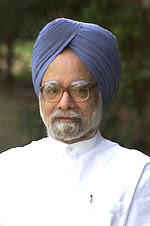 It is perfectly understandable. Denied any flexibility in manoeuvring members of his Cabinet, Prime Minister Manmohan Singh is doing the best he can by reinventing his personal Cabinet, a collection of personally chosen eminent personae given assignments from the PM’s priority list.
 It is perfectly understandable. Denied any flexibility in manoeuvring members of his Cabinet, Prime Minister Manmohan Singh is doing the best he can by reinventing his personal Cabinet, a collection of personally chosen eminent personae given assignments from the PM’s priority list.
Dr Singh can do nothing to Cabinet colleagues because the current law of coalition politics says that once you are seated in a particular chair, only an election defeat can drag you out of it. Competence, performance or even interest in your job has nothing to do with your continuance. DMK supremo’s son Alagiri has around zero interest in his Cabinet job, and does not care who knows this. His real ambition is to succeed his father as Chief Minister of Tamil Nadu, a legacy currently assigned to his brother Stalin. A Cabinet member is meant to be part of a team, and implement a collective decision even if he is personally opposed to it. His politicisation of an important pre-Budget decision, to lift a key fertiliser subsidy, would have been sufficient for dismissal in any normal Cabinet system of governance. The Prime Minister could do nothing about it since the DMK functions as an autonomous ally.
Gradually, through a creep-and-collect process, the Prime Minister has used his rights of appointment to his personal office to create a parallel mini-administration that can address those aspects of the national agenda that he is most interested in. This is not quite the Kitchen Cabinet of the Indira Gandhi days, when a core group of personal favourites functioned as a super Cabinet, arguing the merits and demerits of a particular policy before it was presented to an obedient full Cabinet. The Prime Minister’s Men do not intervene, or interfere, in ministries outside their domain, as the Kitchen Cabinet would. But if the Prime Minister has made any project his own, then the relevant ministry has to understand that there is a higher authority and it is called the PMO.
The two most high-profile members of Dr Singh’s office in his first five years, National Security Adviser M.K. Narayanan and former Foreign Secretary Shyam Saran, have both lost their positions because of the Prime Minister’s increasingly evident desire for some solution to the Kashmir problem. Shyam Saran was an indirect casualty, but a casualty nevertheless. No one resigns from the PMO unless it has been made apparent that the terms of relationship have changed. Media has been fed the perception that Saran was upset because he was denied the status of a Minister of State. Ministers have become so devalued in the last decade, that this is the least of a Prime Minister’s problems. He can get any status for whoever he likes. The substantive disagreement lay in the fact that Shyam Saran was not made NSA, because the Prime Minister decided that Shivshankar Menon was, intellectually and temperamentally, closer to his line of thinking on Pakistan.
Dr Singh knows he is taking huge risks. He has deliberately underplayed hard evidence from Indian intelligence that Pak-based, anti-Indian terrorist organisations continue to get active support from the Pak military, and that they are not non-state actors. Pakistan’s Army chief, Ashfaq Parvez Kayani has reiterated, in his latest doctrine, that India remains the pre-eminent threat to Pakistan, implicitly justifying the military’s support for the second arm of his country’s response to India, the terrorist network. Elements of Pakistan’s political class have not helped Delhi by immature grandstanding, describing India’s return to the talking table as a victory for Islamabad. This obviously grates on Indians. The biggest risk is here: Dr Singh has moved far ahead of Indian public opinion in his peace gambit. This is in direct contrast to the Indo-US nuclear deal, when middle class opinion was cheering on the deal at each stage of negotiations. The middle class that wanted a closer relationship with America is not equally eager to buy the American prescription for peace on the subcontinent, of which these talks are the opening move.
It is not certain that Pakistan will buy it either, because the tail at the end of the dog is that Pakistan might have to dilute its deep friendship with China, which does not fit into the US-Pak strategic paradigm. America would be much happier with a US-Pak-India relationship built on a shared perception of regional threats. Senator John Kerry has described the resumption of the Indo-Pak dialogue as “critical to the United States”, and suggested that the Indian initiative is an extension of the new India-US relationship. More specifically, the US believes that India-Pak cooperation is essential to victory against the Taliban in Pakistan and Afghanistan. However, Senator Kerry might have to convince General Kayani first.
Perhaps Dr Singh is depending on the United States to tweak an ear or twist an arm in Islamabad at the appropriate moment as he tries to woo Pakistan by diluting the status of Kashmir’s relationship with India. This is high-wire politics. We shall watch with some hope and greater apprehension.
Sunday, February 14, 2010
Sharp descent for Padma awards – and the Republic
Sharp descent for Padma awards – and the Republic
By M J Akbar
Maulana Azad has been much on my mind for a variety of melancholy reasons. The neglect of his memory is reflected in the loneliness of his shrine at Urdu Park, near Delhi’s Jama Masjid. It is utterly appalling that we romanticize a pathetic weasel, Bahadur Shah Zafar, who lost an Indian Empire, and diminish the man who, along with a dozen others, sat at the apex of a party that destroyed the British Empire.
Singular conviction was the hallmark of his politics. While his great compatriots had the support of their communities, Azad stood bereft, but resolute and heroic, against a rising tide of venom. His political courage was complemented by intellectual depth: Sarojini Naidu once said Azad was 50 on the day he was born. Find him in two lines of verse he wrote at the age of 14: Azad bekhudi ke nashebofaraz dekh Puchi zamin ki to kahi aasman ki.(Azad, see how this restless spirit soars /The question is of the earth, the answer of the skies.)
He was our first education minister, a chair he filled till his death in 1958. Nehru wanted to honour this giant with a major Padma award. Azad laughed it off. How could a government give itself an award, he asked. Azad did not measure his worth with a political tape. There are still those who turn down awards because they do not want their independence besmirched by a gift from government.
You have to be naïve to believe that the awards process is free of government interference. The obedient will always be allotted their corner a little askance of the deserving.
You have to be either extremely insecure, or be possessed by a hypocrite’s need for camouflage, to lobby and beg and wheedle for a Padma award.
It is perfectly all right if the award comes your way without your knowledge, which still happens half the time. The other half becomes an opportunity for racketeers who treat a Padma award as a certificate of exoneration after a lifetime of deceit and manipulation. This subverts the very purpose of the award.
The people have recognized the cynicism at the heart of the process, and therefore do not much care one way or the other. In any case, awards are a mutual-backscratching operation between the elite. No one is going to rush off to buy a ticket to a Saif Ali Khan movie because he has suddenly become a Padma Shri.
To be fair, Saif himself was a trifle puzzled at the sudden arrival of honour at his doorstep. He has been known to give the odd brilliant performance, and he dances almost as well as his girlfriend, but one doubts if he, or anyone else, thinks of him as a legend.
The most amusing story about awards was told to me by one of the finest human beings I have had the privilege to know, or know of, H Y Sharada Prasad. He was the most trusted member of Indira Gandhi’s inner circle, a bureaucrat of the old school. Honesty was his outstanding virtue, but his principal asset was wisdom born of a marriage between learning and experience.
Sharada Prasad treated fortune and misfortune as equally deceptive imposters, passing the days of exile from power (after Mrs Gandhi’s defeat in 1977) with as gentle a smile as he possessed when he sat in the holy of holies, the Prime Minister’s Office.
He was a friend of D G Tendulkar, whose nine-volume biography of Gandhi may be untidily written, but is one of the great classics of modern Indian history. It is lost today in some forgotten shelf of Publications Divisions, bought by libraries as part of a respectable list that no one reads. Tendulkar used to live very simply in a tenement in Mumbai, with a beloved stray dog as his best companion.
Early every morning, the dog would wake up the author and the two would go for a walk along Marine Drive. On his return home, Tendulkar would catch up on the last of his sleep. One day, the dog came rushing back after Tendulkar had dozed off, and virtually dragged the author out of his bed and on to the street. Just as they reached open air, an earthquake destroyed the flimsy tenement. But this is not the relevant story, of course.
Tendulkar was given a Padma Bhushan when Dr Rajendra Prasad was Rashtrapati. His first reaction was to send a telegram to Rajendra Prasad saying that could he please be given a watch instead — what he really needed was a watch, not a piece of paper from the Government of India. Let it be on record that Tendulkar got both the watch and the Padma.
From Tendulkar to oily businessmen is a sharp descent for the Republic.
Appeared in Times of India - February 14, 2010
By M J Akbar
Maulana Azad has been much on my mind for a variety of melancholy reasons. The neglect of his memory is reflected in the loneliness of his shrine at Urdu Park, near Delhi’s Jama Masjid. It is utterly appalling that we romanticize a pathetic weasel, Bahadur Shah Zafar, who lost an Indian Empire, and diminish the man who, along with a dozen others, sat at the apex of a party that destroyed the British Empire.
Singular conviction was the hallmark of his politics. While his great compatriots had the support of their communities, Azad stood bereft, but resolute and heroic, against a rising tide of venom. His political courage was complemented by intellectual depth: Sarojini Naidu once said Azad was 50 on the day he was born. Find him in two lines of verse he wrote at the age of 14: Azad bekhudi ke nashebofaraz dekh Puchi zamin ki to kahi aasman ki.(Azad, see how this restless spirit soars /The question is of the earth, the answer of the skies.)
He was our first education minister, a chair he filled till his death in 1958. Nehru wanted to honour this giant with a major Padma award. Azad laughed it off. How could a government give itself an award, he asked. Azad did not measure his worth with a political tape. There are still those who turn down awards because they do not want their independence besmirched by a gift from government.
You have to be naïve to believe that the awards process is free of government interference. The obedient will always be allotted their corner a little askance of the deserving.
You have to be either extremely insecure, or be possessed by a hypocrite’s need for camouflage, to lobby and beg and wheedle for a Padma award.
It is perfectly all right if the award comes your way without your knowledge, which still happens half the time. The other half becomes an opportunity for racketeers who treat a Padma award as a certificate of exoneration after a lifetime of deceit and manipulation. This subverts the very purpose of the award.
The people have recognized the cynicism at the heart of the process, and therefore do not much care one way or the other. In any case, awards are a mutual-backscratching operation between the elite. No one is going to rush off to buy a ticket to a Saif Ali Khan movie because he has suddenly become a Padma Shri.
To be fair, Saif himself was a trifle puzzled at the sudden arrival of honour at his doorstep. He has been known to give the odd brilliant performance, and he dances almost as well as his girlfriend, but one doubts if he, or anyone else, thinks of him as a legend.
The most amusing story about awards was told to me by one of the finest human beings I have had the privilege to know, or know of, H Y Sharada Prasad. He was the most trusted member of Indira Gandhi’s inner circle, a bureaucrat of the old school. Honesty was his outstanding virtue, but his principal asset was wisdom born of a marriage between learning and experience.
Sharada Prasad treated fortune and misfortune as equally deceptive imposters, passing the days of exile from power (after Mrs Gandhi’s defeat in 1977) with as gentle a smile as he possessed when he sat in the holy of holies, the Prime Minister’s Office.
He was a friend of D G Tendulkar, whose nine-volume biography of Gandhi may be untidily written, but is one of the great classics of modern Indian history. It is lost today in some forgotten shelf of Publications Divisions, bought by libraries as part of a respectable list that no one reads. Tendulkar used to live very simply in a tenement in Mumbai, with a beloved stray dog as his best companion.
Early every morning, the dog would wake up the author and the two would go for a walk along Marine Drive. On his return home, Tendulkar would catch up on the last of his sleep. One day, the dog came rushing back after Tendulkar had dozed off, and virtually dragged the author out of his bed and on to the street. Just as they reached open air, an earthquake destroyed the flimsy tenement. But this is not the relevant story, of course.
Tendulkar was given a Padma Bhushan when Dr Rajendra Prasad was Rashtrapati. His first reaction was to send a telegram to Rajendra Prasad saying that could he please be given a watch instead — what he really needed was a watch, not a piece of paper from the Government of India. Let it be on record that Tendulkar got both the watch and the Padma.
From Tendulkar to oily businessmen is a sharp descent for the Republic.
Appeared in Times of India - February 14, 2010
Saturday, February 13, 2010
The Boys of Chidambaram
Byline by M J Akbar: The Boys of Chidambaram
The best way to manage a controversy is to initiate it. Omar Abdullah was not giving voice to some sudden inner revelation when he suggested that the “boys” who had gone across the Line of Control could be welcomed back, surely as part of some ongoing Indo-Pak deal. Ghulam Nabi Azad’s riposte stole Opposition space, another clever ploy, if it was prearranged. It might not have been. Azad could have been motivated by legitimate concerns. Home Minister Chidambaram’s support to Omar Abdullah, however, confirmed that there had been consultations between the two before Omar broached such a slippery subject.
Chidambaram, as we all, know, is a fine lawyer. A lawyer’s skill rests on the dictum that facts are malleable, and argument is infallible. This is a heady tribute to human intellect, since it makes the mind a decisive arbiter. Alas, for every forensic ploy there is another waiting on the counter. Chidambaram has introduced the rather disingenuous logic that since these “boys” (can’t call them “terrorists” anymore, can we?) merely went across to territory that India still claims as its own, they never left Indian soil. They are only being resettled at another Indian address.
Counsel for Opposition could open his arguments with a potent challenge: Why is the Home Minister so anxious to bring back those who left India to wage war against it, when it has not been able to rehabilitate those, like Kashmiri Pandits, who were driven out by militants? Is the welfare of those who wanted to destroy India more important to Delhi than the welfare of those who wanted to preserve the multi-religious, secular character of Kashmir and India?
Chidambaram’s “boys” went to Pakistan-Occupied Kashmir not because they thought they were moving on to another part of Indian soil, but to launch a war through which they would snatch Kashmir from India, and were prepared to offer their lives for such a cause. They dreamt of either independence or integration into Pakistan. Perhaps our Home Minister believes that boys will be boys. Or he may have found time to delve into the Bible and ruminate over the parable of the prodigal, which explains the metaphysics of slaying the fatted calf for a prodigal.
The more intriguing question is, why would the prodigal want to come back? Are they ideologically disillusioned and have now become torchbearers of Indian secularism? Or do they want to be reunited with their families, a much more reasonable and realistic aspiration? The one question that cannot be satisfactorily answered, except over time, is this: Have Pakistan-based groups and agencies which still believe in the “Kashmir Jihad” abandoned these “boys” or will there be, among them, some who will resume an insurrection from Indian Kashmir? Is the risk worth taking for India?
Basic question: Who has identified the proposed prodigals as authentic? They did not leave their names and addresses with the Intelligence Bureau in Srinagar when they went off to prepare for their holy war. There are no special genetic traits that differentiate Kashmiris on either side of the LOC. The Pakistan Government did not control this lot directly. They were outsourced to outfits like the Jamaat-e-Islami and Lashkar-e-Taiba, so the only people who would know a genuine cross-border warrior from a homegrown one would be Jamaat or LET. Would Delhi honour certificates handed out by LET?
Who — Delhi or Islamabad? — has placed the return of warriors into the dialogue framework? If it was not on the agenda, or going to be put there, why would Delhi inject the thought into public discourse?
An India-Pakistan dialogue is a tiptoe through minefields at the best of times, so one is curious as to why more mines should be planted on the eve of yet another resumption. There is a special excitement about the 2010 talks because they have been rescued from a trough as deep as crater resulting from the 13 December attack on Parliament; and because Dr Manmohan Singh has made it amply clear that peace with Pakistan is the principal objective of his second term. The adage that the road to hell is paved with good intentions has its uses in a debating society; the road to heaven, after all, cannot be paved with bad intentions. Good intentions take you to a crossroads. After that, your destination, heaven or hell, is entirely dependent on your judgment.
Dr Singh’s good intentions are not in doubt. But he does tend to get tempted towards bylanes in his anxiety to reach heaven. Sharm-el-Sheikh was one such foray that helped no one except India-baiters in Islamabad. The “boys of Chidambaram” is another that can help no one except Pakistan-baiters in Delhi.
The best way to manage a controversy is to initiate it. Omar Abdullah was not giving voice to some sudden inner revelation when he suggested that the “boys” who had gone across the Line of Control could be welcomed back, surely as part of some ongoing Indo-Pak deal. Ghulam Nabi Azad’s riposte stole Opposition space, another clever ploy, if it was prearranged. It might not have been. Azad could have been motivated by legitimate concerns. Home Minister Chidambaram’s support to Omar Abdullah, however, confirmed that there had been consultations between the two before Omar broached such a slippery subject.
Chidambaram, as we all, know, is a fine lawyer. A lawyer’s skill rests on the dictum that facts are malleable, and argument is infallible. This is a heady tribute to human intellect, since it makes the mind a decisive arbiter. Alas, for every forensic ploy there is another waiting on the counter. Chidambaram has introduced the rather disingenuous logic that since these “boys” (can’t call them “terrorists” anymore, can we?) merely went across to territory that India still claims as its own, they never left Indian soil. They are only being resettled at another Indian address.
Counsel for Opposition could open his arguments with a potent challenge: Why is the Home Minister so anxious to bring back those who left India to wage war against it, when it has not been able to rehabilitate those, like Kashmiri Pandits, who were driven out by militants? Is the welfare of those who wanted to destroy India more important to Delhi than the welfare of those who wanted to preserve the multi-religious, secular character of Kashmir and India?
Chidambaram’s “boys” went to Pakistan-Occupied Kashmir not because they thought they were moving on to another part of Indian soil, but to launch a war through which they would snatch Kashmir from India, and were prepared to offer their lives for such a cause. They dreamt of either independence or integration into Pakistan. Perhaps our Home Minister believes that boys will be boys. Or he may have found time to delve into the Bible and ruminate over the parable of the prodigal, which explains the metaphysics of slaying the fatted calf for a prodigal.
The more intriguing question is, why would the prodigal want to come back? Are they ideologically disillusioned and have now become torchbearers of Indian secularism? Or do they want to be reunited with their families, a much more reasonable and realistic aspiration? The one question that cannot be satisfactorily answered, except over time, is this: Have Pakistan-based groups and agencies which still believe in the “Kashmir Jihad” abandoned these “boys” or will there be, among them, some who will resume an insurrection from Indian Kashmir? Is the risk worth taking for India?
Basic question: Who has identified the proposed prodigals as authentic? They did not leave their names and addresses with the Intelligence Bureau in Srinagar when they went off to prepare for their holy war. There are no special genetic traits that differentiate Kashmiris on either side of the LOC. The Pakistan Government did not control this lot directly. They were outsourced to outfits like the Jamaat-e-Islami and Lashkar-e-Taiba, so the only people who would know a genuine cross-border warrior from a homegrown one would be Jamaat or LET. Would Delhi honour certificates handed out by LET?
Who — Delhi or Islamabad? — has placed the return of warriors into the dialogue framework? If it was not on the agenda, or going to be put there, why would Delhi inject the thought into public discourse?
An India-Pakistan dialogue is a tiptoe through minefields at the best of times, so one is curious as to why more mines should be planted on the eve of yet another resumption. There is a special excitement about the 2010 talks because they have been rescued from a trough as deep as crater resulting from the 13 December attack on Parliament; and because Dr Manmohan Singh has made it amply clear that peace with Pakistan is the principal objective of his second term. The adage that the road to hell is paved with good intentions has its uses in a debating society; the road to heaven, after all, cannot be paved with bad intentions. Good intentions take you to a crossroads. After that, your destination, heaven or hell, is entirely dependent on your judgment.
Dr Singh’s good intentions are not in doubt. But he does tend to get tempted towards bylanes in his anxiety to reach heaven. Sharm-el-Sheikh was one such foray that helped no one except India-baiters in Islamabad. The “boys of Chidambaram” is another that can help no one except Pakistan-baiters in Delhi.
Sunday, February 07, 2010
Danger from the New Brahmins
Danger from the New Brahmins
By M J Akbar
Indian democracy is in danger of subversion by a self-confident,aggressive, articulate, patriotic and well-meaning force, the oligarchy of the successful. It might be a mild exaggeration to suggest that its principal characteristics are aftershave and English.
Many of them possibly disdain aftershave or perfume, and would not be crass enough to be preceded by five yards of Axe effect, to name the most advertised aftershave of the moment. But they are loyal to the English language, the proven mantra to worldly success. This new class of thirty-somethings (terribly reluctant to turn 40) is a product of consistent high growth since economic liberalization began in 1991. They bring with them a fresh mindset, a happy sense of purpose, a professional approach to governance and a welcome lack of social baggage.
So why should they be considered a potential hidden danger? Their assets dominate contemporary business, media and politics; their liabilities are buried in a general reluctance to see beyond their celebrity status. Politicians have always been celebrated, and rightly so; if you are in public life, you will be under public scrutiny. But they have not been celebrities. The difference is being squeezed by a squeal culture that is another dominant trait of a substantial and growing elite.
Danger lies in the fact that this creamy layer of 20% at the top has no interest in involving the froth of 80% in decision-making. It recognizes the problem of poverty, of course, and is even concerned enough to address it at policy level. It would much prefer an India in which beggars do not stare through the window panes of its cars; unfortunately, beggars can’t be screened out by black film for reasons to do with public security. But it treats the poor as both the cause and the consequence of poverty, and therefore unworthy of more than a token presence on the table. In a sense this is the old caste system in a modern manifestation; it is a karmic view of government, propagated by the New Brahmins, wearing a tie in front instead of a tiki at the back.
Commonwealth Delhi is their true capital, designed for their comforts and convenience. Not a single bicycle lane has been constructed in the newly reconstructed city, because it is still downmarket in Delhi (unlike London, where mayors and future Prime Ministers use it). You eliminate poverty by denying it space in your environment. If you don’t see a slum it doesn’t exist. The Commonwealth Games, which will last less than a week, are an excuse to switch spending towards an infrastructure for luxury, essential for a class that has found the wherewithal to afford luxury. One is not being a killjoy, or taking the puritan view that India should not host an international event till Ram Rajya has arrived. There will always be imperfection and inequality; but it is what you do with opportunity that determines whether the social purpose is egalitarian or elitist. Capitalist London has used the 2012 Olympics to upgrade its poorer areas. Delhi has done the opposite, improving what was already good, ignoring the squalor that floats under the thin surface of glitter.
Is Delhi the development model for the coming decade? There is a huge and growing aspirational class that supports the oligarchy of success, because it is straining at the door to be let in. This emerging constituency, perhaps a maximum of about 300 million, is keen to outsource its future to an oligarchy because it has sniffed the latter’s success. It wants membership of the oligarchy. It is strong enough to shift a general election towards one political party or the other, but it is not strong enough to sustain governance.
That leaves 800 million dependent on goodwill. Democracy is not about generosity. It is about entitlement. Democracy is not about patronage. It is about equality. Democracy is about being inclusive, not exclusive. Democracy is about an equal vote in the political boardroom, not just in the ballot box.
The slick highways dotted with malls and upwardly mobile dhabas, transporting a world beyond the reach to villages they traverse, are both a tease and a frustration. Why shouldn’t the young of rural India who cannot afford the highway toll dream of magic lights in the big city? They do not want to plod while New Brahmins travel at 100 mph. They do not want to end up as labour in a busybody small town; they want a job in the new New Delhi. The poor are not fools. They know they cannot be managers. But if the nation cannot find a profitable avenue for their skills then the social structure will be vulnerable to their anger.
If the high table cannot find a seat for them, then there are other tables, some with guns.
Appeared in Times of India - February 7, 2010
By M J Akbar
Indian democracy is in danger of subversion by a self-confident,aggressive, articulate, patriotic and well-meaning force, the oligarchy of the successful. It might be a mild exaggeration to suggest that its principal characteristics are aftershave and English.
Many of them possibly disdain aftershave or perfume, and would not be crass enough to be preceded by five yards of Axe effect, to name the most advertised aftershave of the moment. But they are loyal to the English language, the proven mantra to worldly success. This new class of thirty-somethings (terribly reluctant to turn 40) is a product of consistent high growth since economic liberalization began in 1991. They bring with them a fresh mindset, a happy sense of purpose, a professional approach to governance and a welcome lack of social baggage.
So why should they be considered a potential hidden danger? Their assets dominate contemporary business, media and politics; their liabilities are buried in a general reluctance to see beyond their celebrity status. Politicians have always been celebrated, and rightly so; if you are in public life, you will be under public scrutiny. But they have not been celebrities. The difference is being squeezed by a squeal culture that is another dominant trait of a substantial and growing elite.
Danger lies in the fact that this creamy layer of 20% at the top has no interest in involving the froth of 80% in decision-making. It recognizes the problem of poverty, of course, and is even concerned enough to address it at policy level. It would much prefer an India in which beggars do not stare through the window panes of its cars; unfortunately, beggars can’t be screened out by black film for reasons to do with public security. But it treats the poor as both the cause and the consequence of poverty, and therefore unworthy of more than a token presence on the table. In a sense this is the old caste system in a modern manifestation; it is a karmic view of government, propagated by the New Brahmins, wearing a tie in front instead of a tiki at the back.
Commonwealth Delhi is their true capital, designed for their comforts and convenience. Not a single bicycle lane has been constructed in the newly reconstructed city, because it is still downmarket in Delhi (unlike London, where mayors and future Prime Ministers use it). You eliminate poverty by denying it space in your environment. If you don’t see a slum it doesn’t exist. The Commonwealth Games, which will last less than a week, are an excuse to switch spending towards an infrastructure for luxury, essential for a class that has found the wherewithal to afford luxury. One is not being a killjoy, or taking the puritan view that India should not host an international event till Ram Rajya has arrived. There will always be imperfection and inequality; but it is what you do with opportunity that determines whether the social purpose is egalitarian or elitist. Capitalist London has used the 2012 Olympics to upgrade its poorer areas. Delhi has done the opposite, improving what was already good, ignoring the squalor that floats under the thin surface of glitter.
Is Delhi the development model for the coming decade? There is a huge and growing aspirational class that supports the oligarchy of success, because it is straining at the door to be let in. This emerging constituency, perhaps a maximum of about 300 million, is keen to outsource its future to an oligarchy because it has sniffed the latter’s success. It wants membership of the oligarchy. It is strong enough to shift a general election towards one political party or the other, but it is not strong enough to sustain governance.
That leaves 800 million dependent on goodwill. Democracy is not about generosity. It is about entitlement. Democracy is not about patronage. It is about equality. Democracy is about being inclusive, not exclusive. Democracy is about an equal vote in the political boardroom, not just in the ballot box.
The slick highways dotted with malls and upwardly mobile dhabas, transporting a world beyond the reach to villages they traverse, are both a tease and a frustration. Why shouldn’t the young of rural India who cannot afford the highway toll dream of magic lights in the big city? They do not want to plod while New Brahmins travel at 100 mph. They do not want to end up as labour in a busybody small town; they want a job in the new New Delhi. The poor are not fools. They know they cannot be managers. But if the nation cannot find a profitable avenue for their skills then the social structure will be vulnerable to their anger.
If the high table cannot find a seat for them, then there are other tables, some with guns.
Appeared in Times of India - February 7, 2010
Subscribe to:
Posts (Atom)